












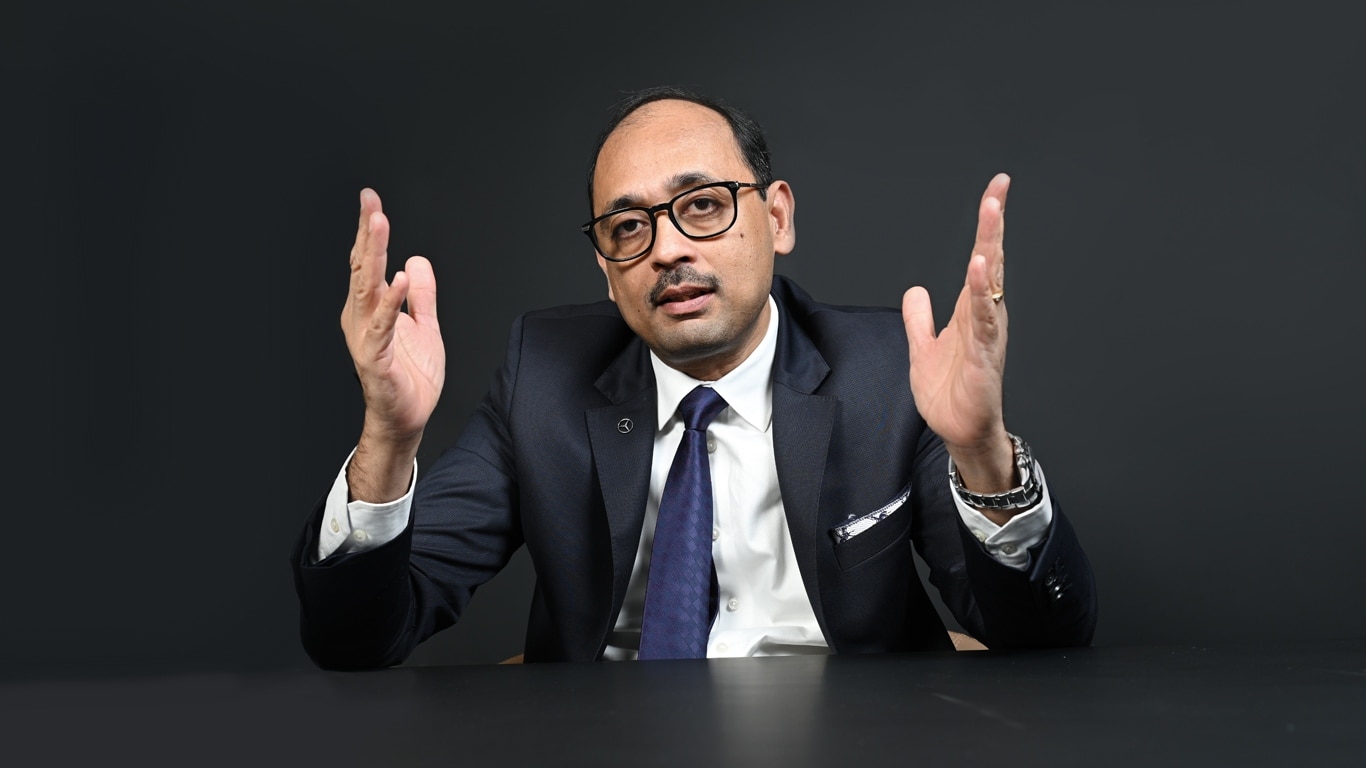

The Indian luxury car market has two sets of customers. One has consumed luxury since childhood. The second is a first-timer. For Mercedes-Benz, both are equally important for the growth of the market. Santosh Iyer, MD & CEO, Mercedes-Benz India, discusses the evolution of luxury in the Indian market in an interview with Chetan Bhutani. Edited excerpts:
CB: Has the meaning of luxury changed for Indians from owning something expensive to experiences, personalisation, or even eco-friendly values? What does luxury mean for Mercedes-Benz?
SI: I keep quoting Coco Chanel in many of my thoughts to our teams as well our partners: Luxury starts when necessity ends. Most of our customers have multiple vehicles, and it is an additional car for them. You must look at luxury from that perspective. For example, to go from point A to point B, you can have multiple solutions. But you need a Mercedes-Benz to do it in the right way, and in the most comfortable and safest manner. This is where the price goes up.
When you look at the price-value equation for the luxury customer, he is not buying expensive, he is buying the right value. He can afford it. That is the difference. Luxury customers can afford these goods and services. And that is the reason—be it watches, cars, or any other category—they continue to consume.
In India, we have two sets of customers. One is a luxury dweller. They are born into rich families. They have consumed luxury in childhood. They have a much better taste, and they understand cars as well.
The second is the first-time entrant into luxury. Someone who has been dreaming of a Mercedes-Benz and wants to fulfil that dream. They also do a lot of research but are super price sensitive. Both groups are equally important for the growth of the market.
On the second part: luxury is going beyond the product. It is also about what kind of curated and bespoke experiences we can give. It is not just limited to the product offering. I have customers buying Mercedes-Benz cars one week before the Mercedes-Benz Trophy because they want to play golf.
Today’s customers are ready to go to great lengths for experiences. Therefore, it goes beyond the product to retail experiences as well. It is not just about events and promotions but also what experience I get with my retail partner.
CB: Is India now at a point where luxury is no longer for a few, but for many more people? What is driving this: higher incomes, aspirations, social media, or lifestyle changes?
SI: The fundamental reason for growth is per capita GDP. If you look at 2014, India’s per capita income was $1,450. Today it has gone up to $2,700. So clearly, with more wealth being created, there is a propensity to spend and an ability to spend. The propensity to spend comes from a lot of social media, a lot of lifestyle aspirations. The Covid-19 pandemic also created a big behavioural impact. Yes, we need to save, but why can’t we spend? So, it is a coming of age.
I still feel we are a long way from a significant consumption pattern. But this is what will happen: when you look at India’s economic growth from a $3-3.5 trillion economy to a $7 trillion economy, the per capita GDP will be $5,500-6,000. You will see almost a doubling of luxury sales.
The brand is always aspirational, but the fundamental layer is economic development and money.
CB: How do people spend on luxury cars? Do buyers spend more on interiors, colours, technology, or customisation? Are younger buyers more experimental compared to older ones who stick to classic styles?
SI: Two things. Number one, the biggest purchasing factor is always styling. The exterior styling of the car has the first impact on a customer’s decision. But then, at the top end of the segment, it is all about personalisation. Can I individualise the car? Can I personalise it to what I want? Maybe my G 63 should be as individual as anybody else’s G 63. Customisation is a big trend.
When it comes to entry-level luxury or even the core luxury segment, most of the products that we offer are standardised. But there, as I said, it is about experiences, and the overall customer support that we can offer. I think all this plays a major role in decision-making in India.
CB: What kind of customisations do you offer?
SI: We offer customisation in terms of colour, paint options, and interiors. The second is upholstery. Then it is about merging all these. We go to customers’ residences and show them personalisation options, both online and offline, between different colours and fabrics. Plus, we offer individualisation.
For example, we just did this G-Wagon wherein every car will have the family name or personal name of the customer etched into the grab handle. We can go to any extent to take care of the customer’s needs.
CB: Who are the buyers of high-end cars, Rs 1-1.5 crore and above? Are they self-made entrepreneurs, young achievers, or established families? What pushes them to buy: status, exclusivity, or personal enjoyment?
SI: As I said, we have two sets of customers. A luxury dweller, for whom buying a luxury car is a state of mind. They have been consuming luxury for many years, whether in their stays or their homes. Then there are first-time buyers, and almost 50% of our customers are in this category. Their needs are different. But there is an increasing maturity among young customers. They identify the product. They have a lot of insights on the product, on performance, on residual value, because they are also looking at upgrading their car every 48 months. At that point, they want the best resale value for their car.
I think all this comes into play much more rationally for consumers coming into luxury for the first time, or people who do not change cars very often. But then, many customers change cars every one to two years. They want the latest available in different parts of the world. We have introduced a campaign called Key-to-Key. The new S-Class is planned in one-and-a-half to two years, so customers wait. What we have said is: buy the current S-Class, and at the end of two years, give us the key. Take the key to the new S-Class and continue driving. No EMI change, no down payment, nothing.
CB: How is luxury car demand different in metros compared to a Tier-II or a Tier-III city? What is the demand scenario in Delhi or Mumbai versus Jaipur or Indore?
SI: Clearly, the demand for top-end cars is strong in Jaipur and Indore. In fact, if I look at the sales growth, it is contrary to expectations. The top-end car, in percentage terms, may sell even more than in Delhi or Mumbai. That is a fundamental difference, at least for Mercedes-Benz. Already, we have a 25% share in the top-end segment. The core segment is 60-65%. Our entry-level is only 10% of sales.
Percentage growth comes sharply from some of these Tier-II markets. But we must remember that Delhi and Mumbai alone account for close to 35-40% of the market. So, while they may not be growing on a percentage basis, in absolute numbers, they are delivering strong growth.
For us, the penetration of luxury in Mumbai and Delhi is already 2.8-2.9%, compared to 1% across the rest of India. In Indore and other markets, penetration would be 0.6-0.7%.
CB: Do Tier II buyers see luxury more as status, while Tier I buyers focus on comfort and lifestyle?
SI: Not really. I think there are a lot of enthusiasts in Tier II and Tier III markets in India. These are emerging markets, but the customers know their stuff. In fact, you may find some people in metros buying just for status, because they are first-time buyers into luxury. I can see a lot of AMGs (Mercedes-AMG GmbH) also being sold in Tier II and Tier III markets.
CB: Beyond cars, are people also showing interest in Mercedes-Benz merchandise and lifestyle products?
SI: That is a very interesting one. Our business has grown almost year-on-year, doubling in terms of volumes. We now do more than Rs 50 crore of business in merchandising alone, in terms of accessories, parts, and others. I think there is a dream to own a small part of Mercedes. It can be a cap; it can be a T-shirt. A lot of gifting has also come up. There is a big shift in online retail, with people gifting Mercedes-Benz merchandise and items.
CB: The government has cut GST on cars, which also makes luxury cars cheaper. In view of this, do top-end cars also benefit, or is it not so relevant since luxury buyers do not mind taxes? Or will this encourage more people to buy luxury cars?
SI: GST 2.0 can influence luxury cars purchase both direct and indirectly. With GST 2.0 reforms we expect a significant boost in consumption, with higher disposable income with consumers. This indirectly will positively influence the market and give a fillip to the luxury car purchase, as it is highly sentiment driven. In addition, we are passing on the entire benefit to our end customers, as Mercedes-Benz price cut ranges from Rs 2 lakh for an A-Class up to Rs 10 lakh for the S-Class. Our cost of servicing has also come down by up to 5%.
@BhutaniChetan


