









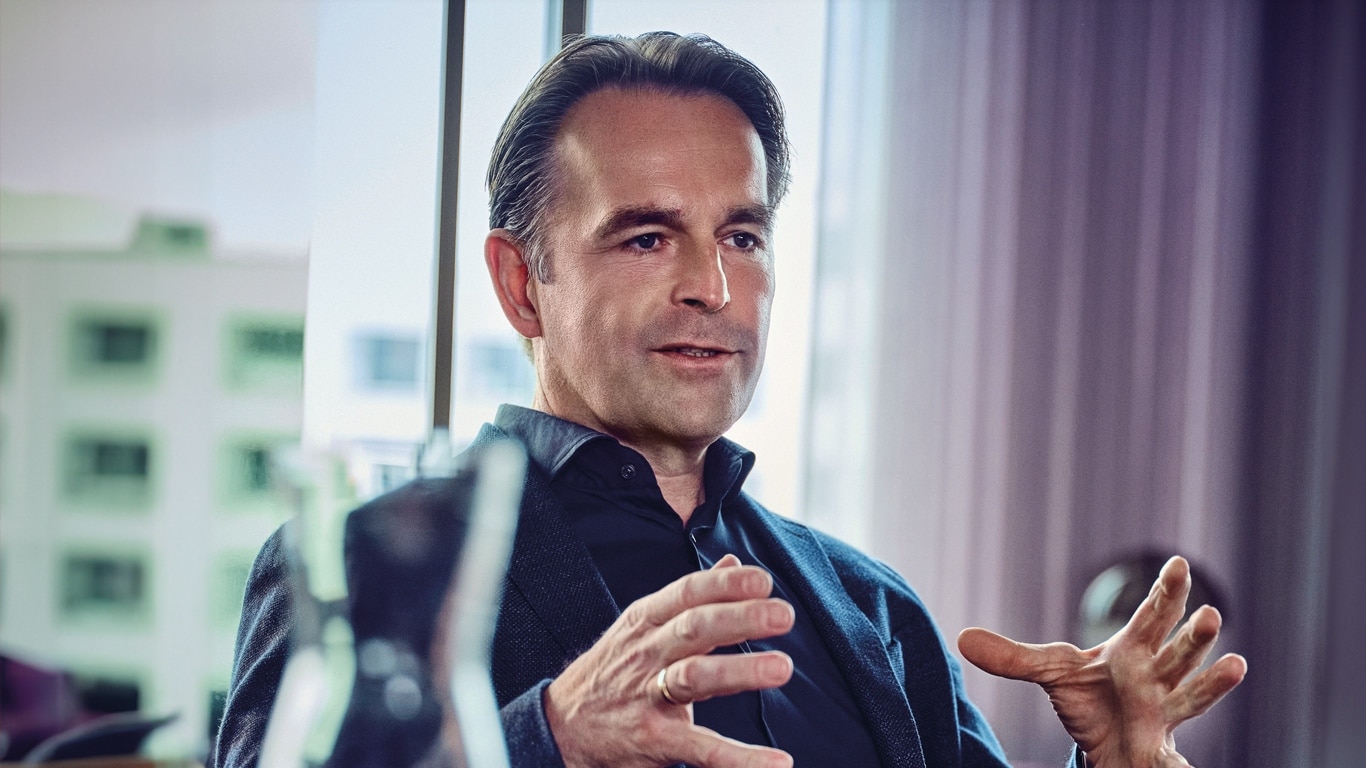

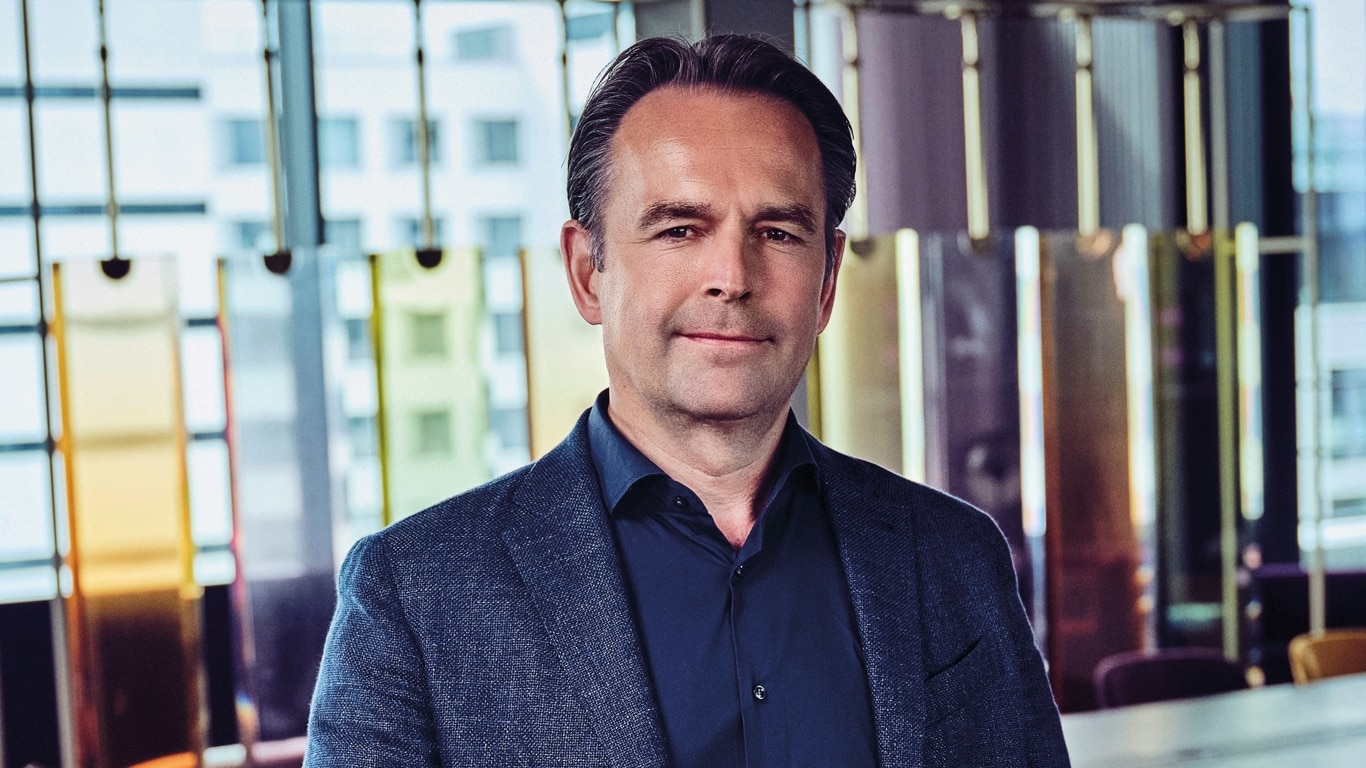
Just before the interview with Business Today, Christian Sobottka had completed an eight‑kilometre run, a ritual he keeps at least three times a week. Sports is his second passion. The first is staying connected to family and friends. “That kind of outside perspective is a source of real reflection and energy,” says Sobottka, who took over as CEO & President, Automotive Division at HARMAN in March 2025, guiding the wholly‑owned subsidiary of Samsung Electronics towards a more product‑ and software‑centric model. HARMAN International designs and engineers connected products and solutions for automakers, consumers, and enterprises worldwide.
Before joining the $11-billion company in 2021, Sobottka held senior leadership roles at Robert Bosch Automotive Steering GmbH, serving as CEO, CTO, and chairman of the executive board. His career spans engineering, sales, marketing, and operations—a breadth that gives him a holistic view of the industry’s transformation. India is key to that transformation, where 5,000 of the 30,000 employees are based.
Sobottka studied Electrical Engineering at Technische Universität Darmstadt in Germany and holds an Executive MBA from the University of Bradford, UK. He discusses shifts in the industry, impact of global geopolitical developments, tariffs, India strategy, and more. Edited excerpts:
Q: You took over as CEO in the middle of some of the biggest shifts in automotive—software-defined vehicles, AI integration, changing consumer expectations. How are you redefining the company’s role?
A: The industry has been evolving for a while. What’s fundamentally changing is the role of the car itself. It’s shifting from a device that organises transport into something that connects you to your digital life and the world around you.
Our vision is centred on the organised ‘consumer experience in the car’ but delivered at ‘automotive grade’ and at the speed of the tech industry.
The first challenge is compressing the development cadence from three or four years to one. The second is creating valuable user experiences—now AI-orchestrated and context-aware—that become the real differentiator for what people feel inside the car.
Q: In your first year as the CEO, you made three key decisions—the €1.5-billion acquisition of ZF’s Advanced Driver Assistance Systems business, acquisition of Sound United and divestment of Digital Transformation Solutions to Wipro. What was the strategic logic?
A: The logic is straightforward: we acquire where we can build or reinforce a leading position, and we divest where others can do it better than us.
On Sound United—brands like Bowers & Wilkins, Denon, and Marantz, bring products that complement our existing portfolio. They strengthen our coverage from mid to high-end, and alongside JBL, where we’re already a leader, amplify our presence across every segment.
On the ZF ADAS (ZF Friedrichshafen AG) acquisition, we are already the leading in-cabin supplier in automotive, but the industry is rapidly centralising compute—a car has dozens of processors for safety, climate control, infotainment.
Q: What’s your India strategy, and how is India contributing to your global ambitions?
A: India is one of our most important hubs. We have close to 5,000 people in India. Not just engineering; it spans all functions, including manufacturing. Pune is a strong and constantly expanding site.
When you have that kind of deep presence in a market, you understand it in a way no one else can. And the Indian automotive market is genuinely exciting right now.
Consumer expectations have shifted rapidly. It’s no longer just about affordability, but about pushing the boundaries of in-car experience. If you sit in the latest models from our Indian OEM customers, the transformation over the last five to seven years is remarkable. HARMAN is often the company behind that screen, building those experiences alongside the automakers.
I expect India to move at a pace like China in terms of speed and ambition. And our solutions are well suited to that trajectory.
We’ve also developed India-specific products. At the recent Mobile World Congress, we launched the Ready Ride connectivity box for two-wheelers—a productised, plug-and-play solution that brings connectivity to motorcycles, covering everything from traffic information to entertainment.
Q: Which Indian automakers are you working with?
A: All of them—Tata, Maruti Suzuki, Mahindra. And we are not just serving the domestic market. We export from India quite significantly, including to Europe and partially to North America. We’ve localised our production as much as it makes sense—electronics, speakers, connectivity modules, controllers, displays. The goal is a verticalised value chain in India, not just a delivery outpost.
Q: With 5,000 people in India, do you partner with Indian IT services companies?
A: We do the core work ourselves. But we partner where it makes sense. The Wipro example is relevant here. Following the DTS divestiture, we continue to collaborate with them, and that’s probably our most significant external partnership right now.
No one in this industry can do everything alone. Companies that tried to keep everything in-house have struggled or had to pivot. The automotive industry is becoming more like tech—a network of value contributors rather than a linear supply chain.
The question is: what do you bring to that network that others genuinely need? For us, that’s user experience expertise, integration capability, speed, and ability to productise at automotive grade. Those are the things we protect and develop. Around those, we build the right partnerships.
Q: Samsung acquired HARMAN in 2017. How has that relationship played out for both sides?
A: It’s been productive. On the product side, one concrete example is display technology. Our joint work with Samsung has produced a QLED equivalent—the same optical quality as OLED but around 30% cheaper. That’s a real commercial breakthrough for in-car displays. Another area is ReadyCare, our driver monitoring product, which we’re developing with Samsung Health.
Q: AI is reshaping every industry. How are you embedding it?
A: We have a clear, two-part view on this. The first is enterprise AI—using it to reimagine our internal end-to-end processes. We’ve taken a focused approach: identify the highest-value processes, reimagine them with agentic AI, and generate real productivity gains before moving to the next one.
Writing test cases, which used to be three per engineering day, has been multiplied tenfold. We’ve benchmarked this across 40 to 50 companies, and our conclusion is: start narrow, go deep, deliver results, then expand.
We’ve also built in a cultural dimension. Each senior leadership team member has an AI buddy, a younger talent from the organisation who reverse-mentors us on using AI effectively.
The second front is AI in the product itself. In a car, this means an AI-orchestrated experience that draws from multiple context layers simultaneously and adapts the in-cabin experience in real time.
Q: With AI driving significant productivity improvements in software development, do you see a reduced need for outsourcing partners?
A: Our view is actually the opposite of contraction. We believe we can nearly double the size of the company in the next five years—both in lifestyle and automotive. The challenge isn’t managing decline; it’s managing growth. Are there still unknowns? Of course. Some AI promises are yet to be fully delivered. But this is the direction we’re heading.
Q: The past 12 to 18 months have brought significant geopolitical turbulence. How does the company navigate this?
A: The first thing I’ve learned is that life is a training centre. What matters most is mental resilience—not just your own, but of the entire organisation.
On the practical side, there are real compliance requirements. Supply chain pressures and tariff situations add further complexity. These are real challenges.
But the formula is: rigorous scenario-based risk management combined with the cultural capability to adapt quickly when the unexpected happens.
Q: With Sound United’s portfolio added to the existing brands—JBL, Harman Kardon, Mark Levinson, Bowers & Wilkins—you now manage a very large number of brands. Is consolidation on the agenda?
A: We manage brand portfolios actively, just as we manage business portfolios. Each serves a distinct audience and positioning. There’s no pressing strategic need for consolidation, and nothing dramatic is planned.


