
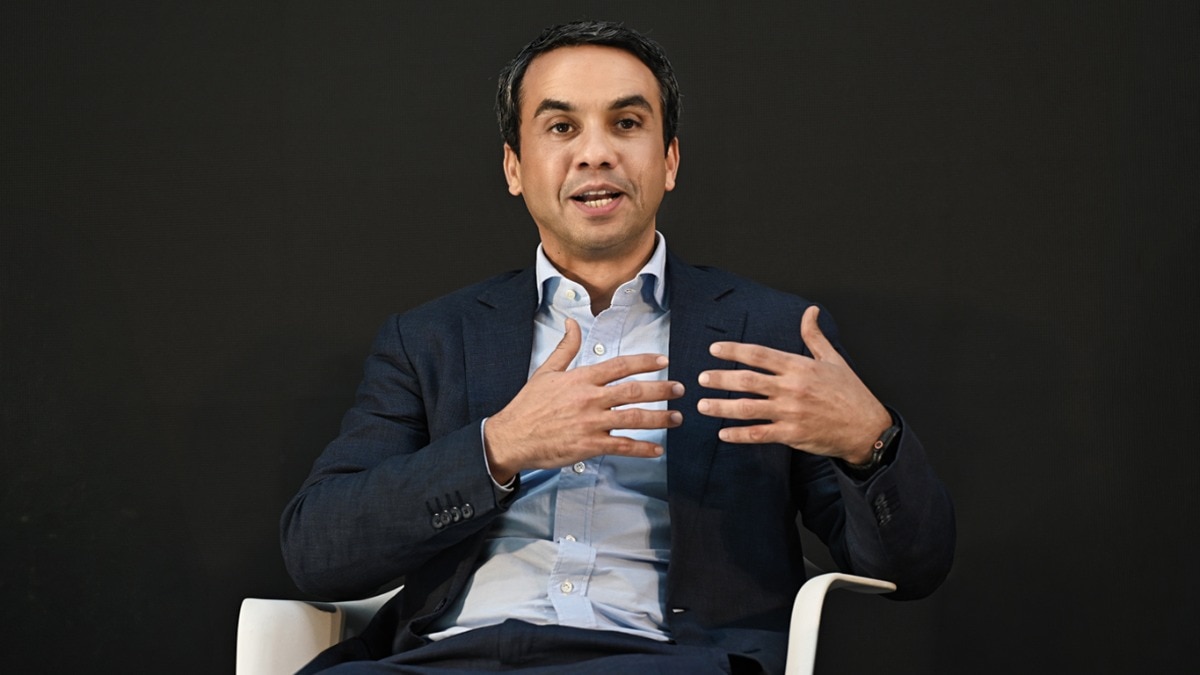
In the verdant surroundings of central Mumbai’s Vikhroli, Pirojsha Godrej is in a relaxed mood. The vast campus is synonymous with Godrej and houses multiple group businesses. In many ways, the rich legacy of the group, founded by Ardeshir Godrej, and the contemporary nature of its businesses, make for an interesting blend. It is a past that Pirojsha Godrej speaks about passionately.
In mid-April, he was named Chairperson-designate of Godrej Industries Group, an entity carved out through a restructuring two years ago. He is at present the chairperson of Godrej Properties.
Full of energy, the Godrej family scion is fresh off a presentation, where he outlined the growth strategy that is expected to more than double the market capitalisation to `5 lakh crore. The unifying purpose is—Crafting Tomorrow Since 1897 (the year the group came into being).
As he sits down for this interaction, Godrej, 45, displays infectious energy. Acutely aware of the legacy, he seamlessly swerves into how that could help him lay the foundation for the future. Excerpts from an interaction with Business Today’s Siddharth Zarabi:
Q: You are taking over a storied legacy of 129 years, with the challenge of continuing that and making it relevant to new India. What is at the core of this strategy?
A: It’s about being in a relatively unique position of celebrating a legacy and enjoying the advantages of a brand that has been built over the years, a great sense of trust and respect among its customers. That said, the Godrej Industries Group is just two years old in this new format. So, I think the aspiration for the group is to bring together the best of what we’ve enjoyed in terms of our legacy, but also bring to that a new sense of energy, purpose and ambition, and really combine these two things.
As a group, we have enjoyed a strong track record. We have six operating businesses, with three of them, Godrej Consumer Products, Godrej Properties and Godrej Agrovet, publicly listed, and three, Godrej Capital, Godrej Chemicals and Godrej Ventures, unlisted. Cumulatively, these businesses have, in the past five years, delivered sales and earnings growth of over 20% a year.
What we would like to do during the next period is to consistently do another five years of over-20% earnings-per-share growth and make sure that we add to that, at the company level, a return on equity of at least 18%.
Q: How much of your legacy businesses will contribute to the targeted market capitalisation of `5 lakh crore by 2031? Where do you see new growth opportunities?
A: We have three listed businesses, each of which has tremendous potential. Our FMCG business has a large portfolio of brands. While the industry has been underperforming in the last couple of years, there has been a turnaround in the last few quarters. Regardless of industry performance, we think the brands we have built will lead to a strong performance. Our medium-term aspiration for that business is 10% volume growth. If it can do that, revenue growth, of course, will be faster, as will earnings. All this can unlock a huge amount of value.
Similarly, another listed business of ours is Godrej Properties. It has been one of the fastest-growing businesses in the group and in the sector. Over the last three years, we have consistently been the largest residential developer in the country, with growth that has been well distributed.
Today, Godrej Properties is the number one or two listed player in all five largest real estate markets. Despite being a leader in the sector, our market share in that business is only about 5%. We believe there’s a tremendous opportunity to continue to benefit from the consolidation in the real estate sector. We are hoping to double our market share over the next five to seven years in Godrej Properties.
Speaking of the agri business (Godrej Agrovet), there has not been much value creation in the stock market in recent years. We’re very committed to turning that around. It’s almost a mini conglomerate of its own with several different verticals under it. Some of those are already leaders in the categories they operate in, with a bright future, like the oil palm businesses.
Q: Tell us a about the unlisted businesses.
A: Financial services is just five years old. It is the youngest business in our group with an AUM (assets under management) over `25,000 crore. The aspiration is to take it from that to roughly an AUM of `1 lakh crore over the next five years. At that point, we think it will be a very good candidate to be publicly listed. I think over a period of time, this can be one of, if not our largest business.
Q: In the age of start-ups across India and the world, very few groups survive even five decades. How would you describe this moment in terms of challenges and opportunities?
A: If you look at it in a narrow way, you can always focus on the challenges. I think there are lots of opportunities, for example, for ease of doing business to be better.
I have spent a lot of my career in the real estate sector. Things like ease of doing business, creating an environment attracting institutional foreign capital, are all important drivers of the economic growth we hope to see unfold.
I think it is a new country now, and one filled with aspirations. If you look at our infrastructure, there’s a transformation. A lot still needs to be done, but a lot has also happened. Most analysts expect India to be the fastest-growing major economy over the next couple of decades. For us, that is a unique place and a unique opportunity to be able to tap into and have an established brand.
Q: You spoke about an established brand, and that is a good example of self reliance. Given how the West Asia crisis is playing out, how important is it for you to develop your own base and supply chains from raw material to final product?
I have mixed feelings about this. On the one hand, I think it’s quite sad to see the way the world is going, where this is becoming more necessary. I think the globalised world, as much maligned as it was in many Western countries, brought unforeseen prosperity, led to great growth, and took millions of people out of poverty. It’s a bit of a shame to see that being questioned globally.
But at the same time, we must take the world as it is, and I think there is an opportunity and a requirement for India to look at becoming much more self-sufficient in key inputs. We’ve seen global disruptions many times in the last few years.
If you look at the pandemic, it made clear what kind of disruptions can be faced, and how you need to make sure that your supply chains are more secure. I think India will have to do a lot of work on gaining self-sufficiency.
This is not something that can happen overnight or in a year or two. But we will have to move in the direction of ensuring that at least key strategic things needed for the country’s security and economic growth are available internally.
Q: Getting back to property, where does residential stand in terms of the cycle? Are we at the peak, and what is likely to happen to rates and consumer adoption?
A: I think we’re probably somewhere in the middle part of the cycle. Typically, a cycle starts off with a couple of years of volume confidence coming back. That’s what happened this time. So, from 2013 to about the end of 2020, we were in a consistent down cycle. Volumes were going down, prices were going nowhere, and that was a pretty tough end of the cycle.
But from the end of 2020, the cycle has been through a strong phase. I would say 2021 and 2022 were more about volumes recovering and the market getting confidence, with 2023 and 2024 seeing rapid price growth, rapid volume growth—that’s typical of the sector.
We saw that in our business as well, where, you know, places like NCR and Bangalore saw 20-30%—even more in some cases—pricing growth in a single year. I think from about the middle of last year, we’ve been in what I would call the steady end of the cycle, which also typically lasts three or four years.
Our best-case estimate is that for the next three years, you should see pricing move roughly in line with inflation.
@szarabi













