
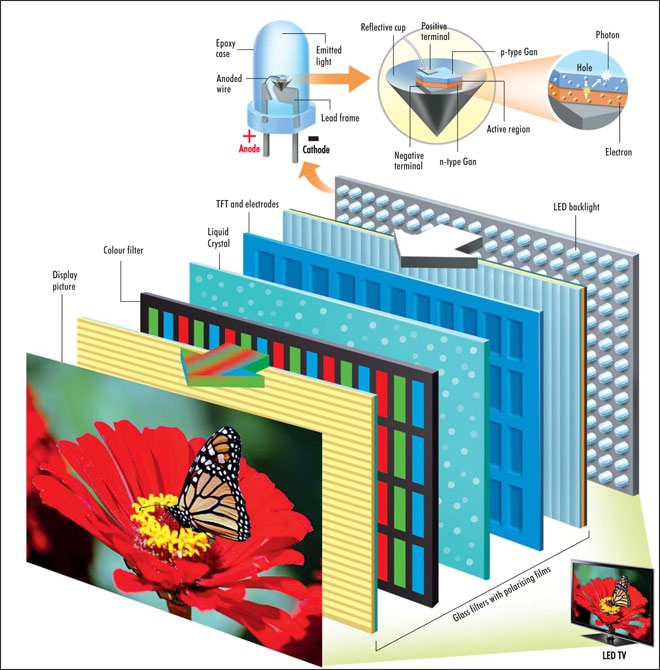

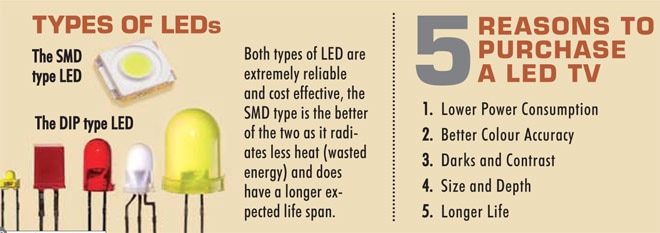

LED facts Directional light: LED lights are used by companies and individuals that want to have light directed at a specific location. They are more reliable than traditional lighting options for this purpose.Life: The life of an LED light bulb can be as long as 50,000 hours. This time frame is based on ideal conditions with the LED light bulb not being exposed to extreme heat or cold, or moisture. Air circulation: Poor air circulation can reduce in the life of an LED light. The bulb itself produces a small amount of heat, but it is enough to result in lessthan optimal conditions for LED bulbs. Applications: LED lights have found a permanent home in Exit signs, traffic lights, store displays, and anywhere where coloured light is needed. LEDs are energy efficient. The Future of LED CRT, LCD, LED, and now OLED. Display technology has made leaps and bounds in the past decade, providing us with better and cheaper televisions. OLED seems to be the hottest term being tossed around in the TV industry. The organic materials used to create these semiconductors are flexible, allowing scientists to create bendable lights and displays. Can you imagine rolling your TV up like a poster and carrying it with you anywhere?THE STORY SO FAR 1907: Electroluminescence as a phenomenon was discovered by the British experimenter H. J. Round of Marconi Labs.1962: The first practical visible-spectrum (red) LED was developed by Nick Holonyak. Holonyak is seen as the "father of the light-emitting diode. 1972: M. George Craford is a former graduate student of Holonyak, invented the first yellow LED 1968: Hewlett Packard (HP) introduced LEDs. 1970: Commercially successful LED devices at less than five cents each were produced by Fairchild Optoelectronics. 1977: All LED TV screen is credited to J.P. Mitchell. |













