
Azim Premji
If reactions to the world bank’s ban on wipro Technologies were starkly different from that to a similar ban on Satyam Computer, the reason was the towering personality of Azim Premji, who has always emphasised the role of ethics in business. “I would go to every conceivable length to preserve integrity at Wipro. There is no point talking of integrity and not doing it when it comes to the bite,” he had once said. How can then a company in which he has over 75 per cent stake follow practices that the World Bank does not approve of? To be sure, the non-disclosure in this case is perfectly legal and, as Premji said in his letter to Wipro employees, the company had not dithered from following the highest standards of business ethics. Perhaps the Bank is overreacting. Yet, when corporate governance has become India Inc.’s new-found mantra, you have to wonder: Shouldn’t have Wipro disclosed this episode when it occurred (in 2007)?
Nimesh Kampani
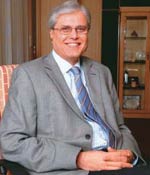
Nimesh Kampani, Chairman, JM Financial, is one of the most soughtafter dealmakers in the Indian corporate world. But over the last few days he is being sought by the police. The matter relates to default of fixed deposits by Nagarjuna Finance. Kampani, 61, was Non-Executive Director on the company board till April 1999. Police officials from Hyderabad visited Kampani’s office in Mumbai in the last week of December and even spoke to Kampani, who was in Dubai. He has informed the police that he was in no way involved with the Nagarjuna Finance matter as he resigned as a Non-Executive Director many years ago in 1999 and was not involved in the management affairs. At the time of writing, Kampani was still in Dubai on a business trip, according to a company spokesperson. With independent directors under increasing scrutiny, there could be few takers left to take up the role.

Rajeev Kapoor
It takes a brave man to launch a car in the current environment. It takes even more gumption to launch a car from a company that is also trying to rebuild its image. Rajeev Kapoor, Managing Director, Fiat India, is gushing with pride for his new Linea and the show to launch it certainly will go down as one of the most over-the-top car launches in recent times. But will the former Hero Honda man’s bravado pay off? With car sales slipping, Kapoor, 56, certainly thinks so. “I strongly believe that good times or bad, people want great products and this is the best car in the market right now,” he says optimistically. But Fiat India could do with the bluster to rebuild its image in India where the word ‘Fiat’ is still associated with an underpowered, cramped, crowded little car. And that, as Mr Kapoor would aver, the Linea certainly isn’t.

Pangal Jayendra Nayak
Pangal Jayendra Nayak, 61, will hang up his boots in August this year as Chairman and CEO of Axis Bank. While Nayak can bask in the glory of leaving the country’s third-largest private sector bank with a strong foundation, there is a lingering issue of succession. Unlike ICICI Bank that saw a smooth transition, there is no clearly defined secondin-command at Axis Bank. Among the possible contenders are four Executive Directors—M.M. Agarwal, V.K. Ramani, S.K. Chakrabarti and Hemant Kaul. If seniority comes into play, Agarwal may get the top job. But a lot depends upon the promoter SUUTI (carved out of UTI) which holds a 27.08 per cent in the bank. Nayak has, however, surely set a clear agenda for the next decade. “I want to see Axis as more of an international bank with a strong presence in several parts of Asia,” Nayak told BT last month. That could well be the recipe for bank’s success after Nayak moves on.

Namita Singh
She is credited with designing Asia’s largest naval academy at Kannur in Kerala, a project Namita Singh nurtured for over 20 years. With the inauguration of the Academy in January, her dream has reached its culmination. Singh, 60, says: “It’s difficult for any architect to get such a large project. Most big-scale projects are executed by the government.” But the biggest fillip for her was winning the national competition for the project in which over 40 firms competed. The Academy is spread over 30 lakh sq. ft, including seven mountain peaks. Next designer dreams for Singh: Nehru Centre for Performing Arts, Chandigarh, and IT Park, also in Chandigarh.














