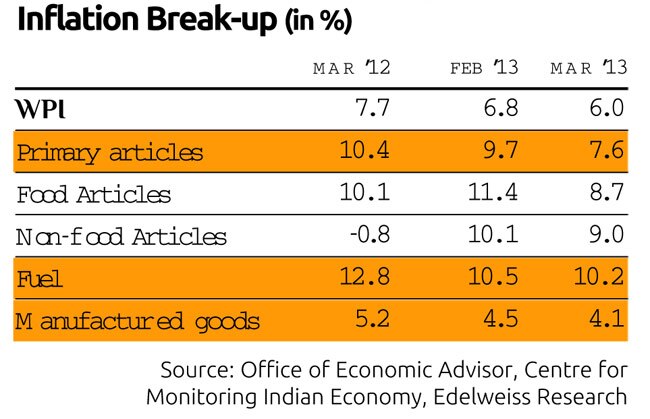
Inflation has fallen below 6% for the first time in three years. The decline in March 2013 Wholesale Price Index (WPI)-based inflation, from 6.8% in February 2013, brought down the overall inflation for 2012-13 to 7.3%, compared with 8.9% in 2011-12.
"Although the decline was broad-based, the main factor leading to the lower-than-expected inflation was a sharp drop in agriculture inflation," says Vinay Khattar, head, research (individual clients), Edelweiss Financial Services.
Imported inflation, too, has been easing for the past six months, led by falling international commodity prices (metals and oil), and is now below 5%, compared with 17% in December 2011. Crude oil prices have come down by 5% in the last one month, while gold has declined more than 10%.
"It could reduce our import bill for crude oil and gold by $15 billion to $18 billion, thus, reducing the pressure on the current account deficit," says Khattar.
Clearly, this opens up more room for the Reserve Bank of India (RBI) to cut policy rates further. In fact, analysts expect a 0.25 percentage cut in the repo rate (the rate at which banks borrow from the RBI) in May 2013, followed by an additional 0.5 percentage cut during the year.
An easy monetary policy and improving macroeconomic scenario will be positive for the stock market. Foreign institutional investors, too, will regain confidence in the attractiveness of the Indian markets in terms of dollar returns, say experts. However, the equity market is not expected to run up in a hurry, considering that the benefit of reduced costs will have a visible impact on companies' accounts only after two-three quarters.
Lower interest rates also augur well for the fixed-income market. The 10-year bond yield declined 0.08 percentage point in April. A decline in bond yields means bond prices are rising.
"With interest rates coming down by 0.75 percentage point in 2013, we could see bond yields in the range of 7%," says Khattar. "Clearly, this will lead to gains from long-duration bonds and gilt portfolios," he adds.