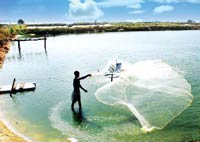
The east coast road, All the way from Chennai to Cuddalore, is abuzz. Shrimp farmers are talking about the introduction of the Vannammei, or the White Prawn from April, following the footsteps of Vietnam, Thailand, Taiwan, all of which have taken to its cultivation with gusto for the last 3-4 years and reaped benefits.
With the Indian Council of Agriculture Research identifying and approving of agencies in Hawaii, the brood stock will be travelling to the Rajiv Gandhi Centre for Aquaculture (RGCA) at Myiladuthurai in South India, where they will be quarantined and cultured by way of field trials. At a later date, private hatcheries would be allowed to import mother prawns directly from the Hawaiian agencies under the Livestock Importation Act.
I meet S.R. Narasimhan, a consultant associated with the aquaculture industry for the last two decades, to ask if shrimp farming is set for a new boom and also what went wrong with the industry in the last few years. “The Black Tiger prawn (Monodon), which fuelled the first boom in the 1990s, was never genetically mapped. We were dependent on wild brood stock from the sea which could have inherent, unknown diseases,” he says. The White Prawn on the other hand has been genetically mapped and output is, therefore, consistent and timely. “It also consumes less feed than the Black Tiger and per acreage output is more,” says O. Henry Francis of Oceanic Edibles International, which has its own farm and hatchery.
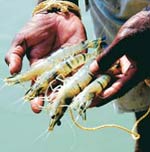
Counting begins: White Prawn is the new hope
I travel down the ECR to see how the industry is doing for itself; to see the changes that have happened in aquaculture and to get a last glimpse of the Black Tiger before it becomes history.
Back in the early 1990s, farming the “Black Tiger” or the Asian Wild Prawn meant profits between 200 and 300 per cent for farmers and breeders. Then the White Spot disease struck, snuffing the life out of the shrimp and prawn farming industry.
How did the disease spread? Apparently, just one diseased shrimp can spread the virus in a pond. The problem accentuates when farmers don’t sterilise their hands and nets before touching healthier species or when birds act as carriers, dropping diseased shrimp remains in uncontaminated areas.

A. Joseb Raj (forefront) and O. Henry Francis
Government statistics reveal India has 12 lakh hectares aquaculture potential land but only 2 lakh hectares are under cultivation now. “Andhra Pradesh and Tamil Nadu both have large tracts lying fallow following the outbreak of the disease,” says the CEO of a large shrimp farming corporation. His company, along with others such as Balaji Biotech and the Thapars, were affected by the disease. Around 1997, labs were set up to pre-detect diseased prawns and seeds but the damage had already been done. Both hatcheries and farms continue to make losses due to the disease even today.
On my journey, I meet F. Barthalome of Chinnu Aquatech, who was luckier than most. “I had disease-free crop for five years because of minute monitoring, a farm that was isolated from others and by validating seed quality with independent testing.” Barthalome tells me that the international price has become unremunerative at just Rs 220 per kg, down from Rs 450 in 1995-97. The actual production costs work out between Rs 180 and Rs 200 per kg. That is how low their margins are.
What lends hope - India has 12 lakh hectares of land of aquaculture potential, but only 2 lakh hectares are under cultivation. Cultivable land needs to be better utilised.
- At least Rs 9,000 crore has been invested into the aquaculture industry and its ancillaries. Despite losses, the infrastructure holds good.
- Incentives by government and financial institutions, like the ones given to poultry farming, will help if properly routed.
- A Coastal Aquaculture Authority has been formed to give licences to farmers.
- The introduction of the White Prawn will eliminate risk during production of seed- and farmlevel cultivation.
|
{mosimage} So, is there hope? I meet A Joseph Raj, Managing Director, Oceanic Edibles International, who has come up with a business plan that could show the way. He has tied up with banks for working capital requirments for farmers and an insurer for insurance protection against disease. Farmers buy the seeds and the feed from him, receive technical help and are assured of a buyback. The software he has introduced ensures traceability of the end-product via coding—something foreign buyers insist on.
But the real hope for a turnaround lies in the introduction of the White Prawn. With the elimination of disease, more banks, insurers and exporters will hopefully come back into the picture and herald a revival for the industry. As I begin my journey back home, I am hopeful that things are going to look up soon. Perhaps tales would one day be told of the era of the Black Tiger—even as its smaller white brethren is set to herald another revolution.