
Advertisement
No rush for retail

No rush for retail

Oddanchatram market is the largest vegetable market in Tamil Nadu in terms of direct procurement from farmers. Major retail chains have set up centres here to feed their outlets across south India. However, these large retail chains have not been able to make a dent on the dominance of traditional buyers. N. Madhavan finds out.

September 5, 2008
Oddanchatram (Tamil Nadu)

Incessant overnight rains have left the ground slushy at the Oddanchatram Gandhi Vegetable Market, located on the picturesque foothills of the Western Ghats, some 93 km from Madurai in southern Tamil Nadu.

Alive and kicking: The Oddanchatram market is among the largest in south India
It is 9 a.m. and the market, spread over four-and-a-half acres, is just about waking up to yet another busy day. Sackloads of small onions, brought in by farmers, are being weighed on tripodmounted scales as we (photographer R. Senthil Kumaran and I) enter the market, cautiously treading the slippery surface.

We are in the Oddanchatram market to study the impact of retail chains on traditional markets. Why Oddanchatram? This 33-year-old vegetable market is the largest in Tamil Nadu in terms of direct procurement from farmers (and one of the biggest in south India), with average daily volumes of over 1,000 tonne of vegetables. A wide variety of vegetables are cultivated on 3,000 hectares in a 20 km radius of the town. Also, major retail chains such as Reliance Retail, Aditya Birla Retail and Spencer’s Retail have set up procurement centres here to feed their outlets across south India. And, if local traders are to be believed, Wal-Mart and Subhiksha will also come calling soon. In fact, Aditya Birla Retail’s procurement centre here, set up in February this year and housed a few kilometres away from the market, is its biggest in south India.

We bump into A. Kalimuthu, a farmer with 10 acres of land in Keeranur village, 15 km away. He is reasonably happy, having just sold seven sacks of small onions (70 kg each) at Rs 14 per kg. We ask him whether he would have got a better price selling to the retail chains. “Though they pay slightly more, they buy only the best quality produce.

Few takers?: Reliance Retails procurement centre, Ranger Farms, is yet to lure farmers in a big way; other retail chains, too, havent made a difference
Consequently, we end up with lots of rejections—sometimes as high as 40 per cent. Also their requirements are limited, so they cannot absorb the full quantity we bring to the market. As a result, we end up with unsold stocks,’’ he says.

Kalimuthu has always sold his produce in the market. There are several buyers here and that ensures that whatever quantity he brings is sold. “I cannot afford to take the stock back home as it is perishable.

More importantly, produce of varying qualities is accepted in the market— though better quality vegetables fetch higher prices,” he adds. A quick (and, admittedly, unscientific) survey across the market reveals that most farmers avoid the retail chains for the same reasons.

 What threat?

  • Despite the presence of retail chains, which pay better prices, farmers prefer to sell their produce to traditional buyers at the Oddanchatram market

  • Age-old ties between farmers and traders, and the insistence of retail chains on buying only quality produce are holding back the latter

  • Retail chains are educating the farmers to improve quality and productivity to meet their requirements
We decide to check out the procurement centres of the retail chains. Reliance Retail’s procurement centre, which is run under the name Ranger Farms, is located on the highway leading to the market, and wears a deserted look. We learn that the centre procures about three-to-four tonne of high quality vegetables every day based on the indent and prices fixed by its Chennai office.

The story at Spencer’s Retail is similar. There is some action at the Birla centre, which, surprisingly, does not have a name board. Hybrid tomatoes brought in by farmers are being graded according to the required specifications—diameter of 45mm to 70 mm, not more than 12 to 15 per kg, glossy appearance, not over-ripe and 50-60 per cent red in colour.

“To cater to our customers’ needs, we procure only the best quality vegetables. At the same time, we work closely with farmers to help them get that quality. We run a Farmers’ Productivity Improvement Programme, specify the right hybrids, help them with their choice of seeds and educate them on best agricultural practices through training programmes,” says K. Parameswaran, Cluster Manager-Sourcing (Tamil Nadu & Kerala), Aditya Birla Retail. In August, this centre procured 257 tonne compared to 173 tonne in June. It plans to open many more such centres in south Tamil Nadu and double its procurement by the end of this year, adds Parameswaran. But at 20 to 30 tonne a day, procurement by the the retail chains pales into insignificance compared to the average daily trade (of 1,000 tonne) in Oddanchatram.

It is 2.00 p.m. by the time we return to the market, and the level of activity has increased manifold. Tomatoes, beans, cauliflowers, drum sticks and coconuts are being unloaded.
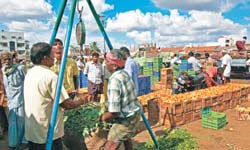
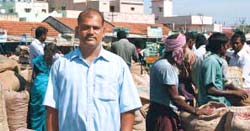
In mandis we trust: A sackload of drum sticks being weighed on a tripod-mounted scale. Over 1,000 tonne of vegetables is traded in the market everyday
The scene is chaotic; dozens of trucks, laden precariously with sackloads of vegetables, inch through the sea of humanity, but that does not seem to affect the focus of the buyers and sellers. We also realise that the market has positioned itself well to attract farmers despite the 10 per cent commission it charges (which retail chains don’t). “It is a cash market. Farmers get immediate cash for what they sell. Also, there are over 500 buyers (many from neighbouring Kerala) on any given day, which ensures that every bit of produce that farmers bring is absorbed. Result: demand and, consequently, prices are always buoyant—much more than in other markets in the region,’’ says V. Arumugam, Secretary, Oddanchatram Gandhi Market Commision Agents’ Welfare Society.
A. Kalimuthu, A farmer from Keeranur village
Buyers also benefit from the generous credit that commission agents offer, chips in K.P. Vaiyapuri, one of the senior-most commission agents in the market. This enables them to procure more. Also, age-old ties between farmers, commission agents and buyers means sellers don’t always have to come to the market. They simply send their produce to the market and leave the agents to conduct the sale. No wonder, farmers from far-flung regions prefer this market. Ask Arumugam about any threat he perceives from the retail chains, and his answer is spontaneous: “None at all.”

By evening, the frenzy has hit an even higher pitch. It is difficult to walk through the market without the fear of being run over by trucks or hit by men carting huge sacks of vegetables. A coconut auction is on. Coconuts of different sizes and from various farms are neatly piled up and coded. An agent is auctioning the nuts. Within 15 minutes, over 5,000 nuts are sold.

The sun has begun to set. As we drive eastward and leave Oddanchatram town behind, the spectre of retail chains swamping the traditional markets appears bizarre—for now, at least.




