

When 9-year-old Shahal took to serious learning of Adobe Photoshop two years ago in Malappuram district’s coastal town of Tirur, Kerala, a Malayalam daily wrote a glowing report. For, the place where he began learning—Akshaya Centre, a District Panchayat initiative—was not meant to train children like him, but adults like his mother, Fathima, 42, in Internet use. After accompanying his mother for two days, the boy yielded to Akshaya’s temptation and pestered the tutor Meena C.G., to teach him too. A few days later, he would reach his classes much ahead of his mother.
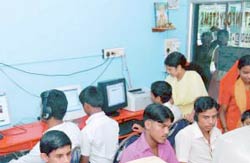
Out in the impoverished villages surrounding Lucknow, the capital of Uttar Pradesh, the solution is quite different. Digital Study Hall (DSH), an initiative developed by Randy Wang and Urvashi Sahni, has been written about by this magazine before.
This is not high-tech in the sense of wireless Internet access and the like, but this project has leveraged the continually falling price of technology to deliver better education to children in rural areas.
The technology is simple: volunteers record the classes of teachers at top public schools in Lucknow, the recording is then copied onto a DVD, which is then sent, often through the postal system, to outlying schools in rural areas. In these schools, far from the closest Internet node, the DSH Foundation, along with local non-governmental organisations (NGOs), has installed DVD players and televisions (sometimes the record lesson. Speaking to this magazine a while ago, Sahni pointed out that the biggest beneficiaries of the project were actually rural teachers, who adapted teaching methods shown on the video, and thus benefited their students.
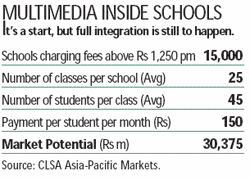 At the same time, the country’s network of 983 centrally-funded Kendriya Vidyalaya schools are also diving into Information Technology (IT). Says M. M. Joshi, Chairman, Kendriya Vidyalaya Sanghathan (KVS): “We entered the digital age over two decades ago, but that was for computer education of students. Today, we are trying to use IT to improve our teaching methods.”
Joshi claims that most KVS schools are connected to the worldwide web, other than a few outlying schools and those without any permanent buildings. However, the biggest advantage of technology, he mentions, has been in teacher training. “There are always curriculum changes every year. Until the IT revolution, re-training teachers took weeks since we had to gather teachers at nodal locations. Now, we can send off training modules to the respective schools a lot faster, and that has dramatically reduced training time.”
The large technology multinationals have also been involved closely in building up the information technology infrastructure of schools and colleges across the country. Cisco, Intel and Microsoft are participating in a slew of small pilot projects. Last year, Intel Chairman Craig Barrett, as part of Intel’s “World Ahead” programme, had unveiled one such programme at Tindivanam, Tamil Nadu, where Sister Amily of St Philomenas Girls School had told this magazine that computers were dominating the curriculum. “All the girls in higher secondary want to study computers now,” she bemoaned with a smile on her face.
Drawn to technology
The rush to have a computer-literate workforce is pushing several states into technology in a big way. Andhra Pradesh and Madhya Pradesh are pioneers, both supported by a host of vendors but using different methods. In MP, according to Manoj Jhalani of the state education department, the state is on the verge of equipping all 5,000-plus secondary and senior secondary schools with computer labs in a public-private partnership.
“The private player will be allowed to recoup his costs by using the labs after school hours to run a business, which could be a cybercafé or a computer training course. Once students realise the positive effects of computers, I hope they will persuade their kin to go to the lab and experience computers as well,” says Jhalani.
And as Mohammed Ali Rafath of the Andhra Pradesh State Council for Education, Research and Training (SCERT) points out, Computer-Aided Learning (CAL) is what really drives students and teachers and has an expected impact of reducing student drop-out rates and lowering faculty absenteeism.
“Particularly in some of the outlying districts, teachers are amazed at what they can do on the computer, and the audiovisual method of teaching the machines provide is remarkable,” says Rafath. However, he admits that the state cannot cope with the demand, having trained approximately 7,000 teachers in CAL since the state tied-up with Microsoft to set up a training institute. “There are approximately 74,000 schools as part of the state system in Andhra Pradesh, so there is a long way to go,” says Rafath.
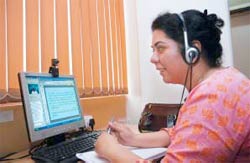
The most ambitious project when it comes to technology, however, is being undertaken by Hughes Communication India Limited (HCIL) in association with the Indian Space Research Organisation (ISRO) to provide a comprehensive two-way audiovisual teaching mechanism under the EduSat banner. According to Partho Banerjee, Chief Executive Officer, HCIL, “This project is imparting elementary and higher education programmes through a network of seven central studios and 800 classrooms at this moment and is benefiting over 10,000 students across the states of Chennai, Kerala, Punjab, J&K and Jharkhand.”
But such projects are just a drop in the ocean in a country like India, where there are millions of students in schools and colleges. Technology has started making a difference to their lives, but not significantly.











