

Institute are an unhappy lot these days, says its head Neville Dumasia. “They are worried about their responsibilities, for there is no law in India that defines their role.” The worst case scenario for these individuals now seems to be facing action in courts in India and abroad. The immediate cause of worry is, of course, the rejection by the Supreme Court of the anticipatory bail plea of Nimesh Kampani, Founder-Chairman of JM Financial.

Would Kampani have fared better if he had surrendered in India and sought bail? Zia Mody, Senior Advocate and Senior Partner at AZB & Partners, asks: “You are asking someone to go to jail. It is a tough call and I do not know if that is the right course. But what do the police want to do here—basically ask him questions? Why cannot they do it in his office? If they want to find some documentation, why do they have to take him to jail?” A JM Financial spokesperson did not want to comment, preferring to point to a December 2008 press release that said that Kampani had answered questions of the policemen on telephone from Dubai when they had visited his Mumbai office on December 29 and had promised to cooperate on his return.
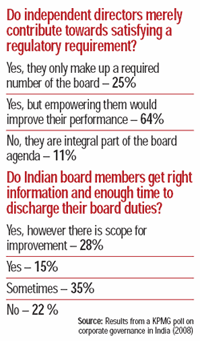
“The distinction would be in the involvement of these directors in the day-to-day management of a company’s affairs. There is enough judicial history to suggest that they may be treated separately on certain occasions.” However, he adds that since independent directors make up the audit committee, they cannot claim to be unaware of a company’s financial condition. “In fact, the courts can now ask the independent directors why they were not doing their duty,” Desai adds. He feels that the law should be amended to create a finer balance. While the independent directors should be made to play a more pivotal role, they should not be penalised for faults of the management.
The question, then, playing in the minds of many independent directors must be: Is it worth running the risk of going to jail for an extra Rs 5,000-20,000 that can be made from such directorships?











