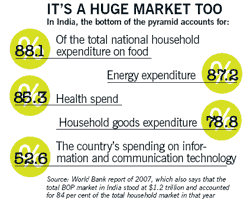
India’s favourite management guru today, C.K. Prahalad rarely minces his words when espousing his theory of fortune at the bottom of the pyramid. At a conclave organised by Confederation of Indian Industry in May ’08 (where Prahalad reiterated his vision for India at 75), he repeatedly pointed out that a red corridor is developing in India, starting at the Nepal borders and extending through Chhattisgarh and Andhra Pradesh. He said that this is an area where the rule of law doesn’t exist. When someone in the audience asked what businessmen could possibly do in such a situation, Prahalad challenged the representatives of companies participating in the seminar to start one enterprise each in these areas, that would buy from, and sell to, the local people.

The terror attack on Mumbai has brought the existence of the two Indias into focus. The attack on the two top hotels of the country resulted in politicians’ heads rolling and the country’s laws being strengthened—previous blasts in Mumbai and at other places like Jaipur, Ahmedabad and Hyderabad could not bring this about. Was it because India’s elite was targeted this time that the political class paid up?
The world is looking at new demand requirements coming from India and China to keep the global economy ticking. However, Chandiramani points out that this can be achieved by spreading the growth to the other India, creating income across the country, providing people with an expendable surplus, and generating demand as a result. If that bond can be forged, then, there will be a rush of investors trying to cater to this new India again, he says. Hindustan Unilever has been doing it for ages—selling to the other India and ITC (Prahalad’s favourite example) has done it with its e-choupal in villages.Washington Post did a story on the two Indias after the terror attacks and noted that the majority in India live on 50 cents a day, while at the same time, the number of dollar millionaires has increased to 100,000, according to government data. Surely, we can change that data a bit.