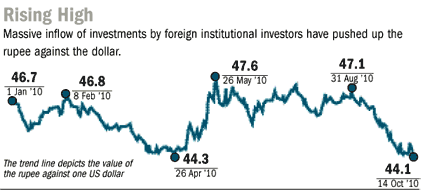
Citius, Altius, Fortius' could well be the rallying cry of the rupee as it rises swiftly, touches new highs and becomes stronger against the dollar. In January this year, the rate of the rupee against the dollar was Rs 46.62.
By 14 October, it had risen by 5.4 per cent to close at Rs 44.10 against the dollar. The last time it was near this level was in August 2008. Will the rupee's growth be beneficial for us? Is it a harbinger of good times or ominous ones? This will depend on which side of the fence you are.
For consumers, it's time to cheer as the price of imported goods falls when the rupee rises. So trawl the Net, look for good deals marked in US dollars and snap them up. You will now have to pay fewer rupees for the same dollar. It's also an opportune time to go on that foreign jaunt you have been promising yourself.
"The liberal pricing regime for Ulips has allowed them to be marketed aggressively, compared with mutual funds, which have had caps on loads and expense ratios for several years."
Ashu Suyash,
MD and Country Head,
Fidelity Mutual Fund
|
The same is true for students planning to enroll in colleges and universities in the US. Not only will air fare be cheaper, even accommodation and fees will be more affordable. However, you don't have to scramble to pack your bags right away.
Analysts expect that the rupee will continue to hover between Rs 43 and Rs 45 in the next few months. In a recent report by Goldman Sachs on the currency market in India, the company has maintained its forecast for the rupee at Rs 43 on a 12-month horizon.
The rupee might already have attained this level had the Reserve Bank of India not intervened. On 14 October, the central bank, after weeks of refusing to enter the foreign exchange market, finally bought the dollar at Rs 44.10. The RBI's move served a dual purpose-minimise the loss to exporters and ease liquidity in the system.
However, an appreciating rupee is watched with dread by exporters as a stronger rupee means less profit for them, which, in turn, means losing out on their competitive pricing edge.
This can lower the earnings of exportoriented businesses such as BPO firms and IT companies. On 14 October, the BSE-IT Index fell by 3.25 per cent, while the decline in the Sensex was 1.82 per cent
However, alarm bells have not begun to ring yet as the rupee is not expected to rise to the Rs 39 level that it had reached in 2007. This is because the government is more vigilant about the money being invested by foreign institutional investors (FIIs), who seem to be making a beeline for the Indian equity and debt markets.
Dejected by the paucity of investment opportunities in the US and European countries, they have been flocking to the great Indian stock sale. From January this year till 18 October, FIIs had invested about Rs 1,60,000 crore in equities and debt instruments, which is a record. The figure is likely to go up further as the US Federal Reserve is expected to buy assets worth $1 trillion from its financial institutions, which could further weaken the dollar index.
"Today, India is best placed among the emerging markets considering that it offers a large interest differential and strong growth momentum, making it a hot investment destination," says Naveen Mathur, associate director, commodities and currencies, Angel Broking. India's closest competitor, China, has been witnessing some resistance in inflows mainly because of the scepticism on its currency.
However, the deluge of foreign inflows is being closely monitored. This is because the slightest glitch in the market could spook FIIs who can withdraw as quickly as they entered. During the global financial crisis, when the FIIs packed their bags and left in a hurry, the rupee touched a low of Rs 52 against the dollar in March 2009.
This explains the RBI's intervention. However, the central bank's dollar purchase means more liquidity in the market, which may lead to inflation. This could prompt the RBI to increase interest rates, leading to more expensive loans. So, while your trip abroad would be cheaper, you may have to pay more on your travel loan. Is the grass greener on your side of the fence?
-
Tanvi VarmaChanging PostsYour neighbourhood post office is soon going to become a one-stop shop for all your financial needs. It's adding two more services to its roster-plastic money and insurance.
In September, the Department of Posts received approval from the RBI to launch its prepaid debit card. The card can have a value between Rs 1,000 and Rs 50,000 and will be launched in partnership with MasterCard.
The department is in talks with banks to ensure that the card can be used for all transactions, such as withdrawal of money from an ATM, online purchases and for electronic transfer of money.
Initially, the card will be issued only by major post offices. You will have to pay an activation fee and the amount that you want loaded in the card. The debit card can be topped up once this amount is used.
Along with the primary card, up to four add-on cards can be issued. India Post added its second feather in October when the Insurance Regulatory and Development Authority allowed post offices to distribute insurance products.
Each circle of the Department of Posts can tie up with two non-life insurance companies, two life insurance firms, one agricultural insurance company and one standalone health insurance company for this purpose.
A Share in EquitiesThe upswing in the Sensex seems to have caught the fancy of the Central Board of Trustees (CBT) of the Employee Provident Fund Organisation (EPFO). After vehemently opposing any move to invest in equities when it announced a 9.5 per cent interest in September, it seems to have softened its stand.
The CBT, which is headed by the Labour Ministry, agreed recently to invest a part of the Rs 3,00,000 crore provident fund corpus in the stock market. The Finance Ministry has been persistently requesting the CBT to invest 15 per cent of its corpus in equities.
For now, the CBT has agreed to put in only 5 per cent.
Even this agreement has certain conditions attached to it. In a communique to the Finance Ministry, EPFO officials have said that "to provide safety to workers' fund, the money will be invested only if positive returns are guaranteed by the ministry for the next five to six years and the government gives capital protection assurance".
This might throw a spanner in the works as the government may not agree to such a binding contract. However, if everything works out, then even a 5 per cent investment will mean an inflow of Rs 15,000 crore in the stock market.
-
Namrata DadwalFaster Justice for ConsumersGetting justice will soon become easier, quicker and smoother. The government is formulating plans to create a new court called the National Consumer Protection Court Authority, which will address grievances against manufacturers and service providers.
This is part of the reforms that are being drafted under the Consumer Protection (Amendment) Bill, which will replace the Consumer Protection Act, 1986.
Consumers will be able to sue the companies that do not disclose full information or retailers who do not issue bills. The new court will aim to provide justice within 10 days, a vast improvement over the present system, where it takes at least a month for the case to be heard.
Currently, consumers have to go through a three-tier redressal at the district, state and national levels. It is also being mulled that if a consumer has to suffer a prolonged court battle, interest should be added to the compensation awarded to him.
Trivia and Telling Figures
- 70 million is the number of houses needed to meet the current housing demand in the country, according to a report by the World Bank.
- Rs 25,000 cr is the estimated size of the consumer durables industry. The sector is growing at an annual rate of 17-18%, according to research agency Crisil.
- Rs 2,000 cr is the value of the currencies that were traded in the first hour of the opening of the United Stock Exchange, the new bourse for currency derivatives.
- 39 million is the number of mobile phones sold in the country between April and June this year, the highest ever, according to a report released by advisory firm IDC, in September.
|
Client-Friendly NormsMutual fund investors may finally get a reprieve from the endless number of forms. Now, instead of filling up the 'know your client' (KYC) form each time you want to invest in a different fund house, you will only need to do so once-with the CDSL Ventures, a subsidiary of the Central Depository Services (India).
The association will accept the KYC application form, verify the documents and provide an acknowledgement. When you want to invest in a mutual fund, you will only have to attach a copy of the acknowledgement. The new rule was launched on 1 October after the Association of Mutual Funds in India (Amfi) decided to set up a centralised record-keeping platform to save investors the bother of repeating the process across different fund houses.
You will have to register the bank accounts you want to use for making payments. In case an account cannot be registered, the cheque should have your name printed on it, otherwise you will have to submit an account statement or a photocopy of the passbook for verification.
In another development, Irda has asked the fund houses not to accept third-party cheques or payment instruments from 15 November. The ruling came after complaints against agents for using such cheques to cheat investors (see The Third-Party Scam, September 2010).
To check frauds and make agents and distributors more accountable, Amfi has made it mandatory for them to complete a 'know your distributor' procedure by 1 February 2011. The agents will have to submit requisite documents, such as PAN card, address proof, etc, as well as undergo biometric identification.
-
Pritam P Hans REGULATOR WATCH
A look at the recent rulings that can affect you:
MARKETS
- Sebi has asked the asset management companies to keep with them all investor-related documents, such as PAN, KYC and specimen signatures, rather than with distributors, in order to provide prompt service to investors.
- The market regulator has asked all AMCs to ensure that mutual fund units are transferred easily from one demat account to another. This will not apply to funds that have a lock-in period.
BANKING
- The RBI has notified all banks to process electronic payment transactions based solely on the account number to avoid delays and frauds. Presently, banks match both the name and the account number before crediting funds. As names can be spelt in different ways, it becomes difficult to perfectly match the transfer instruction with the destination bank's records.
- Banks will now provide clients with details of the remitter, rather than generic mentions like NEFT or NECS, for credit received in their account statements. This will help customers identify the source of credit.
INSURANCE
- The Insurance Regulatory and Development Authority has directed the insurance companies that are marketing policies over the phone to ensure that clients get a copy of either the recording or transcript of the conversation as an evidence of what was promised by the telemarketer.
|