












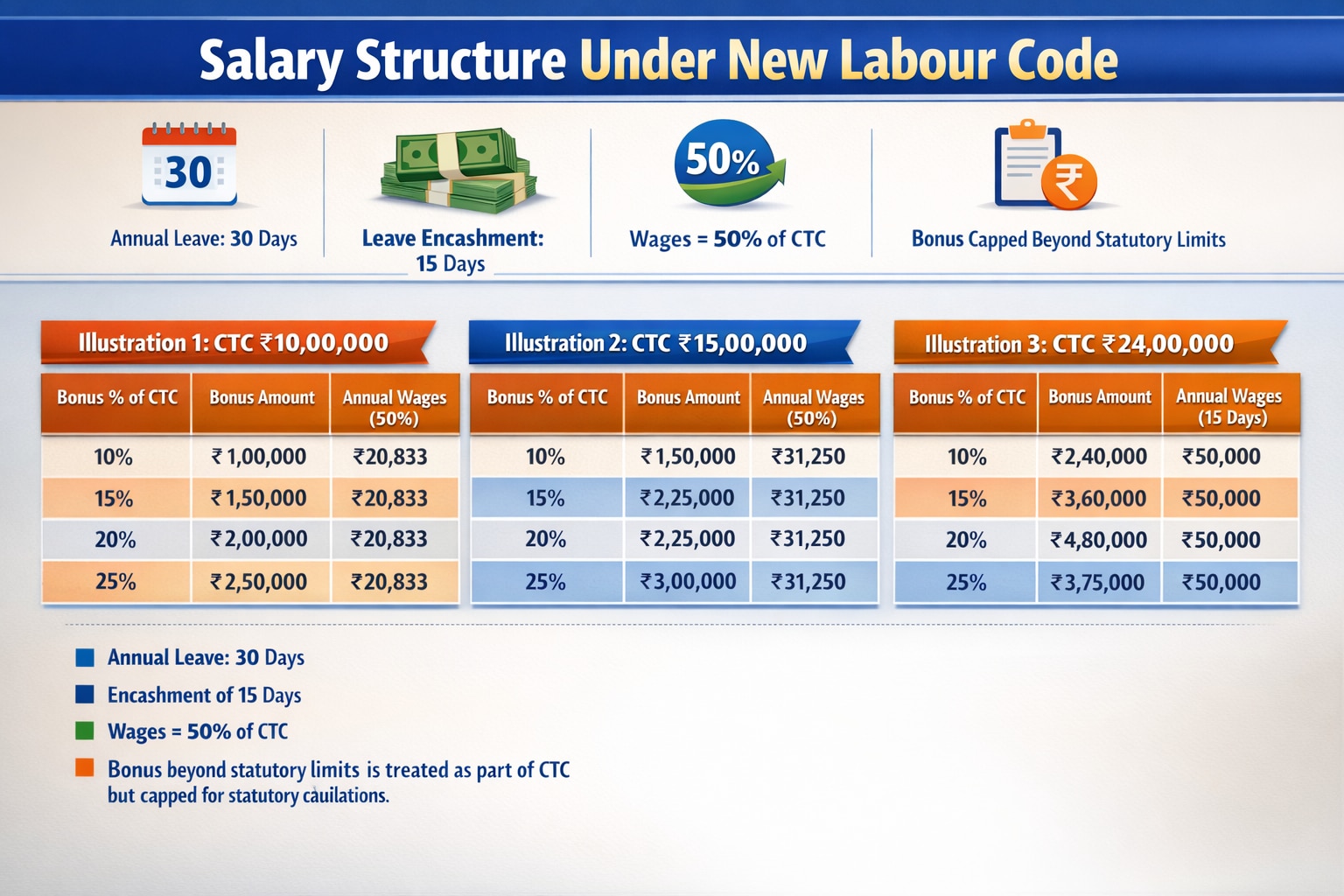



 Under the new rules, a larger portion of pay will now go toward statutory contributions such as provident fund and gratuity, strengthening long-term savings.
The Labour Code, 2025, which came into force on November 21 last year, is reshaping how salaries are structured across corporate India, with far-reaching implications for employee benefits such as gratuity, provident fund and other social security entitlements. At the heart of the reform is a new, uniform definition of “wages”, under which employers must now treat at least 50 per cent of an employee’s total cost-to-company (CTC) as wages for the purpose of calculating statutory benefits.
Under the revised framework, wages include basic pay, dearness allowance and retaining allowance. If these components together fall short of the 50 per cent threshold, employers are required to add the difference to ensure compliance. The change is aimed at bringing consistency to a system that earlier varied widely across organisations, where companies often kept basic pay low and loaded compensation with allowances to reduce statutory payouts.

 90% EVs exported out of India are from Maruti Suzuki: MD & CEO Hisashi Takeuchi
 India's $30 trillion goal needs 8-10% growth, $400 billion more annual investment: Jayant Sinha
 1.1 billion barrels gone: IMF warns that global oil market is running out of safety cushions
 From Devbhoomi to industrial destination: Uttarakhand’s manufacturing moment
 India’s deep-tech startups face a new test: Crossing the valley of death
 #IndiaAt100 : Adipen Bose Nandhiji On Conscious Capitalism- Can Profit & Purpose Coexist?
 #IndiaAt100 : Hisashi Takeuchi On Driving India’s Manufacturing Revolution
 #IndiaAt100 : Manufacturing For Viksit Bharat | Can Industry Power India’s $30-Trillion Dream?
 #IndiaAt100 : Tarun Garg On Hyundai & India’s Manufacturing Powerhouse Ambition
 #IndiaAt100 : CM Pushkar Singh Dhami On Uttarakhand’s Industrial Growth & India’s Next Leap
 Cupid, NTPC Green, NTPC, Raymond Realty, HAL shares: Key technical levels to watch
 Defence stock with Rs 2,654-crore order book hits record high; here's why
  GACM Technologies: FII holding jumps to 29%; penny stock in focus
 Puravankara shares rise 5% on fresh order win
  20 high-conviction ideas for up to 95% upside | stocks to buy
  More homes to get piped gas? Centre unveils incentive scheme to boost domestic PNG connections
 Planning a weekend with children in Delhi? These five destinations combine nature, heritage and practical learning
 Cabinet clears four railway projects worth ₹9,450 crore that will add approximately 410 km of new track
 Panvel adds 42,330 homes outpacing Navi Mumbai as airport-led realty boom takes shape
 NHAI’s ₹350 monthly toll pass now available: who can apply? Check eligibility and benefits


