


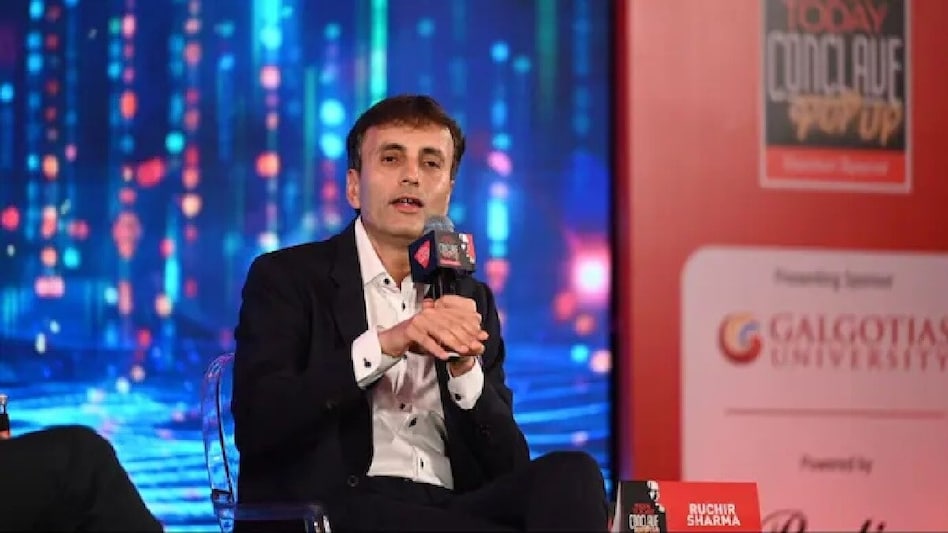
 Breakout Capital founder and Rockefeller International Chairman Ruchir Sharma
Breakout Capital founder and Rockefeller International Chairman Ruchir Sharma said the simultaneous surge in gold, stocks, and the dollar reflects "massive amounts of liquidity sloshing around the system," warning that the current "everything rally" could unwind sharply if central banks withdraw excess money next year.
In an interview with CNBC, Sharma said, "Stocks are partying like it's 1999 and gold is partying like it's 1979, and those two eras were so very different, with 1979 being associated with rampant inflation, geopolitical turmoil. And 1999 with the tech boom, which is what the AI boom is today."
"The only explanation that I get here is the fact that there's still massive amounts of liquidity sloshing around the system and that's fueling momentum trades across different corners of the market," he said.
Sharma, who has long been bullish on gold, cautioned that the recent surge in gold prices is no longer led by traditional safe-haven demand. "I've been a bull on gold for the last few years, but my concern is that there's no good story that too much money cannot spoil. The main demand for gold over the last few months has shifted to ETF demand. When the gold bull market started in earnest around 3 years ago following the sanctions that the US imposed on Russia, that was led by central bank buying. But the last few months it's really been a lot of ETF buying-in fact the ETF flows into gold in the last quarter were the highest ever," he said.
He noted that more than $1.5 trillion in excess liquidity remains in money market mutual funds even five years after the pandemic stimulus, driving speculative trades. "Gold has now got caught up in this liquidity-driven speculative frenzy," Sharma said. "What will happen is that next year, let's say that if inflation resurfaces and by any chance the Fed is forced to withdraw some of this liquidity, then the problem is going to be that gold will no longer act as the hedge."
Explaining why gold's rise may turn risky, he added, "A lot of people who say they're buying gold say they're doing it because it'll be a hedge...but my point is that gold's parabolic increase that's taken place in the last few months is not being driven by the traditional safe investors looking for just hedges. It's being driven by the same momentum retail crowd that's been driving up stocks as well."
According to Sharma, this means gold and stocks could fall together when liquidity tightens. "On the downside, there'll also be a positive correlation. So that's the big change that's happened and that's something we need to be cognizant of rather than thinking that gold is going to act as a hedge on the downside," he said.
When asked if gold had worked as a hedge so far, Sharma said, "Absolutely. So it's not been a hedge, it's been a parallel trade. Everything is rising in sync. We've never had a period where, in fact, gold has outperformed stocks in a bull market. That's just never happened. So, currently everything is rising. Everyone's happy...It's been like an everything bull market."
He added that the surge in gold is being driven by retail investors and excess money in the system, not traditional safe-haven buying. "I'm still bullish on gold in the very long term, but my concern is that on the upside now, we're seeing so much retail flow and so much massive liquidity find itself into gold that on the downside people will be surprised that there is also a positive correlation at least for a while," he said.
Asked how the unusual gold-stock correlation might end, Sharma replied, "A lot of people used to point to gold as an inflationary warning. So, the way I think that this ends is that traditional inflation finally does show up at some point-possibly next year-and then when the Fed is forced to increase interest rates and central banks have to withdraw some of this excess liquidity...that's when both stocks and gold go down simultaneously."
He concluded with a warning: "Until that happens, I guess it's a party everywhere. And that famous line goes that we know that this party is feeling extended, but the clock has no hands."

 CBDT issues new crypto reporting guidance: No new tax, but exchanges must track and report all transactions
 Did Cockroach Janta Party's 'Chalo Sansad' 2.0 threat trigger Dharmendra Pradhan's resignation? What we know so far
 'Will discharge my responsibilities with complete humility': Pralhad Joshi after being appointed Education Minister
 Curious about Pralhad Joshi's wealth? A closer look at his assets, investments and liabilities
 On Cockroach Janta Party's lines, now E20 Janta Party demands choice of 100% petrol
 Best Healthcare Stocks: Gaurang Shah's Outlook On Apollo Hospitals, Fortis & The Manipal Health IPO
 Is Indo-MIM's IPO Valuation Justified? Here's Why The Company Sees Strong Growth Ahead
 Treasury Bills Explained: Why T-Bills Are One Of The Safest Short-Term Investment Options
 FDs vs Markets: Where Should You Keep Your Short-Term Money?
 Why Term Insurance Is Essential for Every Earning Member | Sum Assured & Coverage Explained
 Gland Pharma stock: Price target of Rs 3,250 likely in medium term, says analyst
  Metal recycling stocks to buy: Gravita, Pondy Oxides, Jain Resource among top picks
 TRIL shares: Should you average the falling stock? Here's 'fixed and final' stop loss
 Adani Power: 45 GW target, Rs 2 lakh crore capex plan among conference call highlights
  ITC Hotels, Chalet, Ventive, IHCL, SAMHI: Hotel stocks to buy despite travel disruptions
 Mayor Zohran Mamdani taps tech-slayer Lina Khan to reshape New York City’s economy
 Planning a Nepal trip? You can now carry up to ₹25,000 in Indian cash. Here's what changedGland Pharma stock: Price target of Rs 3,250 likely in medium term, says analyst
  UP saw the largest 34 routes discontinued under the Udan scheme
 A case study in energy security: How India recovered oil imports and rebuilt its crude stockpile









