












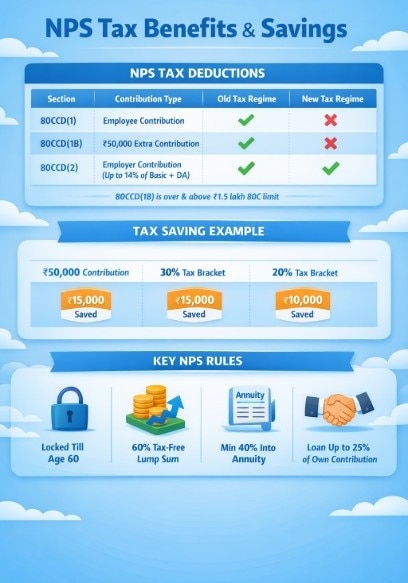



 Tax benefits under NPS are available in three parts — Section 80CCD(1), Section 80CCD(1B), and Section 80CCD(2).
The National Pension System (NPS) is gaining attention ahead of the March 31 tax deadline, as changes in rules and lesser-known deductions allow investors to claim additional tax benefits beyond the standard ₹1.5 lakh limit under Section 80C. Financial experts say the scheme now offers both tax savings and long-term retirement planning advantages, especially for salaried individuals.
Recent reforms have made NPS more flexible. Subscribers can now withdraw up to 80% of their corpus as a lump sum at retirement, compared to the earlier 60%, while at least 20% must still be used to buy an annuity. In addition, NPS accounts can now be used as collateral for loans of up to 25% of personal contributions, reducing the need for premature withdrawals. These features have increased the appeal of the scheme among private-sector employees and self-employed individuals looking for disciplined retirement savings.

 US diesel price hits record $6.49: How much prices have surged since Hormuz crisis
 AI agents are coming for every day tasks: What Goldman Sachs sees for the next AI growth wave
 Escalating Houthi-Saudi clashes trigger fresh US travel warning across West Asia
 French fuel crisis deepens as one in nine stations run out of stock, diesel prices at record high
  'Enjoy the journey, do not turn confidence into arrogance': Chandrasekaran on life lessons
  Gold Price Target 2026: Expert Sees MCX Gold At ₹1.8 Lakh By Year-End Amid Strong Demand
 Health Insurance: Why Pre-Existing Diseases And Waiting Periods Matter For Buyers
 Crude Oil Above $100: How High Energy Prices And Rupee Weakness Impact Gold Prices In India
 CEA On India’s Manufacturing Rise, Atmanirbhar Bharat And Modi’s Economic Policy
 Health Insurance Buying Guide: 7 Things First-Time Buyers Must Check Before Choosing A Policy
 Tata Motors or Ashok Leyland? Analyst reveals his preferred auto stock for near-term gains
 Maharashtra Scooters, Dixon Tech, Bharat Dynamics, Jai Corp among stocks to turn ex-dividend on Monday
 Jindal Supreme, SS Retail, Hero Motors IPOs subscribed up to 181 times on final day; details here
 Sensex, Nifty post sixth weekly loss; TCS, Titan among top laggards, slip up to 4%
 How AI collapse could benefit Indian equity market; Jefferies' Christopher Wood explains
  Dreaming of a Germany job? Indian engineer explains what a €70,000 salary looks like after taxes, rent & other costsGold Price Target 2026: Expert Sees MCX Gold At ₹1.8 Lakh By Year-End Amid Strong DemandTata Motors or Ashok Leyland? Analyst reveals his preferred auto stock for near-term gainsMaharashtra Scooters, Dixon Tech, Bharat Dynamics, Jai Corp among stocks to turn ex-dividend on MondayHealth Insurance: Why Pre-Existing Diseases And Waiting Periods Matter For Buyers


