The Slabs for the New Tax Regime has been updated as below:
It appears that the Ministry is favouring the New Tax Regime over the Old Tax Regime. By adjusting the tax rate slabs, the new tax regime becomes even more attractive, which is likely to result in more taxpayers opting for it over the old regime.
A tax saving of ₹ 17,500 would increase the disposable income for taxpayer, offering relief from the rising costs.
Standard deduction increased by ₹25,000 under new tax regime
With the aim of encouraging and incentivising taxpayers to shift to the new tax regime, the Standard deduction for employees opting for new tax regime has been increased to ₹75,000 from ₹50,000. The standard deduction for employees opting for old tax regime continues to ₹50,000.
Increase in deductions under section 80CCD
The limit for deduction under section 80CCD for an employer’s contribution to a notified pension scheme (National Pension Scheme (NPS) or the Atal Pension Yojana (APY)) is increased from 10% to 14% for employees of the private sector. This applies only to employees opting under the new tax regime. This deduction is brought at par with the deduction available for government employees.
TCS credit in the computation of TDS for salaried employees
To monitor high-value transactions, TCS is currently levied on various purchases, including motor cars and overseas tour packages. While individuals could take credit of TCS while filing their income tax return, there was no provision for the employer to consider this TCS while computing the overall TDS applicable to the employee.
This posed a challenge for salaried employees, who were left with excess taxes paid for the year. The only option available was to claim this excess amount as a tax refund in their ITR filed at the end of the financial year. As a major relief, it is proposed that an employer can now consider the TCS while computing the overall TDS liability of the employees. This amendment will take effect from 1st day of October, 2024.
Clarification and TDS relief for taxpayers with rental income
A new amendment has been proposed to clarify that income earned from letting out a residential house or part of it by the owner will be chargeable under the head "Income from house property" instead of "Profits and gains of business or profession." This amendment aims to resolve ongoing disputes between taxpayers and the tax department regarding the taxability of rental income from residential properties. It overrides previous court rulings that recognised such income as business income. However, the amendment does not address the tax treatment of rental income from commercial properties.
Further, TDS on rental payments under section 194IB is proposed to be reduced from 5% to 2% leaving more disposable income in the hands of landlords. The amendment will take effect from 1 October 2024.
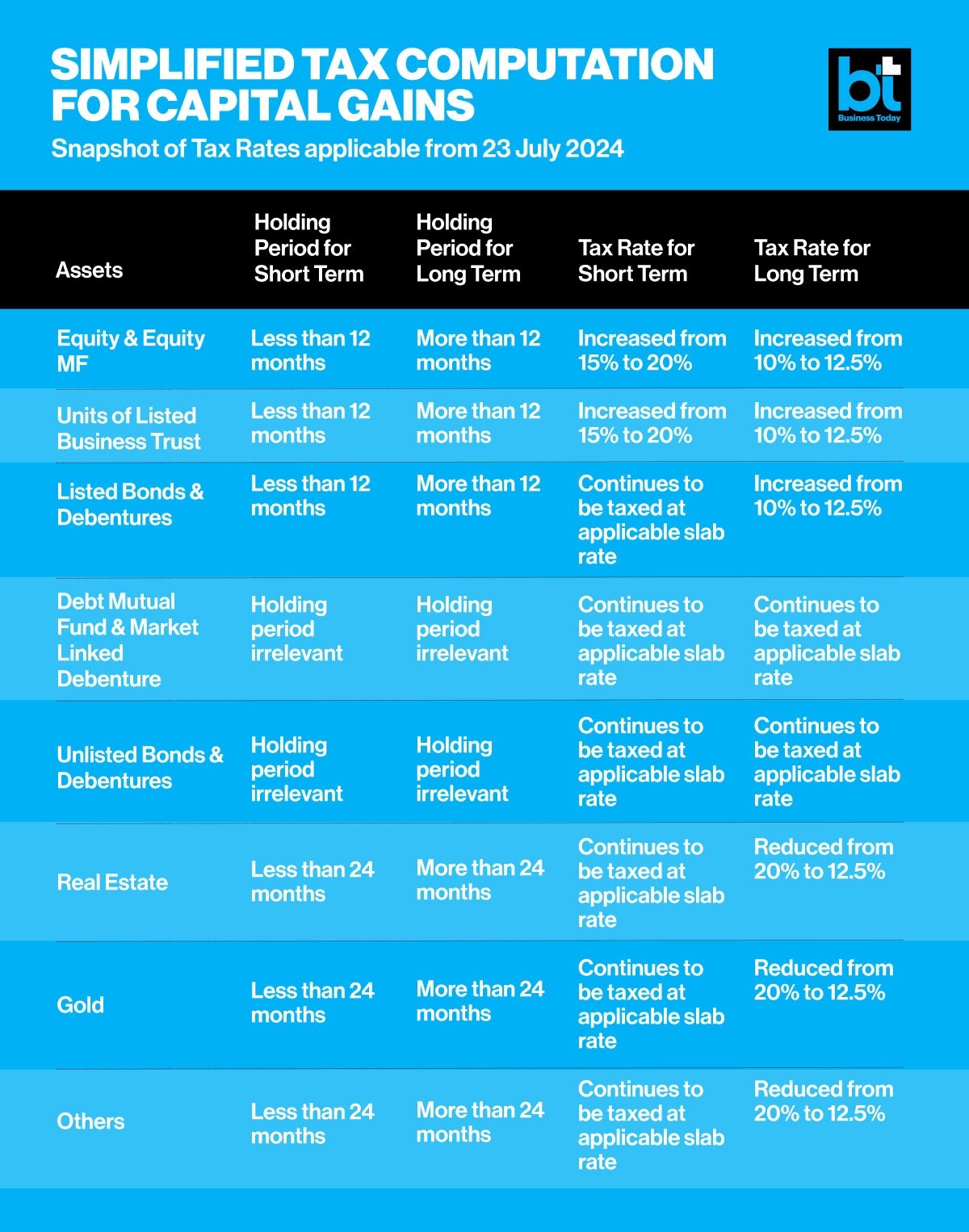
Simplified Tax Computation for Capital Gains
Snapshot of Tax Rates applicable from 23 July 2024
The tax rates on capital gains for listed equity and equity-oriented mutual funds have increased. Short-term capital gains will now be taxed at 20%, and long-term capital gains will be taxed at 12.5%. However, to offset the increase in tax rates, the exemption on long-term capital gains has been raised from ₹1,00,000 to ₹1,25,000.
Additionally, the indexation benefit, previously available for calculating long-term capital gains on real estate, gold, and other unlisted assets, has been withdrawn. To rationalise this change, the tax rate on long-term capital gains from these assets has been reduced from 20% to 12.5%. While the removal of indexation benefits has generally elicited negative reactions from taxpayers, the lower tax rate could adequately compensate them in many cases.
Non-resident to get parity in taxation and rates for non-residents will be the same as residents.
From a personal taxation standpoint, the overall Budget focuses on promoting the New Tax Regime, resolving disputes through clarifications, and providing relief from harsh penalties for minor offences.
The effort to simplify capital gains tax is commendable. The increase in long-term and short-term capital gains tax on listed securities, coupled with the increase in STT, is definitely bad news for the investor community. However, lowering the long-term capital gains tax rate on all other capital assets will benefit the general public at large.
(The author is a senior tax expert and Director at Nangia Andersen. India Pvt. Ltd. Views expressed by the investment expert are his/her own. With inputs from Neetu Brahma)














 Old Tax vs New Tax
 HDFC Bank, Infosys, ITC shares: FPI favourites hit as 2026 outflows top Rs 2.5L cr mark
 Five-day banking week: Panel to discuss proposal today; RBI, finance ministry to take final call
 Apple layoffs: Over 5,000 AppleCare jobs could have been replaced by AI, report says
 Small savings interest rates today: PPF, SSY and SCSS rates face September 30 review; what investors should know
 CAFE-3 is here: Why more EVs, range-extenders and hybrids could hit India’s roads
 U.S. Completes Iraq Military Withdrawal After 23 Years: What Comes Next For Baghdad?
 Banking Stocks To Middle East Plays: Where Is The Value Emerging?
 Stock Market Falling: Best Sectors to Buy During the Correction | Baroda BNP Paribas MF
 Dalal Street Under Pressure: Crude, Yields And Heavy Supply Weigh | Nifty - Sensex
 Vijay Govt Faces DMK Heat: Kanimozhi Invokes Dhanush Film Over Jobs, Welfare, Law & Order
 ICICI Securities sees recovery in ER&D stocks in Q2; Tata Tech, Netweb, IKS, Cyient among top picks
 Lenskart target price hike: Stock rises 4% on thumbs up from Morgan Stanley
 Gland Pharma shares fall over 2% amid block deal report
  Solar Industries shares gain 3% as company issues update on expansion
  ‘Just give me a sample’: Chinese trader explains why Indian clients frustrate him
 Flipkart expands Ekart network by 900 hubs, adds 750 PIN codes ahead of festive sale