








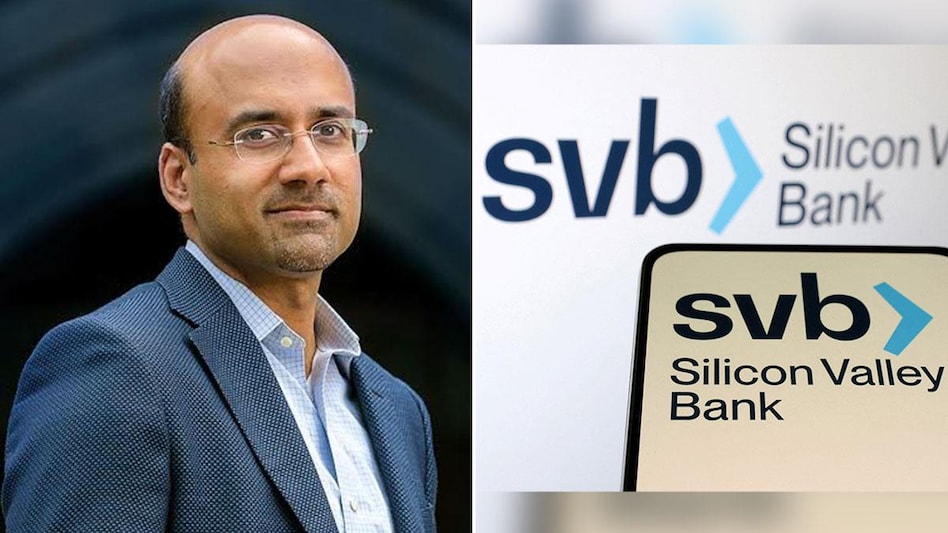
 Atif Mian, who teaches public policy and finance at Princeton School, said the California-based bank collapsed because of its exposure to interest rate risk.
 Atif Mian, who teaches public policy and finance at Princeton School, said the California-based bank collapsed because of its exposure to interest rate risk.
A top economist has explained the risk of higher interest rates that triggered the collapse of America's Silicon Valley Bank (SVB). Atif Mian, who teaches public policy and finance at Princeton School, said the California-based bank collapsed because of its exposure to interest rate risk.
In a series of tweets, he explained how the rising interest rate and the bank's holding of government securities, whose value declined due to rate hikes, caused the meltdown. The bank, whose clients were tech start-ups, had to sell its government bond holding at a $1.8 billion loss as their value had plunged due to high-interest rates.
The professor said the interest rate risk refers to a potential change in interest expense obligations and a potential change in valuation due to a change in interest rates. This risk, he said, is now the highest it has ever been in recent history (if not ever).
Sharing a graph on the market yield on US treasury securities, he pointed to the large and steady decline in interest rates since the 1980s - a fall of about 10 percentage points to near zero till recently. And the total debt to GDP is the highest it has ever been - it has more than doubled, currently well north of 250 per cent of GDP.
The fall in rates and rise in the debt are closely related. But, the professor said, he wanted to highlight the implications for interest rate risk when one is sitting on the biggest pile of debt ever and interest rates start to rise from their lowest level in recent history.
"Say total debt to GDP=250%, then a 1% rise in interest rates => 2.5% of GDP, or about 250 B rise in interest expense every year," he explained. "That's a lot of added pressure on indebted balance sheets - and some may start to pop."
Of course, the professor said, in reality, this happens gradually, but the point was to highlight the force and its magnitude. "But this is just one dimension of the interest rate risk, there is a second one." And it is this second 'valuation effect' of interest rate risk that brought SVB down, Mian said.
To understand this risk, consider the price of a bond that matures in 10 years. "Say this bond was issued at price of 100 in 2019 when the 10-year rate was at 2%. If the interest rate were to rise to 3% (its closer to 4 today), the price of this bond will fall by about 9%."
"It is this valuation dimension of interest rate risk that killed SVB - but remember total debt to GDP=250% - so many more are getting hit," the economist added. The valuation dimension of interest rate risk is not limited to bonds but shows up in all long-lived assets like land and housing.
So, he said, rising rates bring down valuations at the same time that indebted balance sheets are facing increased cash flow pressure. "The two dimensions of interest rate risk can thus feed on each other at the macro level," he said, adding that none of this should be seen as a prediction - "my point is to highlight the 'risks'". "SVB is flashy news - the macro risks may be more grave(er)," he said, in his concluding tweet.
Economists worldwide are worried about persistent inflation and rate hikes by America's central bank - Federal Reserves. They believe that if this continues, the world economy might slip into recession. Global financial institutions like IMF and World Bank have already predicted a slowdown and recession in some countries in the latter half of this year.
 Nifty slips below 50-day EMA for 1st time in 3 months, signals more pain
 NSE in talks with IGX on collaboration to launch Indian Natural Gas Futures
 Sensex, Nifty extend losses for fourth straight day; Rs 8.1 lakh crore investor wealth eroded
 Apple risks $38 billion fine as India upholds antitrust penalty law: All details
 Budget 2026: EY India pushes for direct tax reforms, TDS overhaul and investment
 Macquarie Warns Of Delayed QSR Recovery; EPS Cuts, Delivery Outpaces Dine-In
 Markets May Rise Before A Bigger Fall: Warning on Gold, Silver & Global Economy
 “Today’s Businessman Is Kalyug’s Abhimanyu”: Nilesh Shah On Policy Gaps And Growth Challenges
 CES 2026: AI That Cuts Hair, Scans Health, Does Chores And Keeps You Company Too
 Jio IPO, Tariff Hikes & AGR Relief: Can Telecom Stocks Deliver Big Returns In 2026?
 NSE in talks with IGX on collaboration to launch Indian Natural Gas FuturesNifty slips below 50-day EMA for 1st time in 3 months, signals more pain
 Dixon Technologies shares: Two factors behind the rally amid market crash today
  BHEL shares tumble nearly 9%; here's the possible trigger
 Stock market: Pre-Budget rally ahead? Chances have diminished, says Amit Goel of Pace 360