








 India sees rise in EV registrations: Economic Survey 25-26
 India sees rise in EV registrations: Economic Survey 25-26
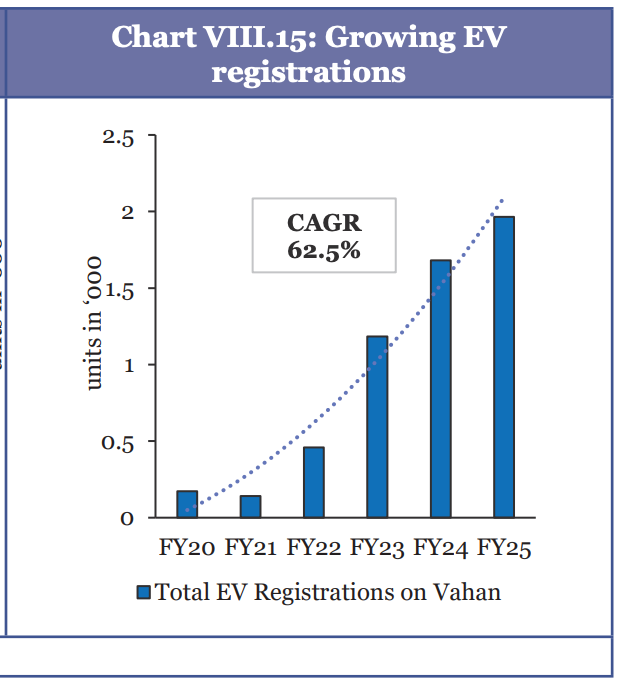
The Economic Survey 2025-26, which was tabled at the Parliament on January 29, highlighted the Indian government’s push towards the electric vehicle (EV) sector. It showcased how dedicated schemes have led to an increase in EV registrations across the country.
Through targeted Production Linked Incentive (PLI) schemes designed to build a high-tech, self-reliant manufacturing ecosystem, the government aims to move India from a model of import substitution to one of strategic resilience.
A surge in EV registrations and market momentum
The impact of these supply-side interventions, combined with demand-side recoveries, has led to a significant upward trend in EV registrations across the country.
The Survey notes that the automotive industry, increasingly fueled by the transition to electric power, has recorded nearly 33% growth in production over the last decade (FY15 to FY25).
The following PLI schemes have had a major role in this growth:
PLI Scheme for National Programme on Advanced Chemistry Cell (ACC) Battery Storage
This scheme is a cornerstone of India's EV strategy, focusing on the most critical and expensive component of an electric vehicle: the battery. The government has allocated a massive outlay of Rs 18,100 crore with a target to establish a domestic manufacturing capacity of 50 Giga Watt Hours (GWh) of Advanced Chemistry Cells.
Out of which, 40 GWh capacity has already been awarded, strengthening the EV ecosystem.
Scheme to Promote Manufacturing of Electric Passenger Cars in India (SMEC)
Notified in March 2024, this scheme aims to attract investments from global EV manufacturers and promote India as a manufacturing destination for e-cars, by allowing temporary imports of high-value e-4W at a reduced customs duty, contingent upon a minimum investment of Rs 4,150 crore ($500 million) and achieving mandatory phased Domestic Value Addition (DVA) targets.
By focusing on passenger cars, the government has intended to begin a mass-market shift toward electric mobility.
This momentum is further supported by the automotive sector, which as per the survey, now accounts for approximately 15% of India's total GST collections, underscoring its role as a vital economic pillar.
The rise in passenger EV registrations is being mirrored by public infrastructure projects as well, such as the Kochi Water Metro, which uses LTO battery-powered electric-hybrid ferries, a model now being replicated in 21 other Indian cities.
 First crude shipment reaches Mumbai port following tense Strait of Hormuz passage
 US-Israel-Iran war LIVE Updates: Tehran embassy is in touch with Indian students, providing all assistance, says govt as conflict continues
 Stock market: Oil price hike not a big concern, AI is, says Nischal Maheshwari
 Auto industry seeks restoration of LPG, PNG, propane gas supply; warns of production cuts
 Who drives India's natural gas demand?
 Daily Calls LIVE: Ask Your STOCK MARKET TODAY QUERIES | Market Update LIVE | Share Market News Today
 Thai Cargo Ship Hit By Projectiles Near Strait Of Hormuz, India Condemns Attack
 Strait Of Hormuz Turns Warzone As Tankers Hit And US Warships Strike Iranian Boats
 West Asia War Forces India’s Strategic Reset As Govt Opens Door To Chinese Investments
 West Asia War Sparks Panic Buying In Chennai; Induction Stoves, Cookware Sold Out
 Sensex tumbles 2,171 pts, Nifty falls over 2% in 2 days; will stock market extend losses?
 Adani Power, Tata Power, Coal India shares jump up to 7%: Jainam Broking's Kiran Jani weighs in
 Iran war, oil-gas crisis: BHEL, Suzlon, Adani Power, Tata Power, AGEL among JM's top picksStock market: Oil price hike not a big concern, AI is, says Nischal Maheshwari
 Rajputana Stainless IPO: Latest GMP, why allotment was deferred & other key details