


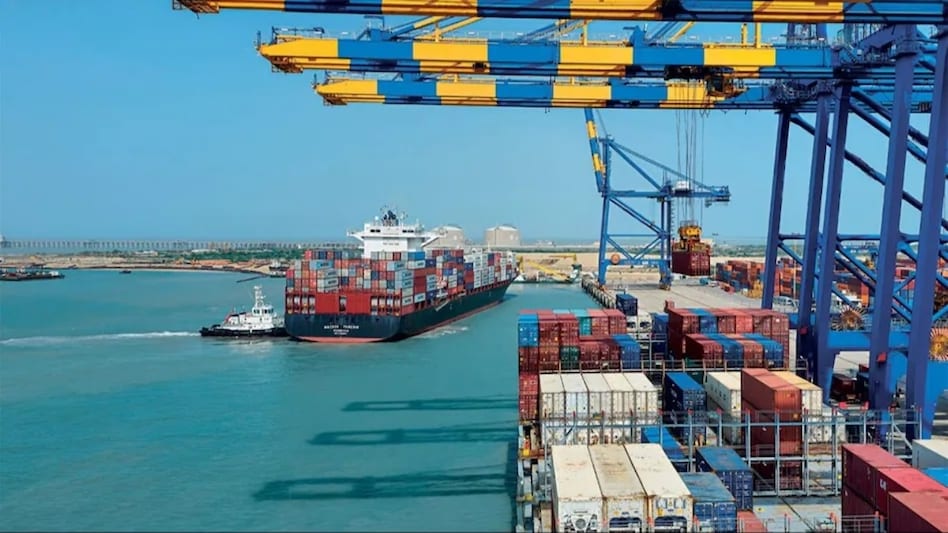
 Economic Survey 2025-26: Trade is increasingly treated not as a permanent reciprocal arrangement, but as a transitional tool — exporting aggressively while reducing dependence on foreign suppliers.
The Economic Survey 2025-26 referred to the Ramayana to focus on how India can learn from its adversaries without dependence — drawing wisdom selectively, without absorbing values or methods that undermine autonomy. Citing the moment in the Yuddha Kanda when Lord Rama reflects on learning even from a defeated enemy, the Survey uses the ancient epic as a metaphor for strategic discernment in an increasingly fragmented global economy.
That framing sets the tone for the Survey’s assessment of the international environment confronting India today — one marked by rising geopolitical tension, fragile financial conditions and a steady erosion of the assumptions that once underpinned globalisation.
Follow our detailed coverage on Union Budget 2026 here
A key development highlighted in this context is China’s launch of the Hainan Free Trade Port (FTP). As 2025 drew to a close, Beijing operationalised full island-wide customs arrangements in Hainan, converting the entire province into a low-tariff, services-led economic zone with a customs system separate from mainland China. Imports into the island face minimal duties, while goods produced locally with sufficient value addition can be sold across China without additional tariffs.
For India, the Survey cautions against viewing Hainan as a single disruptive shock. Instead, it represents a gradual structural shift that could, over time, reshape trade routes, logistics networks and investment decisions across Asia, particularly in the northern Indian Ocean and South China Sea region. Its impact lies less in immediate competition and more in how it subtly alters the economic geography of the region.
The broader concern, however, is the global backdrop against which such changes are unfolding. While the world economy appears to have absorbed the shocks of 2025 better than initially feared, the Survey warns that the window for “business as usual” may be closing. Across economies, financial markets and political systems, the likelihood of moderate to severe disruption now exceeds the chances of a smooth continuation of past trends.
For India, this fragility has concrete implications. As a country dependent on global capital flows, it must plan for stronger liquidity and external buffers in the year ahead. Risks of capital flight — including those emerging from the growing use of US dollar-linked stablecoins — require close monitoring. Although India remains better positioned than many economies to sustain growth, its resilience will continue to be tested by external dependence on capital, energy and critical inputs such as fertilisers.
Looking further ahead, the Survey suggests that the period leading up to 2045 could resemble the interwar years of the twentieth century — a prolonged phase of geopolitical uncertainty, economic fragmentation and social stress in advanced economies. History shows that such periods can generate innovation and industrial expansion, but only where policy responses are proactive rather than defensive.
The Survey underlines that the global economic environment confronting India today is fundamentally different from the earlier phase of globalisation. Trade, technology, finance and supply chains are no longer governed primarily by efficiency and reciprocity, but by strategic considerations. In this setting, outcomes depend not just on macroeconomic stability, but on institutional strength and strategic capacity.
China’s evolving approach to trade is cited as emblematic of this shift. Trade is increasingly treated not as a permanent reciprocal arrangement, but as a transitional tool — exporting aggressively while reducing dependence on foreign suppliers. This creates asymmetric openness, where some economies remain exposed to global markets while others retain the ability to restrict access at relatively low domestic cost.
Building resilience in such a world is a long-term task. The Survey emphasises that institutional and strategic capabilities require patience, credible rule enforcement, competitive firms and citizens who internalise norms. Policymakers must navigate unavoidable trade-offs between speed and patience, protection and competition, and autonomy and integration.

 US tariffs did little to lower export prices, shifted imports to cheaper, lower-quality goods: IMF paper
 India's top private banks defy West Asia shadow with strong Q1 credit growth. Here's why
 Govt warns departments against delays in NPS contributions; employees must get PPF-linked interest on late credits
 'Ready for...': Delhi CM says restaurants, cafes to stay open until 4am for FIFA World Cup 2026 final
 HDFC Bank Q1 results: Net profit rises 5% to Rs 19,060 crore; NII up 6.7%; key takeaways
 Trump Threatens Iran’s “Pickaxe Mountain”: Why This Nuclear-Linked Bunker Is Hard To Hit
 India Launches SHANTI Campaign For 2028-29 UNSC Seat As EAM Jaishankar Makes Global Reform Pitch
 Will BJP Project Yogi Adityanath As Its U.P. CM Face For 2027? Speculation Grows
 Sneha Mordani Ground Report: Can New Rules Stop Misuse Of High-Alcohol Medicines?
 Why FIIs Aren't Returning To India Yet | Punita Kumar Explains The Real Challenges
 RIL Q1 results: O2C recovery drives broadly in-line quarter, says Equirus Securities
 IDBI Bank Q1 results: Net profit rises 5% to Rs 2,115 crore; NIM falls 54 bps QoQ
  Adani Ports: Post 30% rally in six months, more upside likely for the Adani Group stock?HDFC Bank Q1 results: Net profit rises 5% to Rs 19,060 crore; NII up 6.7%; key takeaways
 ICICI Bank Q1 results: Net profit rises 15.9% to Rs 14,805 crore; asset quality stays stable









