US may strike but Iran regime not near collapse, says Ian Bremmer
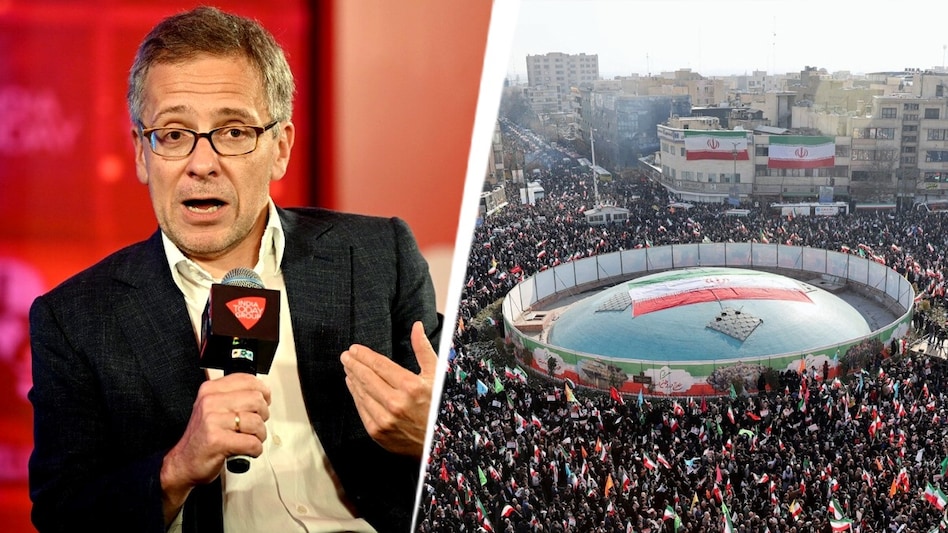
Iran is facing widespread protests and escalating violence, but the situation does not point to an imminent collapse of the regime, according to political risk analyst Ian Bremmer, even as the United States weighs limited military action in response to the crackdown.
Bremmer said demonstrations are taking place across the country and are being met by a state apparatus long accustomed to repression. "We've got various reports from organisations, some credible sources that are saying well over 500 protestors are dead, a fair number of police and soldiers as well, probably in the dozens. There are some sources talking about thousands," he said in a video message on Tuesday.
According to Bremmer, officials within the Trump administration believe the violence is even worse than publicly known. He said President Donald Trump has publicly warned that the United States would intervene if the repression continued. "President Trump has said that if that occurs, the Americans are going to take action to rescue the Iranian protestors," he said.
At the same time, Bremmer, who is also the President of the Eurasia Group, said Washington believes Tehran is seeking dialogue. Taken together, he said, those signals suggest the US is preparing to demonstrate military capability without attempting to overthrow the regime.
"And I think that you put those two things together, and what that gets you is that clearly the Trump administration is preparing to take military strikes soon to show that they can."
Advertisement
He said any strikes would likely be limited and targeted. "Likely something like the Basij headquarters, the paramilitary groups that report to the Islamic Revolutionary Guard Corps and are involved directly in the repression of these unarmed civilians, perhaps also local police headquarters and the rest."
Bremmer stressed that this would not constitute regime change. "This is not, in other words, a regime change operation. It's not, take out the supreme leader, but rather showing that the Americans are directly on the side of the protestors."
Iran has warned it would retaliate against Israel and US bases if attacked, but Bremmer said those threats are not taken seriously in Washington. "Well, the Iranians are saying that if the Americans engage in strikes that they will hit back against Israel, hit back against American bases in the region. That is completely not credible from the Trump administration perspective."
Advertisement
He pointed to past confrontations as context. "Trump ordered the assassination of Qasem Soleimani at the end of his first administration. The Iranian response was virtually nothing." He also referred to last year's conflict involving Israel. While Iran did strike Israel, Bremmer said the response did not significantly affect US interests.
As a result, Bremmer said the US president does not view Iranian threats as a major deterrent. "So he certainly doesn't see the Iranian threats as having any real potential recourse. Don't think he sees any real risk of shutting down the Straits of Hormuz."
Bremmer also referred to an analysis by Iran expert Karim Sadjadpour, citing a recent article. Sadjadpour concludes, in the article, that "brutality can delay the regime's funeral, but it's unlikely to restore its pulse."
While agreeing with the assessment, Bremmer said delaying collapse remains the regime's immediate objective. That calculation, he said, lowers the risk of a wider regional war. "And as long as that is the case, the likelihood that this escalates dramatically militarily in the region is very low."
He said the United States remains open to dealing with Iran under specific conditions, similar to its approach elsewhere. "The United States is willing to work with this regime in the same way that the United States under Trump is willing to work with a brutal regime in Venezuela as long as they do what the Americans want."
Advertisement
Those conditions would centre on nuclear and regional behaviour. "And in this case, the question would be about allowing the inspectors back in and getting rid of their nuclear program and ballistic missile program in ways that would be seen as credible to the Americans and the Israelis."
Iran would also be expected to halt support for regional proxies, he added. In return, Bremmer said Tehran may get some sanctions relief, "the only thing that could help the Iranians turn their economy around a bit."
Bremmer also pointed to the absence of organised opposition leadership and unity within the security forces. "There is no real leadership of the opposition in Iran in that regard…There's also no particular signs, at least now, that the military or the security forces are in any way fragmented."
He said Supreme Leader Ali Khamenei's control over the security establishment remains intact. "Khamenei is in his mid-80s and ailing. He also handpicked all the top security leaders, and so far doesn't seem to be any sense that they are willing to give him up or go against him."
As a result, Bremmer said expectations of rapid regime change are misplaced. "So, it's hard to imagine in the near term this is actually the end of the regime. It doesn't feel like an imminent collapse."
Advertisement
He added that while the long-term outlook may be bleak, immediate change is unlikely. "Even though long-term… these guys are on borrowed time, and hopefully we see the end of this regime very soon."
Business Today brings you the latest news, views and analysis from the world of finance, economy, markets, corporates, startups, tech, and the digital economy. You can find everything from breaking news to deep dives to immersive essays and more on a variety of subjects across all formats - online, magazine, television, data visualisation, et al.



 US may strike but Iran regime not near collapse, says Ian Bremmer
 'AI ending humanity is nonsense': Ex-Infosys CEO Vishal Sikka rejects growing doom warnings
 'Majority among two is two': Tata Trusts says Chandrasekaran reappointment failed AoA condition, has no legal effect
 ICAI plans further reforms to scale up homegrown accounting firms
 'Modi admin has done a phenomenal job': Blackstone's Jon Gray on what changed in India
 'SC/ST Act is being weaponised': Tech CEO backs IIT Bombay Professor, calls for case withdrawal
 Gold Price Target 2026: Expert Sees MCX Gold At ₹1.8 Lakh By Year-End Amid Strong Demand
 Health Insurance: Why Pre-Existing Diseases And Waiting Periods Matter For Buyers
 Crude Oil Above $100: How High Energy Prices And Rupee Weakness Impact Gold Prices In India
 CEA On India’s Manufacturing Rise, Atmanirbhar Bharat And Modi’s Economic Policy
 Health Insurance Buying Guide: 7 Things First-Time Buyers Must Check Before Choosing A Policy
 SpaceX weight in Nasdaq 100 to jump to 2.82% following quarterly index rebalance: Report
 Tata Motors or Ashok Leyland? Analyst reveals his preferred auto stock for near-term gains
 Maharashtra Scooters, Dixon Tech, Bharat Dynamics, Jai Corp among stocks to turn ex-dividend on Monday
 Jindal Supreme, SS Retail, Hero Motors IPOs subscribed up to 181 times on final day; details here
 Sensex, Nifty post sixth weekly loss; TCS, Titan among top laggards, slip up to 4%
 LPG refill without Aadhaar authentication: What changes from October 1 and how to get subsidy
 From terrace Wi-Fi to IIT Delhi: How this Mumbai student secured AIR 2,456 in JEE Advanced
 Hormuz crisis exposed the world's energy weak spots: Why the next shock could hurt more
 ‘Just have to know what floats your boat': Former Uber CMO on quitting Rs 1 crore job for farm life
 Could AI really kill us all? Here’s what MIT researchers fear and what they don’t












