


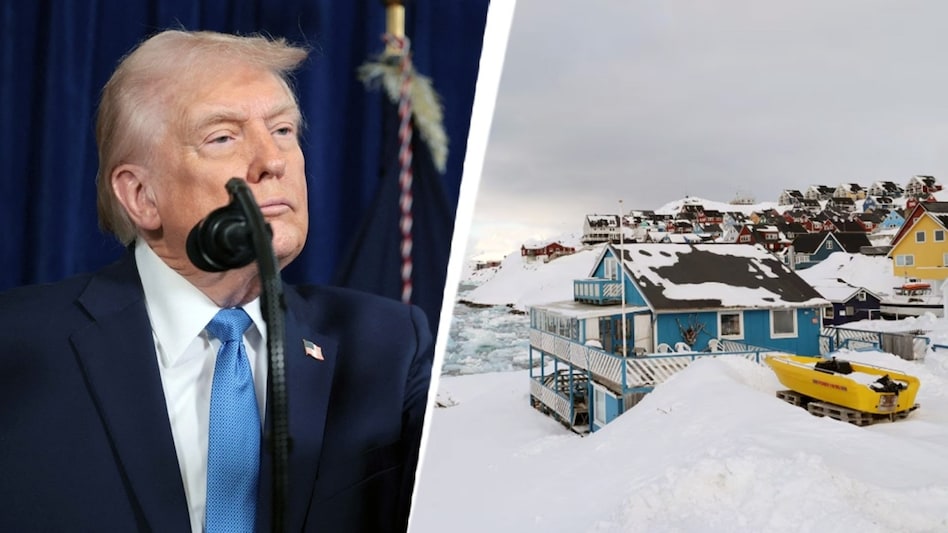
 The US President framed the tariffs as retaliation for what he described as the deployment of European troops to Greenland.
European governments reacted with sharp criticism after US President Donald Trump announced plans to impose a 10% tariff on goods from eight European countries, accusing them of opposing American control over Greenland. The tariffs, set to take effect next month, target Denmark, Norway, Sweden, France, Germany, the United Kingdom, the Netherlands and Finland.
Trump’s move has triggered alarm across European capitals, raising concerns about a new strain on transatlantic relations and exposing fresh fault lines within NATO at a time of heightened geopolitical tension in the Arctic. While it remains unclear whether the tariffs would extend to the European Union as a bloc, the announcement has already sparked coordinated diplomatic pushback.
The US President framed the tariffs as retaliation for what he described as the deployment of European troops to Greenland. European leaders, however, rejected that characterisation, saying the troop presence was symbolic and undertaken in response to Trump’s own calls for strengthened Arctic security amid growing concerns over Russia’s activity in the region.
Denmark: Transparency with allies
Denmark, which holds sovereignty over Greenland, sought to strike a measured tone while firmly rejecting the premise of Trump’s threat. Danish Foreign Minister Lars Løkke Rasmussen said Copenhagen agrees that the Arctic is no longer a low-tension region, stressing that recent steps were taken in coordination with NATO.
“That’s exactly why we and NATO partners are stepping up in full transparency with our American allies,” Rasmussen said, underscoring Denmark’s view that cooperation — not coercion — should guide Arctic security policy.
Norway & Sweden: ‘No place for threats’
Norwegian Prime Minister Jonas Gahr Støre was more direct, saying “threats have no place among allies.” He reaffirmed Norway’s full support for Denmark’s sovereignty over Greenland and noted that there is broad NATO consensus on the need to strengthen Arctic security.
Sweden echoed that stance, with Prime Minister Ulf Kristersson warning against what he described as political blackmail. Calling the issue larger than the eight countries singled out by Trump, Kristersson framed the dispute as a wider European Union concern.
France & Germany: Tariffs ‘unacceptable’
French President Emmanuel Macron dismissed the tariff threat outright, saying intimidation would not influence France’s positions, whether on Ukraine, Greenland or elsewhere. Macron argued that trade measures are inappropriate tools in security disputes between allies.
Germany struck a more cautious but coordinated note. Government spokesperson Stefan Kornelius said Berlin is consulting closely with European partners and would decide on an appropriate response collectively, signaling that retaliatory steps remain an option.
UK: ‘Completely wrong’
British Prime Minister Keir Starmer emphasized that Greenland’s future lies with Greenlanders and Denmark, while warning that punishing allies for pursuing NATO’s collective security undermines the alliance itself.
“Applying tariffs on allies for pursuing the collective security of NATO allies is completely wrong,” Starmer said, reinforcing London’s view that Arctic security is a shared responsibility.
Netherlands & Finland: Warning of Escalation
Dutch Foreign Minister David van Weel criticized the use of trade tariffs in a non-trade dispute, saying allies should seek dialogue rather than pressure. Speaking on a current affairs program, he said he was “very unhappy” with Washington’s approach.
Finnish President Alexander Stubb warned that tariffs could trigger a dangerous spiral, undermining the transatlantic relationship. Even as someone who has publicly shared a cordial personal rapport with Trump, Stubb stressed that disputes between allies are best resolved through discussion, not economic pressure.
Trump’s tariff threat marks a rare moment in which security disagreements within NATO are spilling over into trade policy.

 Rs 4 Lakh crore investor wealth boost! Why stock market is back in green after four days
  Coforge shares gain ahead of Q1 results: Profit may rise 80-90%; Encore integration eyed
 RAF’s conduct during students’ Parliament march under review, say sources
  US-Iran pause attacks for second day; Trump 'giving talks some space' as Hormuz deal discussed
 New paper leak bill in Lok Sabha today, proposes harsher punishment; MPs given draft
 AI Data Centers, Aerospace & Gas Turbines: What's Powering Indo-MIM's Future Growth?
 Best Healthcare Stocks: Gaurang Shah's Outlook On Apollo Hospitals, Fortis & The Manipal Health IPO
 Is Indo-MIM's IPO Valuation Justified? Here's Why The Company Sees Strong Growth Ahead
 Treasury Bills Explained: Why T-Bills Are One Of The Safest Short-Term Investment Options
 FDs vs Markets: Where Should You Keep Your Short-Term Money?
 AU SFB shares at Rs 800 or Rs 1,275? Targets by JPMorgan, Morgan Stanley, MOFSL and others
 Tanfac, Emcure, Privi, HFCL among 8 stocks with fresh brokerage interest for upto 84% rise
 Juniper Green Energy IPO to open on July 30; check price band, issue size & more
 Adani Power vs NTPC: Share price targets, power capacity and capex post Q1 earnings
 MV Electrosystems IPO opens on July 30; check price band, issue size, key dates & more
 OpenAI's GPT-5 was labelled a high-risk AI model over biohazard concerns
 First-time homebuyers beware! Five common home loan traps that could cost you big
 Renting a flat? Who really bears housing society penalties for rule violations, tenant or landlord?AU SFB shares at Rs 800 or Rs 1,275? Targets by JPMorgan, Morgan Stanley, MOFSL and others
 'Jana Nayagan' box office collection day 4: Thalapathy Vijay's farewell film crosses ₹217 crore globally









