








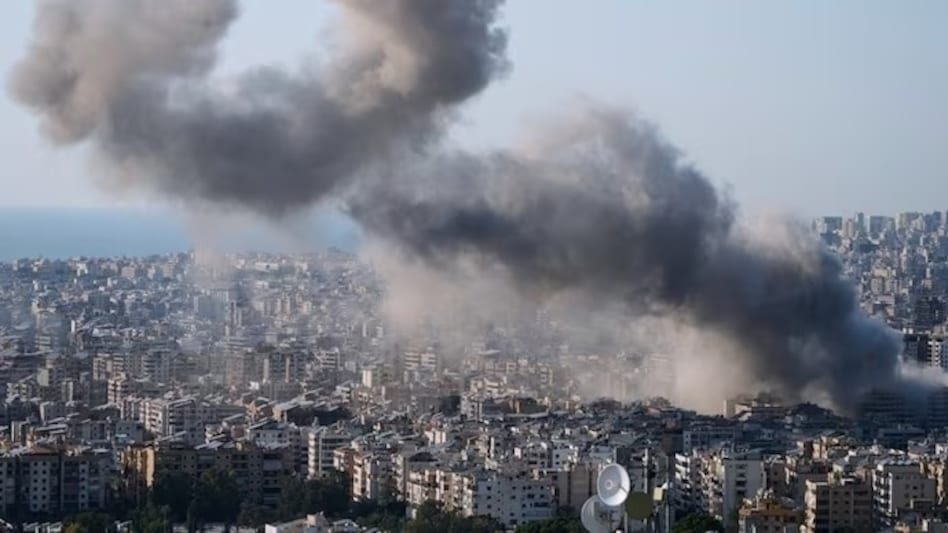
 Iran war: Expert said US-Israel's strategy is actually working and that critics are looking at the wrong things
 Iran war: Expert said US-Israel's strategy is actually working and that critics are looking at the wrong things
The US-Israel’s strategy against Iran in the war is working, despite what many critics might seem to think, said international politics scholar, Assistant Professor in the Critical Security Studies Program at the Doha Institute for Graduate Studies, and an Honorary Research Fellow at the University of Exeter, Muhanad Seloom. He said many critics who believe that the US is losing ground are looking at the wrong indicators.
In an opinion piece for Al Jazeera, Seloom wrote that while the dominant narrative is that the US-Israel stumbled into the war without a plan, Iran has retaliated with force across the region, global energy order has gone into a tailspin, and the world has been thrown into a crisis.
“But this narrative is wrong. Not because the costs are imaginary, but because the critics are measuring the wrong things. They are cataloguing the price of the campaign while ignoring the strategic ledger,” wrote Seloom. If Iran’s ballistic missile arsenal, nuclear infrastructure, air defences, navy and its proxy command architecture are looked at, one would not see the picture of US’ failure. He called it the “systematic, phased degradation of a threat”.
IRAN’S MISSILES
Iran’s ballistic missile arsenal has fallen by 90 per cent from February 28 to March 14, hundreds of missile launchers have been rendered inoperable, and reportedly 80 percent of Iran’s capacity to strike Israel has been eliminated.
Seloom said US-Israel’s campaign moved through two distinct phases – the first “suppressed Iran’s air defences and decapitated its command and control, and degraded its missile and drone launch infrastructure” and the second one, currently underway, is targeting Iran’s “defence industrial base”.
Iran’s dilemma is if it fires the remaining missiles, it will expose the launchers but if Iran conserves them, then it will forfeit the ability to impose costs of the war.
“Much of the criticism of the US-Israeli campaign focuses on its costs while treating the status quo ante as if it were cost-free. It was not,” wrote Seloom.
IRAN’S NUCLEAR CAPABILITY
Iran’s Natanz nuclear facility has been further damaged, and the one in Fordow remains inoperable. Seloom said that the critics’ implicit alternative to the war – continued restraint – is the policy that created the crisis in the first place. Every year of restraint meant that Iran added “centrifuges to the enrichment halls and kilogrammes to the stockpile”.
STRAIT OF HORMUZ
While the closure of the Strait of Hormuz is dominating the critical commentary space, it is many-a-times missing Iran’s own woes. Closing the strait was Iran’s “most visible retaliatory card”. Iran’s own oil exports pass through the strait.
China, Tehran’s largest economic partner, cannot receive Iranian crude oil if the strait is shut. “Every day the blockade continues, Iran severs its own economic lifeline and alienates the one major power that has consistently shielded it at the United Nations. The closure does not just hurt the global economy; it accelerates Iran’s isolation,” said Seloom.
Iran’s naval assets are degraded daily, and its Bandar Abbas and Chahbahar naval bases have been severely damaged, said Seloom. “The question is not whether the strait reopens but when and whether Iran retains any naval capacity to contest it,” he said.
PROXY WAR AND THE ENDGAME
When proxies launch attacks – like Hezbollah attacks on Israel, Iraqi militia attacks on US bases, Houthis threatening the Red Sea – it is not the evidence of an expanding network but of predelegated response authority. A centralised command system activates the authority when it anticipates its own destruction, said Seloom. “Predelegation is a sign of desperation, not strength. It means the centre can no longer coordinate,” he said.
“But the critics are making a different error: They are treating the costs of action as if the costs of inaction were zero. They were not. They were measured in the slow accretion of a threat that, left unchecked, would have produced exactly the crisis everyone claims to fear: a nuclear-armed Iran capable of closing the Strait of Hormuz at will, surrounded by proxy forces that could hold the entire region hostage indefinitely,” said Seloom.
 BT Exclusive: Indian airlines to raise concerns over Dubai curbs amid Gulf rights debate
 Youth in labour market: Graduate unemployment remains high in India
 US-Israel-Iran War Live: Israel targets Mojtaba Khamenei's aide Ali Larijani, Basij militia head killed
 India VIX: Market volatility index falls 12% in two days as bulls attempt recovery
 IDBI sale setback leaves over half of FY26 disinvestment receipts unmet
 Health Insurance Gets Cheaper: FM Nirmala Sitharaman Backs Low-Cost Cover
 Daily Calls LIVE: Ask Your STOCK MARKET TODAY QUERIES | Market Update LIVE | Share Market News Today
 Everything's Getting Expensive - Oil, Cars, Life | What's Hot LIVE
 U.P. CM Yogi’s “Special Advice” To Parents: No Smartphones For Kids Under 18!
 Trump Explodes At Keir Starmer As Allies Back Off While Hormuz Crisis Spirals Globally
 NSE IPO: Largest stock exchange may eye elite m-cap club entry on market debutIndia VIX: Market volatility index falls 12% in two days as bulls attempt recovery
 NTPC Green Energy shares: Brokerage starts coverage with 'Buy' on renewable growth outlook
 MOIL shares climb, snap 3-session fall; here's the trigger
 Persistent Systems launches Nvidia-backed AI solution for generative molecules, virtual screening; stock reacts