








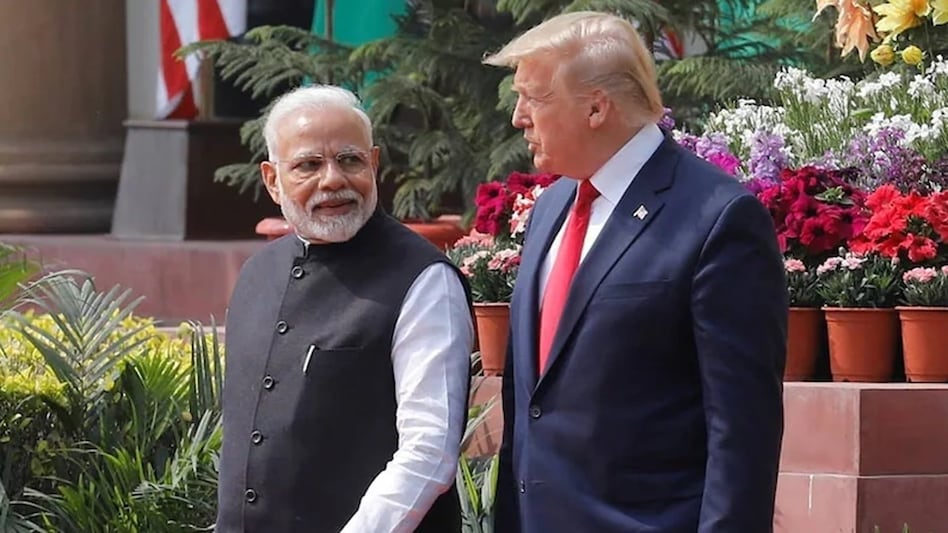
 PM Modi, who arrived in the US on February 13 for his first bilateral visit since Trump’s re-election, has emphasized strong ties between the two leaders.
 PM Modi, who arrived in the US on February 13 for his first bilateral visit since Trump’s re-election, has emphasized strong ties between the two leaders.
US President Donald Trump has set the stage for another trade showdown, declaring he will announce new “reciprocal tariffs” today. His latest move, aimed at countries that impose duties on American imports, comes just hours before his scheduled meeting with Indian Prime Minister Narendra Modi.
“THREE GREAT WEEKS, PERHAPS THE BEST EVER, BUT TODAY IS THE BIG ONE: RECIPROCAL TARIFFS!!! MAKE AMERICA GREAT AGAIN!!!” Trump wrote on Truth Social, hyping up the announcement. He will hold a press conference at the White House at 1:00 p.m. local time (11:30 p.m. IST) to outline the details.
PM Modi, who arrived in the US on February 13 for his first bilateral visit since Trump’s re-election, has emphasized strong ties between the two leaders. He hopes their previous collaboration (2017-2021) will strengthen trade, technology, and defense partnerships.
A senior White House official said, "I think the US-India partnership is a significant part of our Indo-Pacific strategy that you have seen for nearly a decade is a core part of our national security focus in our approach. So, that has economic elements. That also has political elements too. But this is one of the most critical, if not the most critical, bilateral relationships of the 21st century. President Trump is going to do his part to ensure that the remains foundational element moving forward..."
Trump has long argued that the US is being unfairly treated in global trade, pushing for an “eye for an eye” approach to counter foreign tariffs. “The only fair way to trade,” he insists.
His stance on India has been particularly tough. He previously labeled the country a “very big abuser” on trade, and his economic adviser, Kevin Hassett, described its tariffs as “enormously high.” Last month, Trump included India, Brazil, and China in a list of nations that “mean us harm.”
India, in a bid to ease tensions, recently slashed tariffs on American goods, including high-end motorcycles, cars, and smartphone components. Yet, Trump's tariff policies remain aggressive—his 25% duty on steel and aluminum imports applies to India as well.
As Trump ramps up his protectionist push, all eyes are now on the White House briefing, where he is expected to unveil the next big shift in U.S. trade policy.
 India in discussions with Iran for safe passage of 20 oil tankers through Hormuz: Report
 PM Modi speaks to Iranian President, raises unhindered transit of goods and energy
 Iran denies laying mines in Hormuz, warns nations backing 'aggression' won't get safe passage
 Iran's new Ayatollah says Hormuz must remain closed
 'It can't happen now': US Navy not ready to escort oil tankers through Hormuz
 Rahul Gandhi Vs Hardeep Puri In Lok Sabha Over India’s Oil Security
 Induction Cooktop Sales Jump 300% In Delhi-NCR Amid LPG Supply Concerns
 Market Fall Deepens | Oil Hovers Near $100, Nifty Slips - Sanjay Sinha Explains What Next
 Market Crash Amid Oil Surge? Devang Shah Decodes | Live Market Commentary
 #Podcast | #Episode09 | From Bollywood Icon To Entrepreneur: Malaika Arora On Food, Fashion & Fitness
 Brent oil prices above $100 again after Khamenei signals Hormuz will stay shut
 NSE IPO: Leading exchange appoints 20 merchant bankers for its mega issue; check full list
 Sensex tumbles 2,171 pts, Nifty falls over 2% in 2 days; will stock market extend losses?
 Adani Power, Tata Power, Coal India shares jump up to 7%: Jainam Broking's Kiran Jani weighs in
 Iran war, oil-gas crisis: BHEL, Suzlon, Adani Power, Tata Power, AGEL among JM's top picks