









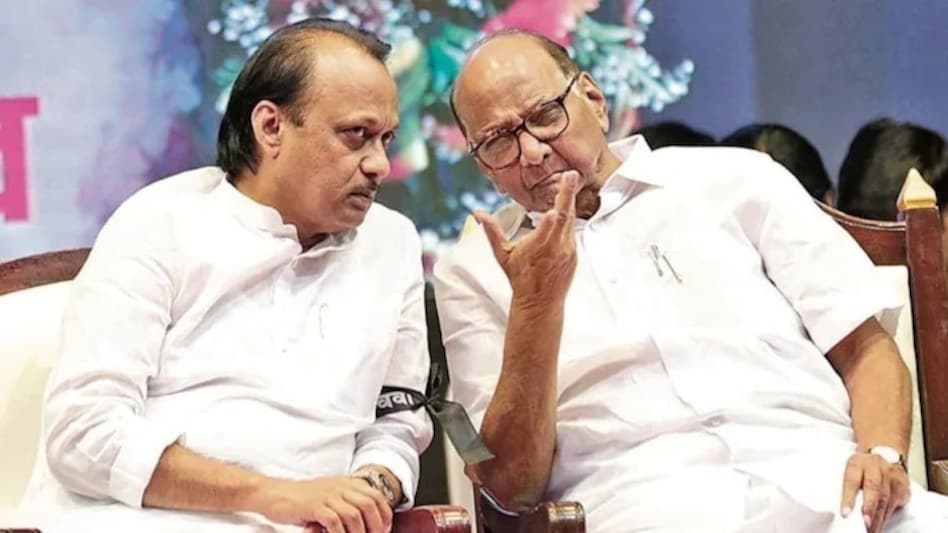
 Ajit Pawar, the loyal nephew, the rebel tactician, and Sharad Pawar’s heir in waiting

 Ajit Pawar, the loyal nephew, the rebel tactician, and Sharad Pawar’s heir in waiting
Maharashtra Deputy Chief Minister Ajit Pawar, 66, died on Wednesday after the private chartered plane he was travelling in crashed while attempting to land in Baramati.
The accident has abruptly ended the career of a politician who rarely operated on the margins, a leader who remained at the centre of Maharashtra’s power structure across governments, alliances and political churn.
Born on July 22, 1959, in Deolali Pravara in Ahmednagar district, Ajit Pawar grew up in a family where public life was not a general idea but a daily rhythm. His world, early on, was shaped by the cooperative institutions that anchor western Maharashtra’s politics, sugar factories, milk unions and local banks, long before he became a familiar face in Mantralaya.
The cooperative roots that became his political launchpad in 1982
His early years were spent building networks in rural Maharashtra's most influential ecosystem: the cooperative sector. It was here that he learnt the mechanics of mobilisation, organisation and resource control, the fundamentals that later translated into political strength.
Pawar entered public service through the cooperative sector, winning a seat on the board of a local sugar factory in 1982. He soon emerged as a key figure in the cooperative movement, which he consistently described as the “backbone of rural Maharashtra.”
He later served as chairman of the Pune District Central Cooperative Bank for 16 years, building an organisational base that would become central to his rise.
Ajit Pawar's electoral breakthrough
Ajit Pawar’s electoral breakthrough came in 1991, when he won from Baramati, a constituency he would go on to retain repeatedly. Over time, he became a six-term MLA from Baramati, turning it into one of the state’s most politically secure and symbolically loaded seats.
Known for his intense grassroots connect, Pawar was often credited with transforming Baramati into a model constituency through investments in irrigation, education and infrastructure.
The administrator who never left the budget room
From the early phase of his legislative career, Pawar gained a reputation for being more than a campaign politician. He was seen as a man who stayed in files, numbers and execution, building influence through the machinery of government.
Across different governments, he remained central to budget-making and bureaucratic decision-making.
The portfolios Pawar handled
Over the years, he handled some of the most powerful portfolios in Maharashtra like:
- Finance and Planning
- Water Resources
- Energy
- Rural Development
- State Excise.
He presented the Maharashtra budget multiple times and became known as a leader deeply involved in financial allocations, deficit decisions and welfare spending.
His grasp of numbers and state finances earned him a reputation as the man who effectively ran Maharashtra’s fiscal machinery.
The Sharad Pawar relationship: legacy, proximity, and a parallel power centre
Ajit Pawar was the nephew of veteran leader Sharad Pawar, and his politics carried an impression of that relationship: the method, the practicality and the regional instincts of western Maharashtra’s most seasoned strategist.
But his relationship with Sharad Pawar was never just about lineage. It was also about inheritance, political, organisational and emotional, and the tension that often comes when an heir becomes a power centre in his own right.
In public imagination, Ajit Pawar was frequently viewed as Sharad Pawar’s most formidable political extension, equally capable of loyalty and disruption, depending on what the moment demanded.
A strategist who shaped governments and survived them
A senior leader of the Nationalist Congress Party, Ajit Pawar, emerged as the party’s operational brain in Maharashtra. He was deeply involved in alliance negotiations, floor management and government formation, the backstage moves that decide outcomes long before ballots do.
His political journey was marked by several turning points. He played a key role in the Nationalist Congress Party for decades and was its most prominent leader in western Maharashtra.
In recent years, he became a pivotal force during multiple splits and realignments within the party. His moves often rewired the state’s political equations and reshaped coalition governments.
The end of an era, and the vacuum it leaves
Pawar’s working style was defined by pace and presence, sharp, direct, and rooted in daily political contact. He remained active till his last day in office.
Known for his fast-paced working style and for holding regular public interactions, Pawar remained active in government till the end. He was serving as Deputy Chief Minister in the current Maharashtra government at the time of his death.
Ajit Pawar is survived by his wife Sunetra Pawar and sons Parth and Jay.
 Delhi EV policy 2026: Should you buy these premium electric SUVs & MPVs under ₹30 lakh?
 Big news for commercial petrol, diesel buyers: India lifts emergency curbs on retail sales from July 1
  'Never seen so many tankers': India's Russian crude imports may hit record high in June
 Delhi EV Policy 2026 Explained: What's changing for car, bike and auto buyers
 Why Jio BlackRock feels hybrid long-short is the perfect fund to launch now as it enters the SIF space
 Why Jio BlackRock AMC Is Launching Hybrid Long-Short As It's First SIF
 Delhi Unveils ₹15,000 Crore EV Policy: What It Means For Auto Companies And Consumers
 Gold, Silver Or Crude? Where Should Investors Bet Now? | Vandana Bharti
 How India Strategically Managed LPG & Crude Oil Supplies During West Asia War | K. Surana Explains
 Delhi’s Green Revolution: CM Rekha Gupta Unveils Massive ₹15,000 Crore EV Policy To Combat Pollution
 Why Jio BlackRock feels hybrid long-short is the perfect fund to launch now as it enters the SIF space
 Where should investors put their money? PL Wealth CEO has some tips
  Axis Bank CFO Puneet Sharma steps down; stock likely in focus on Tuesday
 Apollo Hospitals, Medanta, Healthcare Global, Max Healthcare, Artemis Medicare: Check target prices, outlook
 Polycab: Amid record FII buying, shares at all-time high but brokerages expect more upside