





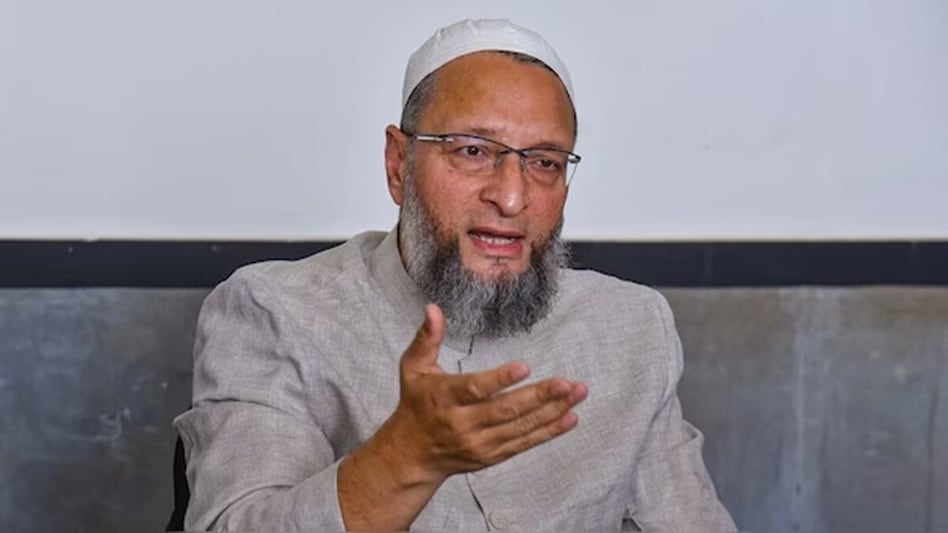
 Owaisi questioned the appropriateness of a sitting High Court judge attending a conference organised by the VHP, an entity previously banned at various points.
 Owaisi questioned the appropriateness of a sitting High Court judge attending a conference organised by the VHP, an entity previously banned at various points.
AIMIM chief Asaduddin Owaisi on Monday criticised Justice Shekhar Kumar Yadav of the Allahabad High Court for participating in a Vishva Hindu Parishad (VHP) event and delivering controversial remarks that, according to Owaisi, raise concerns about judicial independence and impartiality.
The VHP, a right-wing organisation affiliated with the Rashtriya Swayamsevak Sangh (RSS) — the ideological parent of the ruling Bharatiya Janata Party (BJP) — hosted the event in Prayagraj on Sunday, where Justice Yadav spoke on the Uniform Civil Code (UCC).
Taking to X (formerly Twitter), Owaisi questioned the appropriateness of a sitting High Court judge attending a conference organised by the VHP, an entity previously banned at various points. “The VHP was banned on multiple occasions. It is associated with the RSS, an organisation that Vallabhbhai Patel banned for being a ‘force of hate and violence.’ It is unfortunate that a High Court judge attended the conference of such an organisation,” he said.
Criticising the judge’s purported remarks, Owaisi stated, “The Constitution of India expects judicial independence and impartiality. The Constitution is not majoritarian but democratic, where the rights of minorities are protected.” He also described Justice Yadav’s comments as an “indictment” of the collegium system for judicial appointments, adding that it raises serious questions about the fairness of the judiciary.
Referring to Justice Yadav's statements at the event, Owaisi asked, “How can a minority party expect justice before someone who participates in VHP programs?”
At the convention, Justice Yadav reportedly remarked, “I have no hesitation in saying that this is Hindustan (India), and this country will function according to the wishes of the majority (the Hindus). This is the law.” He further dismissed concerns about his judicial role, saying, “You can’t say that I am saying this despite being a High Court judge. The law works according to the majority.”
Owaisi’s sharp response highlights growing concerns over the intersection of judiciary and ideological affiliations, reigniting debates about judicial neutrality and constitutional values in a pluralistic democracy.
 Exclusive: Govt wraps up inter-ministerial consultations on raising FDI limit in PSBs; Cabinet note soon
 ‘Stop sticking your heads in the sand’: JPMorgan CEO Jamie Dimon warns AI will eliminate jobs
 India faces over $200 billion yearly climate protection bill at 2°C warming: McKinsey
 Global AI race: India emerges as a powerhouse, takes third spot in Stanford ranking
 ‘$1.5 trillion bets’: IBM CEO sounds alarm on AI spending, says current tech has ‘0-1%’ chance of AGI
 Chandigarh Round Wrap-Up: BT Golf Winners At Panchkula Golf Club | Season 2025–26
 Chandigarh Round Wrap-Up: BT Golf Winners At Panchkula Golf Club | Season 2025–26
 Golf, Legacy & Milkha Singh | HM Singh At BT Golf
 Four Decades Of Golf: Indian Oil Team Shares Stories & Tips At BT Golf Chandigarh
 In The Game Of Golf, You Win Some And Lose Some But It's Important To Keep Going...
 '80% of original Sensex firms no longer...': Top CIO explains why 'new age' valuation fears may be misplaced
 IndiGo, BEL, KEC International, IOC, Wipro among stocks in focus next week; here's why
 Is Elon Musk’s SpaceX IPO the biggest ever? What Indian investors need to know
 2.5 crore women investors added in last 10 years: NSE CEO Ashish Chauhan
 Eternal-backed Shiprocket files updated DRHP for Rs 2,342 crore IPO; key details