












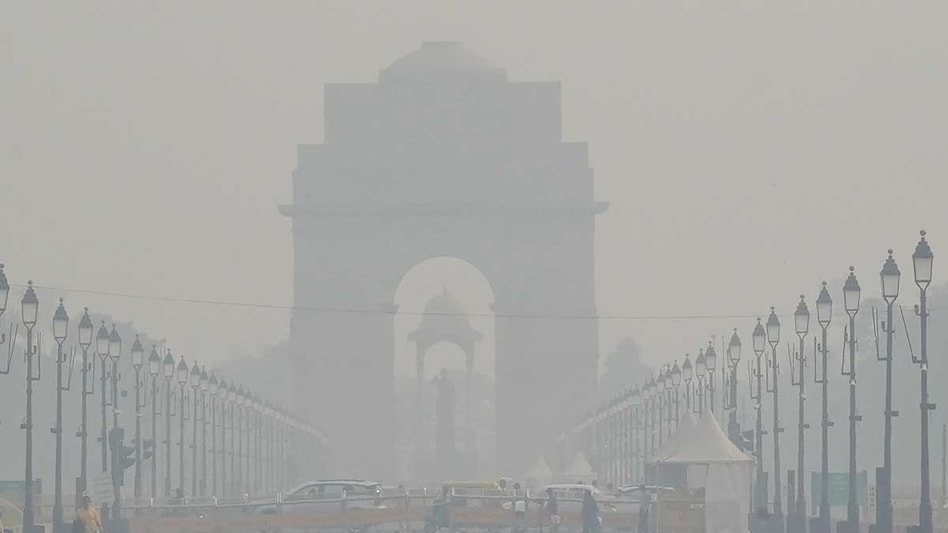
 The average AQI of Delhi stood at 278 today a slight improvement from Friday’s AQI of 292, according to the Central Pollution Control Board (CPCB).
  The average AQI of Delhi stood at 278 today a slight improvement from Friday’s AQI of 292, according to the Central Pollution Control Board (CPCB).
 Even though, winter days are still few weeks away from the national capital, the air quality over the region has already taken a big hit. At 8 am on October 20, majority of the areas were struggling to breathe as smog reduced visibility while increasing pollutant levels.
In the morning, most places in Delhi saw air quality levels in the ‘poor’ category at places like Patparganj (294), Nehru Nagar (258), JLN Stadium (212), Lodhi Road (219), Mandir Marg (222) and RK Puram (251), while Vivek Vihar and Shadipur had AQI recorded at 302 and 322, both in ‘very poor’ category. Anand Vihar had the worst AQI with a reading of 454, falling in the ‘severe’ category.
The average AQI of Delhi stood at 278 today a slight improvement from Friday’s AQI of 292, according to the Central Pollution Control Board (CPCB).
The daily bulletin from the CPCB, released at 4 pm on October 19, showed that Delhi’s air quality has remained ‘poor’ for the past four days. However, certain areas fared much worse.
Like in the past, Anand Vihar emerged as the most polluted neighbourhood in the NCR with its AQI shooting above 400 placing it in the ‘severe’ category. The air quality in Anand Vihar remained hazardous throughout the day, raising concerns for residents.
The Early Warning System (EWS) for Delhi, a forecasting model, predicted that air quality is expected to worsen over the coming days. “The air quality is likely to be in the very poor category from Sunday to Tuesday,” the bulletin noted. It also projected that “air quality will likely remain in the very poor to poor category” for the subsequent six days
The EWS bulletin further warned that unfavorable meteorological conditions are preventing the effective dispersion of pollutants, exacerbating the situation. “Additional emissions from sources such as stubble and waste burning are likely to deteriorate air quality significantly,” the system added.
According to IMD, the national capital is to witness clear skies over the next week, which offers little respite from the pollution that continues to blanket the city.
The first stage of the Graded Response Action Plan (GRAP) restrictions took effect Delhi on October 15 due to the worsening air quality, and measures such as frequent cleaning of roads with water to reduce dust are already underway.
Delhi Environment Minister Gopal Rai on Saturday warned that the air pollution situation could deteriorate further in the days ahead due to changing weather conditions. He said the Delhi government is doing everything it can to control dust pollution and urged cooperation from the residents.
“Approximately 2.5 lakh inspections have been conducted and anti-dust campaigns are in full swing across Delhi. Wherever violations are found, penalties are being imposed,” he said.
The minister will visit Anand Vihar, a major pollution hotspot, at 9 am today. During the last emergency meeting on pollution, the Delhi government had decided to control sources of spiking pollution at 13 hotspots.
The minister had earlier blamed Uttar Pradesh for sending diesel buses to Anand Vihar, contributing to a spike in pollution levels in the East Delhi locality.
He also said that fines totalling Rs 17.40 lakh were levied on those who violated dust control regulations, adding that the enforcement drive would be intensified from Sunday onwards.
 Why Swiggy wants to stop being called ‘foreign-controlled’
 This Vedanta Group stock is set to benefit from import duties on gold, silver
 SBI shares: Time to buy? After short-term correction, stock heads toward oversold zone
  Southwest monsoon likely to set in over Kerala on May 26: IMD
 Can sector rotation drive better returns? ICICI Prudential has a strategy
 "Drones Only Opening Act Of Robotic War", Says Air Marshal Ashutosh Dixit On Operation Sindoor
 LIVE | Sharda Cropchem Q4: Profit Jumps 56%, Margins Hit Multi-quarter High
 Is Fuel Price Hike Cycle Still On? OMCs Losses, Crude Shock And Rupee Weakness | What's Hot
 Fuel Price Shock Ground Report: Petrol & Diesel Hiked By ₹3 Across India Amid West Asia Crisis!
 Let Rupee Fall & Petrol Prices Rise To Fix India’s Economy: 16th Finance Chief Arvind Panagariya!
 Jaiprakash Power shares soar in fag-end trade amid heavy volumes; what analysts say
 BT Closing Bell | Sensex, Nifty snap two-day winning run; Tata Steel, Eternal lead index losers
 TD Power Systems shares rise 11% in the afternoon session today; here's why This Vedanta Group stock is set to benefit from import duties on gold, silver
 Why Solara Active Pharma Sciences shares surged 18% today