Johns Hopkins professor: India has seen enormous change in lower-caste representation in bureaucracy
Johns Hopkins professor: India has seen enormous change in lower-caste representation in bureaucracy
'We show that in government, public sector as well as in the bureaucracy - compared to what things were in the 50s and 60s - there is enormous change in representation,' says Devesh Kapur
Devesh Kapur, Professor of South Asian Studies at Johns Hopkins University
India has seen enormous change in caste representation across the bureaucracy and public sector over the decades, but senior-most positions remain harder to reach because officers from lower castes enter the system later, political scientist Devesh Kapur said during a discussion on his new book 'A Sixth of Humanity'.
Kapur, who has co-authored the book with former Chief Economic Advisor Arvind Subramanian, was speaking at a conversation with economist Rathin Roy at an event organised by Q Collective.
When Roy raised the question of whether caste continues to present a deep barrier to development - citing arguments around low representation at senior levels - Kapur said the book deliberately avoids being "obsessed with caste", treating it as "one of the cleavages".
"So, yes...it's true that the book is not obsessed with caste. We see it as one of the cleavages," Kapur said. He argued that the fixation on caste politics has often sidelined gender. "The obsession with caste has led to the other major sort of social cleavage in India, gender being put on the side."
Advertisement
He pointed to the first backward classes commission, which he said had argued that the first claim to reservation in India should be for women, a recommendation that was ignored. "All the major caste-based parties you will see have almost no female leaders," Kapur said. "You don't have to go to the Supreme Court. You have to ask the caste-based parties, 'where are your female leaders?'"
On the question of progress, Kapur said the situation had improved markedly over time. "Having said that, we make it clear that what we see in caste is that it has moved from terrible to bad, which is a significant improvement. But we have made no claims that it is good."
He said the data shows a clear change within government and the bureaucracy when compared with the early decades after Independence. "We show that in government as well as in the bureaucracy - compared to what things were in the 50s and 60s - there is enormous change in representation."
Advertisement
Addressing the specific issue of why very few officers from lower castes reach the rank of secretary in the government, Kapur, Professor of South Asian Studies at Johns Hopkins University, pointed to entry timing at the point of recruitment. "The reason why you don't have secretaries in the government of India, very few from the lower caste is that they join late," he said. He linked this to resistance to changes in age limits that were once justified but may now be outdated.
"The refusal of lower-caste parties to allow an age limit, which made sense in the 1970s when there were far fewer Dalit students in higher education," Kapur said, adding that "we show (in the book) that the number of Dalits in higher education has increased 45-fold since 1980. So the pool is much deeper and wider than it used to be."
The professor argued that higher age limits compress career spans at the top. "But if you insist on (higher age limit and more trials) there are fewer years, and we don't want to deal with that fact."
Under current rules, recruitment to civil services through the UPSC sets a minimum age of 21 years. General and EWS candidates have an upper age limit of 32 years, OBC candidates are allowed up to 35 years, while SC and ST candidates can apply up to 37 years - a structure that directly affects career length at the highest levels of government. The IAS officers typically require 30-33 years of service to reach the rank of Secretary.
Advertisement
Kapur argued that deep social inequalities have rarely been reduced through democratic processes alone. "If you ask this question about equality, let's step back. There's this great book by this Stanford historian that looks around the world on social inequalities and what were the factors that lead to an attenuation of social inequalities. It's never the democracy," he said.
"It's either what he calls the Four Horsemen. (It is) is either revolutions or natural catastrophes...or it is natural disasters of some sort...or of course wars. So if you really want what you're seeking for, I think you're pointing that either India needs to have a massive war or a massive revolution or India needs a massive natural catastrophe. Which of these three would you choose?
Turning to the roots of caste persistence, Kapur cited Dr BR Ambedkar, who he said identified occupation and marriage as the two mechanisms through which caste replicates itself. "What he saw was that modernity, rapid growth means you have entirely new caste-neutral occupations coming into the fore," Kapur said, arguing that growth weakens the caste–occupation link. But marriage remains the harder barrier. "Ambedkar was very clear. Unless marriage patterns change, it is impossible."
The professor pointed to survey data showing resistance across communities. "Every single caste, every single religion is opposed to intermarriage. Dalits are as opposed to intermarriage as Brahmans. Hindus are as opposed to intermarriage as Muslims." He also questioned whether the state could realistically intervene. "Do you think the state can force people to marry you?" he asked.
Advertisement
In the past few years, Rahul Gandhi, Leader of the Opposition in the Lok Sabha, has accused the Centre of presiding over low representation of lower castes in senior positions across the bureaucracy, judiciary, and the armed forces. He has repeatedly argued that elite institutions remain dominated by upper castes despite decades of affirmative action.
Saurabh Sharma is Senior Assistant Editor at Business Today Digital. He writes on the economy, policy, business, and politics. With over a decade in journalism, he has worked with The Financial Express, Mint, and Times Now.
At BT, he tracks Indian politics, global affairs, and the strategic rivalries shaping Washington, Moscow, and Beijing, with a focus on China, Pakistan, the Middle East, and Southeast Asia.
Away from the newsroom, he enjoys non-fiction, especially books on geopolitics, intelligence, and international relations.



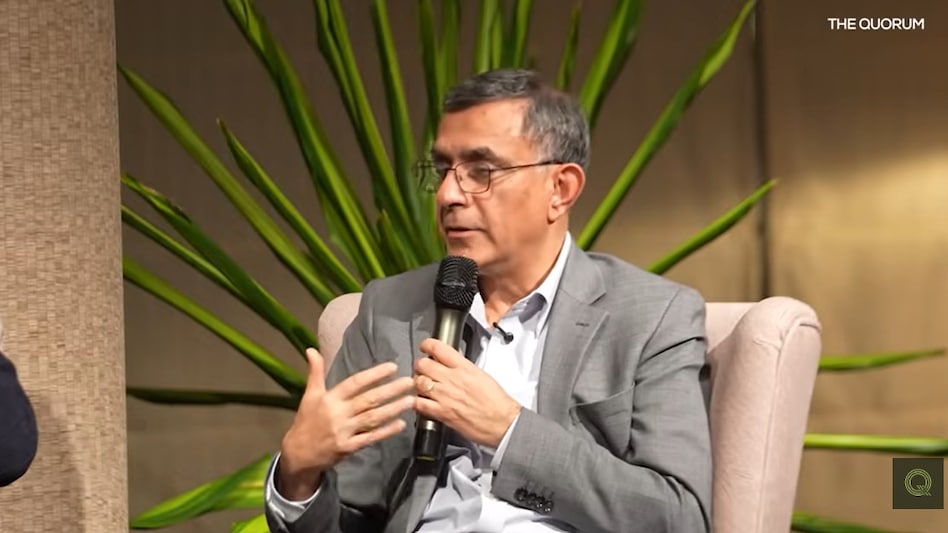 Devesh Kapur, Professor of South Asian Studies at Johns Hopkins University
 'AI ending humanity is nonsense': Ex-Infosys CEO Vishal Sikka rejects growing doom warnings
 'Majority among two is two': Tata Trusts says Chandrasekaran reappointment failed AoA condition, has no legal effect
 ICAI plans further reforms to scale up homegrown accounting firms
 'Modi admin has done a phenomenal job': Blackstone's Jon Gray on what changed in India
 'SC/ST Act is being weaponised': Tech CEO backs IIT Bombay Professor, calls for case withdrawal
 Gold Price Target 2026: Expert Sees MCX Gold At ₹1.8 Lakh By Year-End Amid Strong Demand
 Health Insurance: Why Pre-Existing Diseases And Waiting Periods Matter For Buyers
 Crude Oil Above $100: How High Energy Prices And Rupee Weakness Impact Gold Prices In India
 CEA On India’s Manufacturing Rise, Atmanirbhar Bharat And Modi’s Economic Policy
 Health Insurance Buying Guide: 7 Things First-Time Buyers Must Check Before Choosing A Policy
 SpaceX weight in Nasdaq 100 to jump to 2.82% following quarterly index rebalance: Report
 Tata Motors or Ashok Leyland? Analyst reveals his preferred auto stock for near-term gains
 Maharashtra Scooters, Dixon Tech, Bharat Dynamics, Jai Corp among stocks to turn ex-dividend on Monday
 Jindal Supreme, SS Retail, Hero Motors IPOs subscribed up to 181 times on final day; details here
 Sensex, Nifty post sixth weekly loss; TCS, Titan among top laggards, slip up to 4%
 Could AI really kill us all? Here’s what MIT researchers fear and what they don’t
 Major milestone: Rajasthan's 700 MWe nuclear reactor begins initial fuel loading, enters key commissioning stage
 IMD warns of extremely heavy rain as Bay of Bengal low-pressure system heads towards Andhra-Odisha coast












