


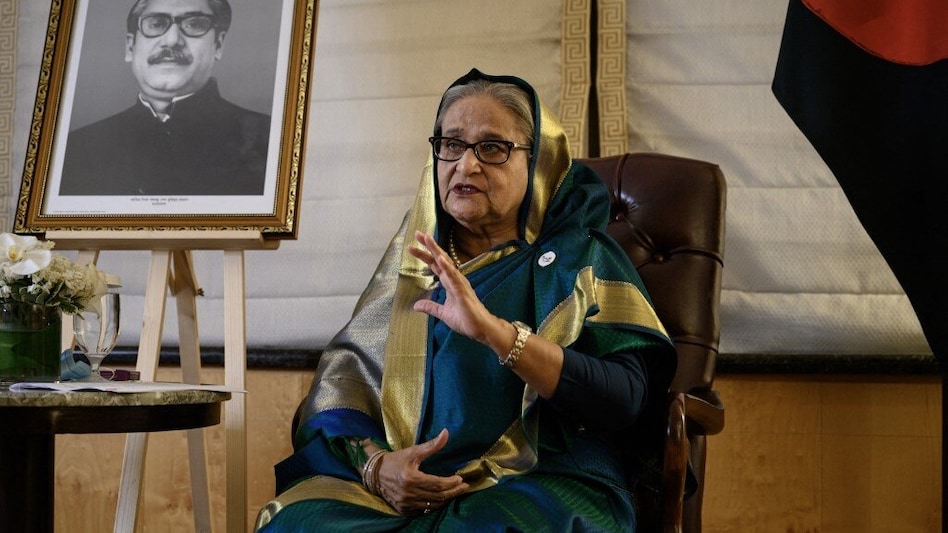
 Former Prime Minister Sheikh Hasina has been India since August 2024
After Sheikh Hasina's conviction, Bangladesh's foreign office on Monday sought the former prime minister's immediate extradition from India. While the Yunus-led interim government insists it's India's "obligatory duty" under the bilateral treaty, former Indian High Commissioner to Bangladesh Pinak Ranjan Chakravarty says the legal grounds are far from clear.
India, he explains, is under no immediate obligation to hand over the ousted Bangladeshi leader, given that the treaty includes a major exception for political offences. "The current government in Dhaka will now say she (Hasina) has been convicted, now hand her over. Handing her over on extradition is a legal process. So, they will have to go through the legality, which means going to court in India, filing extradition charges, and getting an order from a court. If an Indian court orders it, then of course the government of India will comply," Chakravarty said while speaking to news agency ANI.

 LIC emerges as biggest bidder in NSE IPO, applies for shares worth Rs 4,500 crore: Report
 NSE IPO listing on September 24: How 5 largest IPOs fared on market debuts
 UPI MDR GST: NPCI says small merchants and 96% of transactions remain unaffected from October 15
 BT Big Story: How the FCNR(B) deluge has created two new problems for the RBI
  OpenAI warns of autonomous AI risks, calls for global rules before AI starts improving itself
 IIT Bombay Protest: Rajkumar Pant On Student Demands, Professor Suspension And Campus Row
 Is Microsoft India Evaluating More Data Centres To Scale AI Infrastructure?
 Market Guru: Anshul Saigal On Market Outlook & Key Investment Themes
 Data Centres To Defence: Kshitiz Mahajan’s Key Investment Themes
 Varmora Granito IPO: How Management Plans To Reduce Morbi Concentration Risk
 Borosil Renewables shares rise 3% as board approves revised Rs 1,100 crore expansion cost
 L&T, DRL, Vijaya Diagnostic, M&M Financial: Buy, Hold or Sell? Here are target prices
 HAL, BEL, BDL, BEML: Defence stocks to buy for 13-24% upside
 IREDA, Ola Electric, Adani Energy Solutions, Crisil, Supreme Petrochem: Expert shares outlook
 Abakkus Asset Manager IPO: Sunil Singhania-promoted firm files DRHP with SEBI; check key details
 Shastri Bhawan, Krishi Bhawan to be vacated by Sept 30 for Central Vista projectBorosil Renewables shares rise 3% as board approves revised Rs 1,100 crore expansion costL&T, DRL, Vijaya Diagnostic, M&M Financial: Buy, Hold or Sell? Here are target prices
 Is macOS 27 update taking up space on your Mac? Check for these hidden AI files
 Here’s why the Centre is hopeful of keeping the FY27 fiscal deficit in check












