








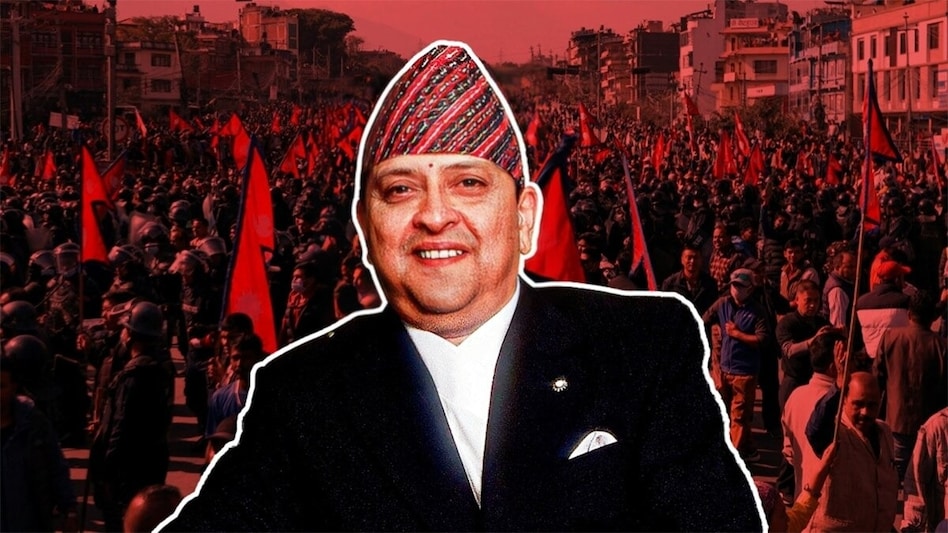
 Gyanendra ascended to the throne in 2002 after the death of King Birendra in 2001.
  Gyanendra ascended to the throne in 2002 after the death of King Birendra in 2001.
 Nepal is currently faced with its worst political unrest as student-led protests against a government ban on social media and demanding action against corruption clashed with security forces. The protests turned violent in no time, leaving at least 20 people dead and hundreds injured.
The protests and arson at the private residences of several top politicians prompted KP Sharma Oli to resign as the Prime Minister of Nepal. With this, the question is will former King Gyanendra Shah take over the reins of Nepal in these times of uncertainty?
While speaking to AajTak, many people favoured the return of the king. "Be it any government, they should work for the welfare of the public," a bystander said. Another bystander said: "Rajtantra chahiye (We want monarchy). We want the former King to return and take care of the people."
People said that the protests are no longer about the ban on 27 social media apps, but they are protesting against corruption and nepotism.
"The government is highly corrupt, youngsters are unemployed, and businessmen and youngsters are frustrated. All these leaders are 'chor' (thieves)," a citizen told AajTak. Calling it "dacoity in broad daylight", yet another citizen said that there is no system to help the public in need.
This, however, is not the first time that the Nepalese public has demanded the return of the monarchy. In March 2025, a huge crowd of more than 10,000 people gathered at the main entrance of the Tribhuvan International Airport in Kathmandu to catch a glimpse of the former King of Nepal, Gyanendra Shah, who returned after a 2-month stay in Pokhara.
The crowd raised slogans for the return of the 'Hindu Rasthra' and monarchy in Nepal. The crowd was heard raising slogans like 'Narayanhiti khali gar, hamro raja aunde chhan' (Narayanhiti/the king's palace, our king is coming); and 'Jai Pashupatinath, hamro rajalayi swagat chha' (Jai Pashupatinath, our king is welcome).
Many in Nepal have become frustrated with the democratic government due to political instability, a struggling economy, and widespread job losses and corruption.
During his stay in Pokhara, he visited over a dozen temples and pilgrimage sites and tried to gauge the mood of the public, as he wants to return to the political scene of Nepal. Not just this, the Rashtriya Prajatantra Party (RPP) is also supporting the former monarch and his demand for governance change in the Himalayan country.
The RPP believes that Hindu Rashtra and monarchy are complementary to each other in Nepal. This, however, is not the first time that the people of Nepal demanded the return of the monarchy that was abolished in the wake of similar protests around 2 decades back.
Moreover, thousands of people took to the streets, demanding the return of the monarchy. “Vacate the royal palace for the king. Come back, King, save the country. Long live our beloved king. We want monarchy,” the crowds chanted at the time.
But why was Gyanendra ousted in the first place? Gyanendra ascended to the throne in 2002 after the death of King Birendra in 2001. He ruled as the constitutional head of state without executive or political powers until 2005, before there were mass street protests seeking his ouster.
As the monarch, he disbanded the government and parliament, jailed politicians and journalists. Gyanendra also declared a state of emergency and used the army to rule Nepal. Not just this, he also ruffled feathers with political parties, which led to his downfall.
In April 2006, the seven-party alliance and the then-banned CPN Maoist led protests and strikes in Kathmandu against King Gyanendra’s direct rule, resulting in 23 deaths. Gyanendra announced he would hand over executive power to a new prime minister to restore democracy.
On 24 April 2006, he reinstated parliament in a televised address, appointing Girija Prasad Koirala as interim prime minister. By June 2007, Koirala, once a monarchy supporter, called for Gyanendra’s abdication in favour of Prince Hridayendra.
On 28 May 2008, Nepal abolished the monarchy, becoming a republic. Gyanendra vacated Narayanhiti Palace on 11 June 2008.
 India in discussions with Iran for safe passage of 20 oil tankers through Hormuz: Report
 Iran denies laying mines in Hormuz, warns nations backing 'aggression' won't get safe passage
 Iran's new Ayatollah says Hormuz must remain closed
 'It can't happen now': US Navy not ready to escort oil tankers through Hormuz
 From 20 mn barrels a day to a trickle: IEA says Hormuz closure is biggest oil supply disruption ever
 Rahul Gandhi Vs Hardeep Puri In Lok Sabha Over India’s Oil Security
 Induction Cooktop Sales Jump 300% In Delhi-NCR Amid LPG Supply Concerns
 Market Fall Deepens | Oil Hovers Near $100, Nifty Slips - Sanjay Sinha Explains What Next
 Market Crash Amid Oil Surge? Devang Shah Decodes | Live Market Commentary
 #Podcast | #Episode09 | From Bollywood Icon To Entrepreneur: Malaika Arora On Food, Fashion & Fitness
 Brent oil prices above $100 again after Khamenei signals Hormuz will stay shut
 NSE IPO: Leading exchange appoints 20 merchant bankers for its mega issue; check full list
 Sensex tumbles 2,171 pts, Nifty falls over 2% in 2 days; will stock market extend losses?
 Adani Power, Tata Power, Coal India shares jump up to 7%: Jainam Broking's Kiran Jani weighs in
 Iran war, oil-gas crisis: BHEL, Suzlon, Adani Power, Tata Power, AGEL among JM's top picks