









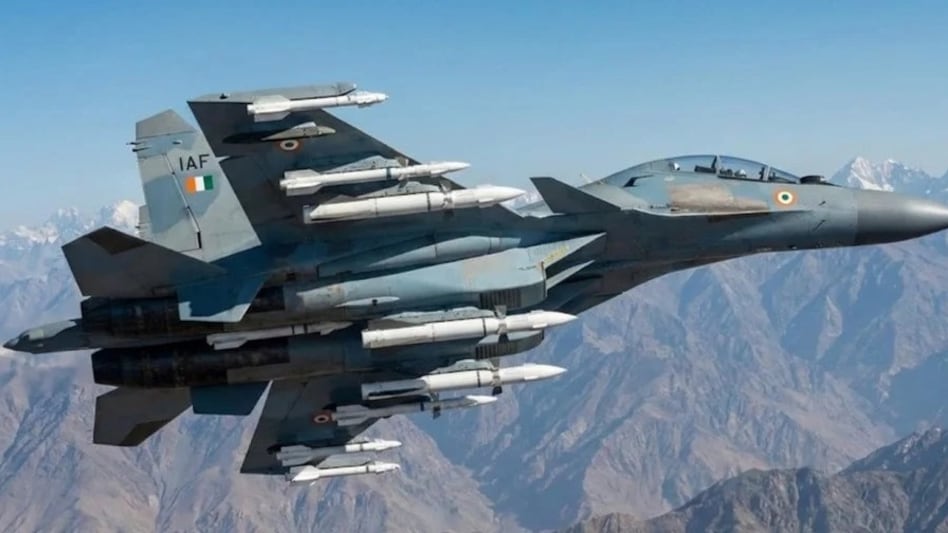
 Designed originally for Russian interceptor aircraft, the missile reportedly has a strike range between 300 km and 400 km and can travel at speeds exceeding Mach 6.

 Designed originally for Russian interceptor aircraft, the missile reportedly has a strike range between 300 km and 400 km and can travel at speeds exceeding Mach 6.
 As India marks the first anniversary of Operation Sindoor — the military campaign that began on May 3, 2025 — one lesson has become increasingly clear: long-range precision weapons now define modern warfare. From deep-strike operations to beyond-visual-range aerial engagements, missiles played a critical role during the conflict, reshaping military thinking around deterrence and air dominance.
Against that backdrop, India’s reported decision to procure 300 Russian R-37M long-range air-to-air missiles in a deal worth over $1.2 billion is being viewed as a major strategic upgrade for the Indian Air Force (IAF).
Must read | ‘Genius move’: India’s Rafale decoy play during Operation Sindoor earns rare praise from US pilot
The missiles are expected to arm the Su-30MKI fleet, the backbone of the IAF, significantly expanding the aircraft’s engagement range and strengthening India’s ability to counter advanced aerial threats from China and Pakistan.
What makes the R-37M so dangerous
The R-37M, known by NATO as the “AA-13 Axehead,” is among the longest-range operational air-to-air missiles in the world. Designed originally for Russian interceptor aircraft, the missile reportedly has a strike range between 300 km and 400 km and can travel at speeds exceeding Mach 6.
Unlike traditional fighter-to-fighter missiles, the R-37M is designed to eliminate high-value airborne assets such as AWACS surveillance aircraft, aerial refuelling tankers and electronic warfare platforms. These systems are vital to modern air operations because they coordinate attacks, extend radar coverage and support long-range missions.
Don't miss | Inside Operation Sindoor: How 5 strategic strikes redefined India’s counter-terror playbook
Military experts say the missile could allow Indian fighters to target enemy support aircraft from extreme distances, disrupting battlefield coordination before frontline aircraft engage directly.
Boost for the Su-30MKI
The missile acquisition is expected to dramatically enhance the combat relevance of the Su-30MKI fleet, which already forms the largest segment of India’s fighter inventory. Known for its heavy payload capacity and long endurance, the aircraft is particularly suited for carrying oversized long-range missiles like the R-37M.
The integration also complements ongoing upgrades to the fleet involving advanced radars, avionics and electronic warfare systems.
China-Pakistan factor
The deal comes amid growing concerns over Pakistan’s Chinese-supplied J-10C fighters armed with PL-15 beyond-visual-range missiles, as well as China’s development of even longer-range systems.
Don't miss | Operation Sindoor, drone procurement: India becomes world's 5th largest military spender at $92.1 billion
Defence analysts believe the R-37M provides India with a credible counter-capability while reinforcing deterrence by threatening enemy surveillance and tanker aircraft operating near contested airspace.
The acquisition also highlights India’s continued reliance on Russian-origin systems even as indigenous programmes like the Astra missile series evolve. For now, the R-37M offers India an immediate long-range solution in an increasingly missile-centric era of air warfare.
 India's monsoon runs on a double engine: The hidden weather tag team deciding where the rain falls
 Same 43°C temperature, different reality: Why Europe's heatwave is more brutal than India's
 'Think of yourselves like stocks': WhatsApp chief Kunal Shah's advice for youth - what he means
 Dixon Technologies shares: Four factors why JM Financial upgraded the EMS stock
  From engineers to product managers: Here's how much Anthropic pays, with salaries up to ₹13.02 crore
 HP EliteBook X G2a Review: An AI PC in 2026 With 64 GB RAM And A Price To Match
 China’s Modern Inequality System | Akshita Nandgopal Unpacks The Brutal Reality Of The Hukou System
 India Food Label Scam Explained By Sneha Mordani | FSSAI Issues Strict Action
 Should You Get Your Heart Check Before Gym? Sneha Mordani & Dr Devi Shetty Explain
 Biggest Water Dispute In Asia | India-Pakistan Indus Crisis Update
 Dixon Technologies shares: Four factors why JM Financial upgraded the EMS stock
  Coforge, KPIT Tech, Cyient among top IT stocks to buy for upto 44% upside amid AI recovery
 Infosys, Hindalco, Redington: How FPI-heavy stocks fared in June as outflows hit ₹53K crore
 Last chance next week to buy four Bajaj Group stocks for dividend; check payout, record dates
 Coforge, Mphasis, Persistent, LTIMindtree: Share price targets as IT stocks under pressure