









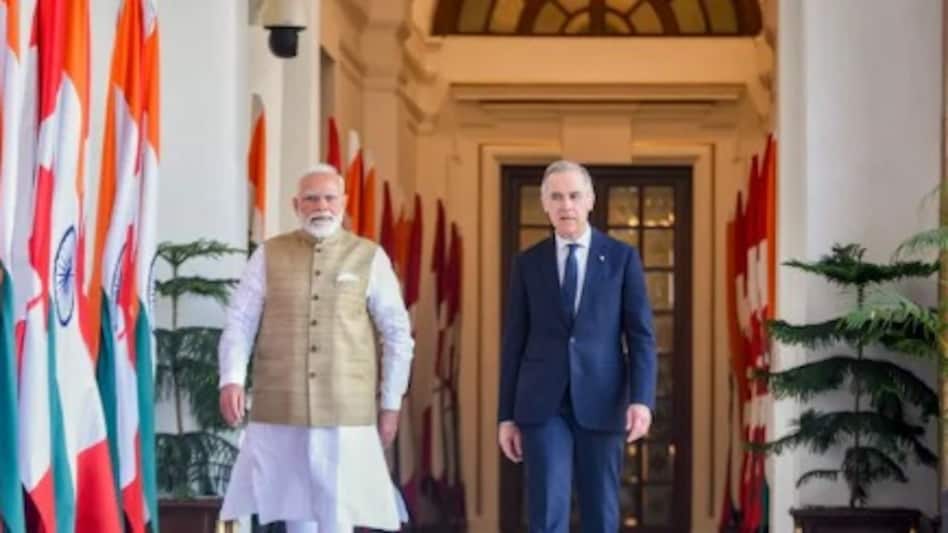
 The deal was finalised during the visit of Canadian Prime Minister Mark Carney to New Delhi, where he held talks with Prime Minister Narendra Modi.

 The deal was finalised during the visit of Canadian Prime Minister Mark Carney to New Delhi, where he held talks with Prime Minister Narendra Modi.
India and Canada, earlier this week, signed a long-term uranium supply agreement valued at approximately C$2.6 billion (around $1.9 billion), aimed at strengthening India’s civil nuclear energy programme.
Also read :Canada launches $100 mn scholarship programme for Indian students amid changing visa polices
Under the agreement, Canadian uranium major Cameco Corp. will supply nearly 22 million pounds of uranium ore concentrate to India between 2027 and 2035, ensuring long-term fuel security for Indian nuclear reactors.
The deal was finalised during the visit of Canadian Prime Minister Mark Carney to New Delhi, where he held talks with Prime Minister Narendra Modi.
Both sides also agreed to accelerate efforts to enhance bilateral economic engagement, setting a target to raise trade to $50 billion by 2030 and advance negotiations on a Comprehensive Economic Partnership Agreement (CEPA).
Officials in New Delhi described the uranium supply arrangement as a step toward ensuring stable and diversified fuel sources as India expands its nuclear power capacity to meet long-term clean energy goals.
Why Pakistan is upset
Pakistan has objected to the long-term uranium supply agreement between India and Canada, saying the arrangement could have "implications for regional stability" and the global non-proliferation regime.
Responding to media queries on Wednesday, Pakistan's foreign office spokesperson Tahir Andrabi said Islamabad had “noted with concern” the agreement on uranium supply and potential cooperation on small modular reactors and advanced nuclear technologies.
Describing the deal as a “country-specific exception” in civil nuclear cooperation, Andrabi said it was “particularly ironic” that India was being granted preferential access despite its 1974 nuclear test, conducted using plutonium from a reactor supplied by Canada for peaceful purposes — an event that led to the creation of the Nuclear Suppliers Group.
He said India “has neither placed all its civilian nuclear facilities under International Atomic Energy Agency safeguards nor undertaken any binding commitment to do so under this arrangement,” adding that several facilities remain outside international inspection.
He also questioned what “concrete non-proliferation assurances, if any,” accompany the agreement.
Raising strategic concerns, the spokesperson said assured external uranium supplies could free up India’s domestic reserves for military use, “enabling the expansion of its fissile material stockpiles” and accelerating the growth of its nuclear arsenal.
 HDFC Bank shares in focus as Rajiv Kumar named part-time Chairman
 ‘People ask why it’s taking so long’: Only 1% negotiations left for India-US trade deal, says Sergio Gor
 'We will cut off those hands': Pakistan minister threatens India over Indus water row
 Using Indane, Bharat Gas or HP Gas? These rules could affect your bill & connection from July 1
 Top stocks in news: HDFC Bank, RITES, YES Bank, Concor, Axis Bank, SW Solar, Afcons Infra
 Why Jio BlackRock AMC Is Launching Hybrid Long-Short As It's First SIF
 Delhi Unveils ₹15,000 Crore EV Policy: What It Means For Auto Companies And Consumers
 Gold, Silver Or Crude? Where Should Investors Bet Now? | Vandana Bharti
 How India Strategically Managed LPG & Crude Oil Supplies During West Asia War | K. Surana Explains
 Delhi’s Green Revolution: CM Rekha Gupta Unveils Massive ₹15,000 Crore EV Policy To Combat Pollution
 BT Opening Bell | Sensex, Nifty open in green; Maruti, Axis Bank, Sun Pharma top gainers
  Adani Power, NTPC, ACME Solar shares among Antique's top power sector picks
 YES Bank stock in focus as board approves Rs 16,000-crore fundraising plan
  Adani Ports shares in focus: APSEZ to sell 49% stake in AVPPL to MSC Group for $1.4 billion
 Nifty monthly expiry today: Kotak Securities suggests this options strategy; check details