


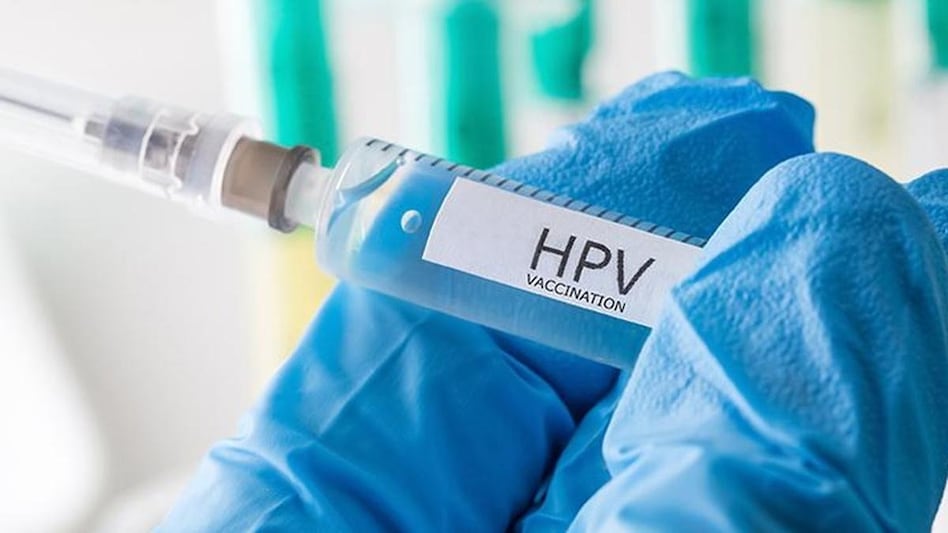
 Prime Minister Narendra Modi launched the campaign from Ajmer, targeting approximately 1.15 crore 14-year-old girls annually across States and Union Territories.
 The Central government’s rollout of vaccination against cervical cancer on Saturday opened a public procurement opportunity for vaccine manufacturers, with the Serum Institute of India (SII) indicating that its made-in-India Human Papillomavirus (HPV) vaccine will be supplied to the Universal Immunisation Programme (UIP) this year.
Prime Minister Narendra Modi launched the campaign from Ajmer, targeting approximately 1.15 crore 14-year-old girls annually across States and Union Territories. The vaccine will be administered free of cost at government health facilities during a three-month special drive before being included in routine immunisation services.
A day before the launch, Serum Institute of India CEO Adar Poonawalla wrote on X: “It’s heartening to see the Government of India and @MoHFW_INDIA roll out the HPV vaccine to help prevent cervical cancer in young girls and women. HPV vaccines have a strong safety and efficacy record globally. @SerumInstIndia will also be making a made-in-India HPV vaccine available very soon this year for the UIP.”
The Union Health Ministry said the national programme will use Gardasil, manufactured by Merck & Co., a quadrivalent vaccine protecting against HPV types 16 and 18, which cause cervical cancer, as well as types 6 and 11. Supplies have been secured through a procurement mechanism supported by GAVI, the Vaccine Alliance.
Cervical cancer is the second most common cancer among women in India. According to GLOBOCAN 2022 data, the country reports more than 1.2 lakh new cases and nearly 80,000 deaths annually. Persistent infection with high-risk HPV types, particularly 16 and 18, accounts for over 80% of cervical cancer cases in India.
Until now, HPV vaccination in India was largely confined to the private market, where uptake remained limited due to pricing and uneven state-level implementation. Inclusion under the UIP establishes an annual target base of around 1.15 crore girls, creating recurring demand through central procurement.
Assured Volumes Under UIP
The scale of the rollout translates into a meaningful procurement pipeline. With the World Health Organization (WHO) endorsing a single-dose schedule for girls aged 9–20 years, the steady-state annual requirement broadly aligns with the target cohort of around 1.15 crore doses. UNICEF’s published HPV vaccine price data show international procurement prices ranging from about $2.90 per dose (approximately ₹240) for lower-cost manufacturers to around $13.50 per dose (approximately ₹1,120) for Merck & Co.’s Gardasil in certain markets.
Applying these benchmarks to India’s annual target cohort suggests a potential procurement range of roughly $33 million (approximately ₹275 crore) to $155 million (approximately ₹1,290 crore) annually, depending on the supplier mix and contracted price.
Dr Naveen Thacker, Executive Director, International Pediatric Association, said achieving and sustaining high coverage will be crucial as the programme scales nationally. “The momentum must be maintained by the government. Consistency in implementation and procurement planning will be important,” he said. “The government’s decisions are guided by available scientific evidence. Gardasil has accumulated safety data across more than 150 countries over many years, and data for Serum’s vaccine is being generated actively. It is a good decision to introduce HPV vaccination at this scale, and continued evidence generation will further strengthen the programme.”
Thacker said India could draw lessons from countries that have already implemented large-scale immunisation programmes. “The HPV vaccine is safe, effective and protective against cervical cancer. Vaccinating girls aged 14 years offers the highest benefit because this age group develops a stronger immune response compared to older age groups. India should take examples from countries where sustained vaccination has led to reductions in HPV infection and cervical disease,” he said.
He added that clear communication would be essential in addressing hesitancy in certain segments. “There is some hesitancy around the HPV vaccine, largely due to misinformation. Clear messaging on safety and long-term protection is essential.”
Global Players and Domestic Entry
Globally, HPV vaccines are manufactured by Merck & Co., which produces the Gardasil portfolio; GlaxoSmithKline, which markets Cervarix; and a growing group of manufacturers including China’s Innovax and Walvax. In India, the Serum Institute of India markets Cervavac, a quadrivalent HPV vaccine. Cervavac is currently available in the private market with an MRP of ₹2,000 per unit, with effective retail prices ranging between ₹1,200 and ₹1,700 per dose. Industry data indicate that Merck & Co.’s Gardasil portfolio accounts for a significant share of global HPV vaccine revenue, supported by long-standing national immunisation tenders and established uptake in developed markets.
According to a report by IMARC Group, the India HPV vaccine market was valued at approximately USD 0.28 billion (approximately ₹2,320 crore) in 2024 and is projected to reach around USD 1.05 billion (approximately ₹8,715 crore) by 2033, driven by expanding immunisation coverage and the entry of lower-cost domestic products such as Cervavac. Separately, estimates by Global Market Insights place the global HPV vaccine market at about USD 5.4 billion (approximately ₹44,820 crore) in 2024.

 US tariffs did little to lower export prices, shifted imports to cheaper, lower-quality goods: IMF paper
 India's top private banks defy West Asia shadow with strong Q1 credit growth. Here's why
 Govt warns departments against delays in NPS contributions; employees must get PPF-linked interest on late credits
 'Ready for...': Delhi CM says restaurants, cafes to stay open until 4am for FIFA World Cup 2026 final
 HDFC Bank Q1 results: Net profit rises 5% to Rs 19,060 crore; NII up 6.7%; key takeaways
 Trump Threatens Iran’s “Pickaxe Mountain”: Why This Nuclear-Linked Bunker Is Hard To Hit
 India Launches SHANTI Campaign For 2028-29 UNSC Seat As EAM Jaishankar Makes Global Reform Pitch
 Will BJP Project Yogi Adityanath As Its U.P. CM Face For 2027? Speculation Grows
 Sneha Mordani Ground Report: Can New Rules Stop Misuse Of High-Alcohol Medicines?
 Why FIIs Aren't Returning To India Yet | Punita Kumar Explains The Real Challenges
 RIL Q1 results: O2C recovery drives broadly in-line quarter, says Equirus Securities
 IDBI Bank Q1 results: Net profit rises 5% to Rs 2,115 crore; NIM falls 54 bps QoQ
  Adani Ports: Post 30% rally in six months, more upside likely for the Adani Group stock?HDFC Bank Q1 results: Net profit rises 5% to Rs 19,060 crore; NII up 6.7%; key takeaways
 ICICI Bank Q1 results: Net profit rises 15.9% to Rs 14,805 crore; asset quality stays stable









