








 Nearly 4,000 business and HR leaders across 26 territories and from organisations across diverse sectors participated in the global survey conducted by PwC India.
 Nearly 4,000 business and HR leaders across 26 territories and from organisations across diverse sectors participated in the global survey conducted by PwC India.
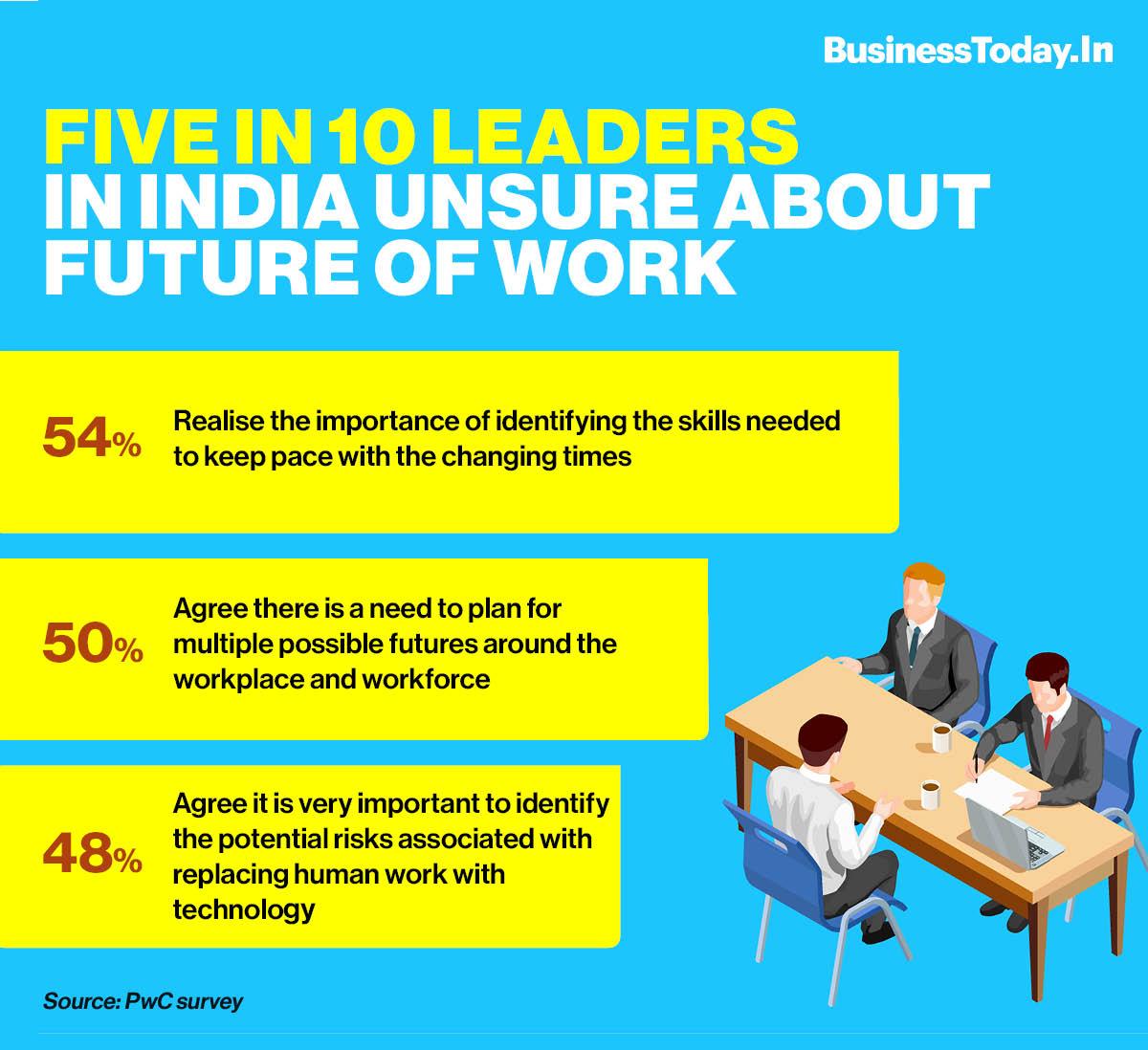
Five in 10 leaders in India concur that there is a need to plan for multiple possible futures around the workplace and workforce, but cost pressure and the fear of setting a precedent holds them back from taking action, finds a survey by PwC India.
Titled 'People and Culture First: Transformation journey in the future of work', the report further finds that 48 per cent agree it is very important to identify the potential risks associated with replacing human work with technology but are reluctant to create a culture of transparency.
Meanwhile, 54 per cent realise the importance of identifying the skills needed to keep pace with the changing times.
Also Read: How Covid-19 Has Changed the Concept of Work, Workplace and Workforce
However, they are reluctant to take action owing to competing priorities. India leaders increasingly agree that the workplace - which in the past was for the people - has now evolved into a workspace of the people and that the future will entail further reimagining of the workforce and work model.
Aligning individual goals to organisational purpose has now become all the more critical with the pivotal role it plays in driving organisational growth in a hybrid world.
Despite this realisation, cost pressures, competing investments or priorities, lack of systems and data, and organisational culture are the biggest inhibitors faced by India leaders in creating a more fit for future workplace, according to the survey.
It also reveals that the future of work involves tapping into talent virtually in Tier-2 and Tier-3 cities on the one hand, and leveraging the gig economy on the other.
"Earlier workforce challenges centred around broader areas of organisational design and capabilities woven in with organisational culture. But with the changing nature of the workplace, the challenges seem to be more employee driven, both globally and locally. At this juncture, it is important for all organisations across the world to prioritise leadership capabilities in order to orchestrate changes and move the needle in business," noted Chaitali Mukherjee, partner and leader, people & organisation and HR transformation, PwC India.
Also Read: Firms see hybrid work curtailing office space expansion
Over the past two years, the pandemic has compelled leaders to question their choices on many aspects affecting their organisations, right from people to culture to technology.
They have realised that along with strategic organisational intent and system optimisation, they also need to proactively act on workforce initiatives, build capability in a well-considered way, and, among other things, work towards making their culture more resilient in order to be future-ready.
Nearly 4,000 business and HR leaders across 26 territories and from organisations across diverse sectors participated in the global survey, of which 210 leaders were from India.
 India-US interim trade agreement: 'No GM modified product allowed, agri sector protected,' says Piyush Goyal
 'Decided to give 0% tariff on some cancer medications, neuro treatment': Piyush Goyal on what US got
 Cyberattack impact on Tata Motors PV earnings crosses Rs 3,200 crore; losses still mounting
 'Strengthens supply chains against China, support Rupee stability': Amitabh Kant says tariff cut to 18% gives India edge in US market
 Inside the India-US interim trade agreement: Reciprocal tariffs on India to come down to 18%, 0% duty on generic pharma
 RBI Says Trade Deals With EU, US & Others Strengthen India’s External Sector Outlook
 Jeffrey Sachs Praises Modi On India-US Trade Deal: “Trump Blinked, India Must Not Depend On U.S.”
 Agra’s ₹127 Cr Housing Project In Ruins: Flats For Poor Rot Before Occupation
 RBI Credit Policy LIVE Analysis | Aditya Pagaria Explains Rate Pause Impact
 TeamLease Q3 Results: Profit Jumps 47% As Margins Improve Despite Headcount Loss
 IDBI Bank stake sale: Kotak Mahindra Bank says ‘has not submitted a financial bid’
 BDL, Mazagon Dock, MRF, Hindustan Copper, RVNL, others to turn ex-dividend next week
 Q3 results: HAL, Titan, M&M, HUL, ONGC, Lenskart to post earnings next week; check dates
 'Think about it': Deepak Shenoy warns indices mask stress as majority of Nifty 500 stocks lag
 Bitcoin avoids $60,000 breakdown, still down over 50% from record high