








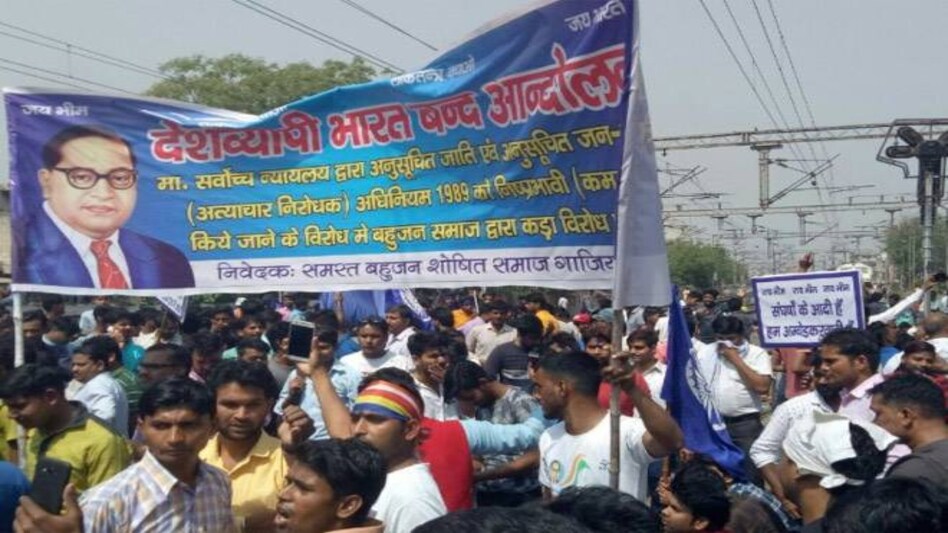
Protesting against a Supreme Court ruling that allegedly dilutes a law for people from scheduled caste and scheduled tribe, Dalit organisations across the country have today called for a Bharat Bandh. From Uttar Pradesh to Punjab to Gujarat, the effect of the nationwide strike is widespread as thousands of protesters have blocked various national highways.
In Uttar Pradesh, the dalit protestors blocked Delhi-Dehradun highway and torched several vehicles, leaving thousands stranded on roads. UP CM Yogi Adityanath has appealed to the people to maintain law and order. He said: "The central and state governments are dedicated towards the welfare of backward castes, SCs and STs. I appeal to all to not disturb the law and order. If at all there are any issues you can bring them to government's notice."
Something similar is happening in other north-Indian states: Rajasthan and Punjab. In Rajasthan, the protestors set several vehicles on fire in Barmer and blocked roads in Bharatpur. Protesters stopped trains in Jaipur. One person killed in police firing in Rajasthan's Khairthal.
In Punjab, angry protesters blocked Pathankot-Amritsar national highway and stopped trains in Firozpur and Patiala. Taking precautionary measures, the Punjab government on Sunday decided to suspend the services of public transport across the state. It also ordered suspension of services on mobile internet, besides all SMS services and dongle services provided on mobile networks except voice calls from 5 pm (Sunday) until 11 pm (Monday).
In Madhya Pradesh, the protestors resorted to stone pelting in Bhind. In MP, four people died during protests. The state government has imposed curfew in parts of Gwalior and Sagar.
The whole issue started after a two-judge bench of the Supreme Court on March 20 diluted certain provisions of the stringent Scheduled Castes and the Scheduled Tribes Prevention of Atrocities Act and said that there shall be no immediate arrest on any complaint filed under the law. It said that before arresting a public servant under the Act, a preliminary probe by an officer not below the rank of deputy superintendent should be conducted.
The apex court's order came after it found rampant misuse of the SC/ST Act against government servants. However, the verdict did not go well with several Dalit organisations who called the move 'anti-Dalit' and asked the centre to take a stand and file a review petition. They fear that diluting the law will result in rising crime against SCs and STs.
Earlier in the day, Union Law Minister Ravi Shankar Prasad informed that the Central government filed a comprehensive review petition on the Supreme Court's order. Last week, a delegation of NDA's SC and ST MPs and Union Social Justice Minister Thawarchand Gehlot had met Prime Minister Narendra Modi to discuss the apex court's judgement. Gehlot recently wrote to Prasad, informing him that there were concerns that the order would make the law ineffective and adversely impact dispensation of justice to Dalits and tribals.
With inputs from PTI
 Inside the India-US interim trade agreement: Reciprocal tariffs on India to come down to 18%, 0% duty on generic pharma
 BDL, Mazagon Dock, MRF, Hindustan Copper, RVNL, others to turn ex-dividend next week
 Q3 results: HAL, Titan, M&M, HUL, ONGC, Lenskart to post earnings next week; check dates
 India, US to boost trade in GPUs, advanced tech under interim pact framework
 India-US interim trade pact: From diamonds to silk — Full list of products under 18% tariffs
 RBI Says Trade Deals With EU, US & Others Strengthen India’s External Sector Outlook
 Jeffrey Sachs Praises Modi On India-US Trade Deal: “Trump Blinked, India Must Not Depend On U.S.”
 Agra’s ₹127 Cr Housing Project In Ruins: Flats For Poor Rot Before Occupation
 RBI Credit Policy LIVE Analysis | Aditya Pagaria Explains Rate Pause Impact
 TeamLease Q3 Results: Profit Jumps 47% As Margins Improve Despite Headcount Loss
 BDL, Mazagon Dock, MRF, Hindustan Copper, RVNL, others to turn ex-dividend next weekQ3 results: HAL, Titan, M&M, HUL, ONGC, Lenskart to post earnings next week; check dates
 'Think about it': Deepak Shenoy warns indices mask stress as majority of Nifty 500 stocks lag
 Bitcoin avoids $60,000 breakdown, still down over 50% from record high
  NSE IPO: NSE board approves long-delayed listing plans; IPO to have equity shares of face value Re 1