












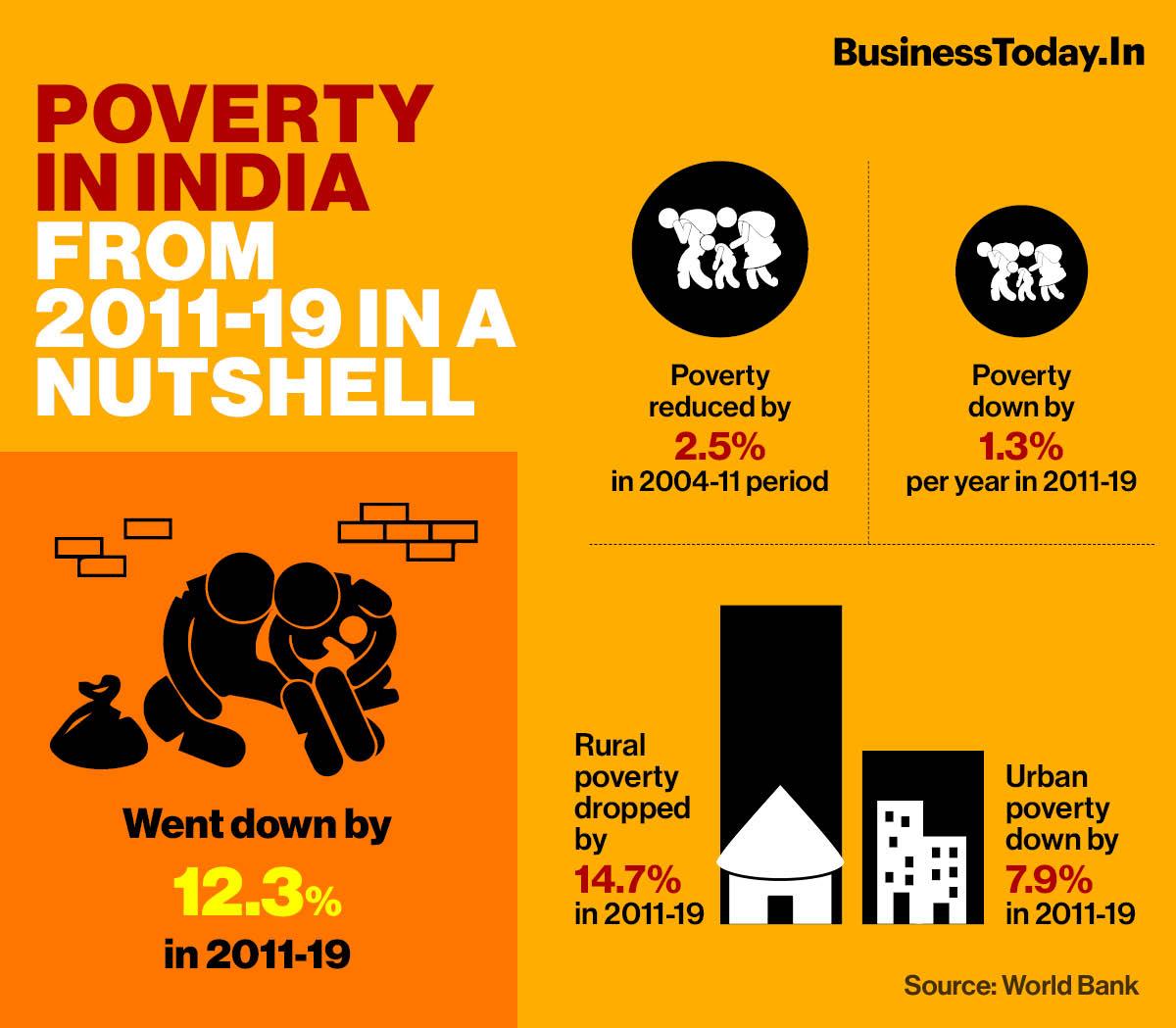



 The paper further claimed that by the authors' estimates, poverty has declined by an average of 1.3 percentage points per year between 2011 and 2018.
Extreme poverty has gone down by 12.3 percentage points between 2011-2019, a rate significantly lower than that of the 2004-2011 period. Poverty headcount rate dropped from 22.5 per cent in 2011 to 10.2 per cent in 2019 with more pronounced deductions in rural areas compared to urban areas, according to a recent World Bank working paper.
The paper -- titled ‘Poverty in India has declined over the last decade but not as much as previously thought’ and authored by Sutirtha Sinha Roy and Roy van de Weide -- posited that the “rate of poverty reduction between 2004 and 2011 is estimated at approximately 2.5 percentage points per year. After 2011, poverty reduction has slowed down."

 SEBI settles proceedings linked to Hindenburg report against 5 Adani firms for ₹1.51 crore
 'No positive response on 5-day banking': Bank unions to go ahead with 3-day strike
 LIC emerges as biggest bidder in NSE IPO, applies for shares worth Rs 4,500 crore: Report
 NSE IPO listing on September 24: How 5 largest IPOs fared on market debuts
 UPI MDR GST: NPCI says small merchants and 96% of transactions remain unaffected from October 15
 Family Disputes Can Hold Businesses Back: Nirmala Sitharaman’s Message To Family Firms
 TRAI New Rules: Voice-SMS Only Plans Mandatory | What It Means For 20 Crore Non-Data Users
 Oil & Gas Capex Boom: Anshul Saigal Names Energy Stock He Owns | Saigal Capital Advisors
 Small Caps Too Expensive? Anshul Saigal On Valuations, Earnings & Upside
 Markets Going Nowhere? Anshul Saigal On The Opportunity For Stock Pickers
 Sansera Engineering shares rise 7%; Goldman Sachs raises target; sees further upside
 US-Iran talks today? Oil slips to $98 a barrel; will Sensex, Nifty rebound?
  Borosil Renewables shares rise 3% as board approves revised Rs 1,100 crore expansion cost
 L&T, DRL, Vijaya Diagnostic, M&M Financial: Buy, Hold or Sell? Here are target prices
 HAL, BEL, BDL, BEML: Defence stocks to buy for 13-24% upside
 All You Need To Know About Varmora Granito IPO
 Railway tickets above ₹2,000: The ₹5 UPI charge passengers may never see
 JSW Group Enters Electric Commercial Mobility With AMPSTAR Bus And Truck Brand In India
 Multibagger Smallcap Stock TARIL Turns Rs 1 Lakh Investment To Near Rs 60 Lakh!'No positive response on 5-day banking': Bank unions to go ahead with 3-day strike


