









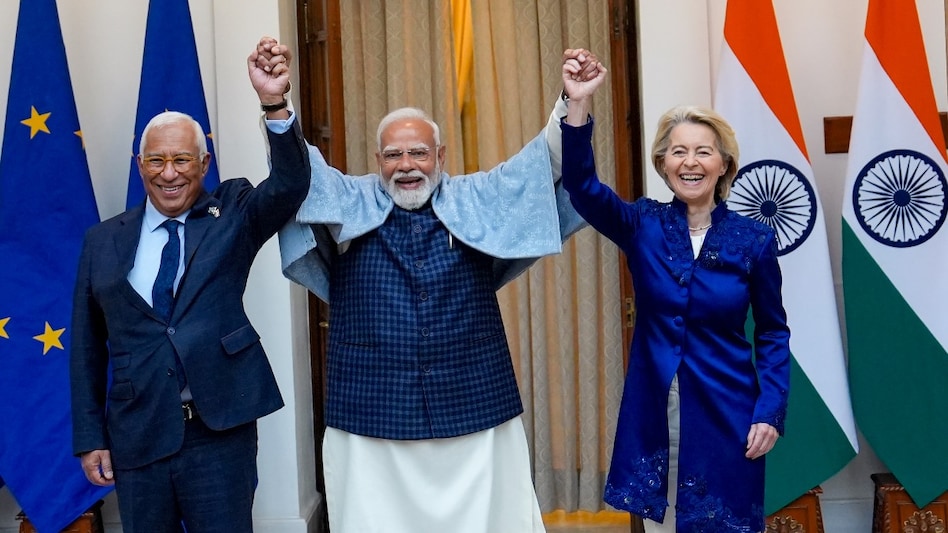
 India-EU FTA: Brahma Chellaney says the trade deal is not merely a commercial pact

 India-EU FTA: Brahma Chellaney says the trade deal is not merely a commercial pact
Amid trade wars and power coercion, New Delhi and Brussels have decided not to retreat as they sign the ‘mother of all deals’, the India-European Union Free Trade Agreement (FTA), said geostrategist Brahma Chellaney.
“Bottom line: In an age of trade wars and great-power coercion, New Delhi and Brussels have chosen not retreat but alignment. This agreement elevates the India–EU relationship from a transactional arrangement into a strategic anchor of the 21st-century global order, centered on a shared project of economic resilience, strategic autonomy and geopolitical balance,” said Chellaney.
He added that this is not merely a commercial pact, but is a strategic insurance that positions the EU and India as a democratic counterweight to China’s state-centric trade model while also blunting Trump’s weaponising tariffs.
Chellaney elaborated that India seeks to reduce overreliance on both the US and China over “chronic tariff uncertainty”. “For the EU, it secures a durable foothold in the world’s fastest-growing major economy and advances Brussels’ drive to de-risk critical supply chains,” he said, adding that the deal also signals a turn toward deeper maritime cooperation.
INDIA-EU FTA
Tariffs on over 90 per cent of EU goods exports to India would be eliminated or reduced in the wide-ranging India-EU FTA. The EU has projected duty savings of up to €4 billion per year on European products once the changes are implemented.
Core sectors that are set to benefit from the India-EU FTA include machinery, chemicals, and pharmaceuticals, with duties of up to 44 per cent on machinery, 22 per cent on chemicals, and 11 per cent on pharmaceuticals mostly eliminated. The chemicals segment, in particular, stood out, as tariffs on its chemicals will be eliminated for almost all products.
Other key industries to see substantial tariff reductions are medical equipment and aerospace. The EU states tariffs on optical, medical, and surgical equipment will be eliminated for 90 per cent of products, which could affect the pricing and availability of imported devices in hospitals and clinics. Tariffs on aircraft and spacecraft would be eliminated for almost all products.
The agreement also covered the automotive and food sectors. Car tariffs will gradually come down to 10 per cent, with a quota of 2,50,000 vehicles per year. For consumer goods, duty cuts would include olive oil, margarine, and vegetable oils. Tariffs on EU beer will be cut to 50 per cent, and there will be a duty cut of about 20-30 per cent on EU wine.
On services and climate, the EU will get privileged access to India for service providers in financial and maritime sectors. Additionally, €500 million in EU support over the next two years is planned to help India cut greenhouse gas emissions. The EU expects the deal to double its exports to India by 2032.
 Delhi EV policy 2026: Should you buy these premium electric SUVs & MPVs under ₹30 lakh?
 Big news for commercial petrol, diesel buyers: India lifts emergency curbs on retail sales from July 1
  'Never seen so many tankers': India's Russian crude imports may hit record high in June
 Delhi EV Policy 2026 Explained: What's changing for car, bike and auto buyers
 Why Jio BlackRock feels hybrid long-short is the perfect fund to launch now as it enters the SIF space
 Why Jio BlackRock AMC Is Launching Hybrid Long-Short As It's First SIF
 Delhi Unveils ₹15,000 Crore EV Policy: What It Means For Auto Companies And Consumers
 Gold, Silver Or Crude? Where Should Investors Bet Now? | Vandana Bharti
 How India Strategically Managed LPG & Crude Oil Supplies During West Asia War | K. Surana Explains
 Delhi’s Green Revolution: CM Rekha Gupta Unveils Massive ₹15,000 Crore EV Policy To Combat Pollution
 Why Jio BlackRock feels hybrid long-short is the perfect fund to launch now as it enters the SIF space
 Where should investors put their money? PL Wealth CEO has some tips
  Axis Bank CFO Puneet Sharma steps down; stock likely in focus on Tuesday
 Apollo Hospitals, Medanta, Healthcare Global, Max Healthcare, Artemis Medicare: Check target prices, outlook
 Polycab: Amid record FII buying, shares at all-time high but brokerages expect more upside