








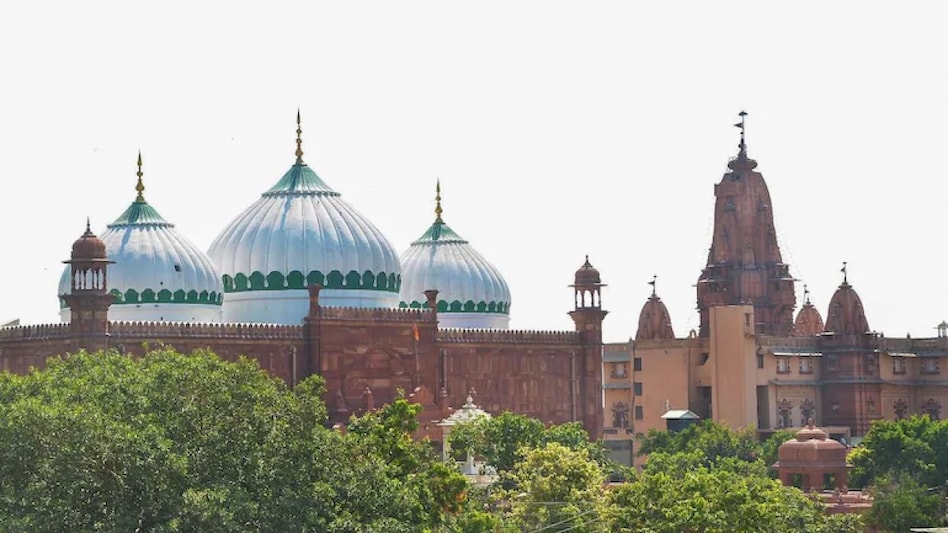
 According to the petitioners, the Shahi Idgah mosque was built at the Krishna Janmabhoomi on the orders of Mughal emperor Aurangzeb in 1669-70.
 According to the petitioners, the Shahi Idgah mosque was built at the Krishna Janmabhoomi on the orders of Mughal emperor Aurangzeb in 1669-70.
The district court in Mathura on Thursday has allowed a lawsuit demanding the removal of the Shahi Idgah mosque in Mathura that is claimed to be built on the “Krishna Janmabhoomi” or the birthplace of Lord Krishna.
The Krishna Janmabhoomi complex spans 13.37 acres.
According to the petitioners, the Shahi Idgah mosque was built at the Krishna Janmabhoomi on the orders of Mughal emperor Aurangzeb in 1669-70.
Lucknow resident Ranjana Agnihotri had filed the lawsuit as the 'next friend of the infant Lord Krishna' of the Katra Keshav Dev temple.
The ruling by District and Sessions court means that the civil suit will be heard by a lower court. The courts will look into revenue records and judge the validity of a 1968 ‘compromise agreement’ between Shri Krishna Janmasthan Seva Sansthan--- the temple management authority and a registered society under law and the Trust Masjid Idgah. The temple trust claim that the compromise is not valid because the trust holds the land and the temple management authority cannot enter into a compromise, according to Bar and Bench.
The Shri Krishna Janmabhoomi Trust was established in 1958.
Earlier, the Mathura court had dismissed the Krishna Janmabhoomi suit because a large number of worshippers may approach the court in barious similar cases.
The civil court in Mathura had earlier dismissed the case saying it cannot be admitted under the Places of Worship Act of 1991, which maintains that the religious status of any place of worship as it was on August 15, 1947. The only exception to the law was the Babri mosque case which was partially destoyed in 1992 by Hindu activists who believed it was built on the ruins of an ancient temple.
The Supreme Court in 2019 handed over the mosque site to Hindus for a grand Ram temple and ordered alternative land for a mosque.
(With inputs from India Today)
 'Strengthens supply chains against China, support Rupee stability': Amitabh Kant says tariff cut to 18% gives India edge in US market
 Inside the India-US interim trade agreement: Reciprocal tariffs on India to come down to 18%, 0% duty on generic pharma
 From ‘embarrassing’ to impressive: Top Silicon Valley VC calls Sarvam praises Indic AI breakthroughs
 India-US interim trade pact: From diamonds to silk — Full list of products under 18% tariffs
 IDBI Bank stake sale: Kotak Mahindra Bank says ‘has not submitted a financial bid’
 RBI Says Trade Deals With EU, US & Others Strengthen India’s External Sector Outlook
 Jeffrey Sachs Praises Modi On India-US Trade Deal: “Trump Blinked, India Must Not Depend On U.S.”
 Agra’s ₹127 Cr Housing Project In Ruins: Flats For Poor Rot Before Occupation
 RBI Credit Policy LIVE Analysis | Aditya Pagaria Explains Rate Pause Impact
 TeamLease Q3 Results: Profit Jumps 47% As Margins Improve Despite Headcount Loss
 IDBI Bank stake sale: Kotak Mahindra Bank says ‘has not submitted a financial bid’
 BDL, Mazagon Dock, MRF, Hindustan Copper, RVNL, others to turn ex-dividend next week
 Q3 results: HAL, Titan, M&M, HUL, ONGC, Lenskart to post earnings next week; check dates
 'Think about it': Deepak Shenoy warns indices mask stress as majority of Nifty 500 stocks lag
 Bitcoin avoids $60,000 breakdown, still down over 50% from record high