


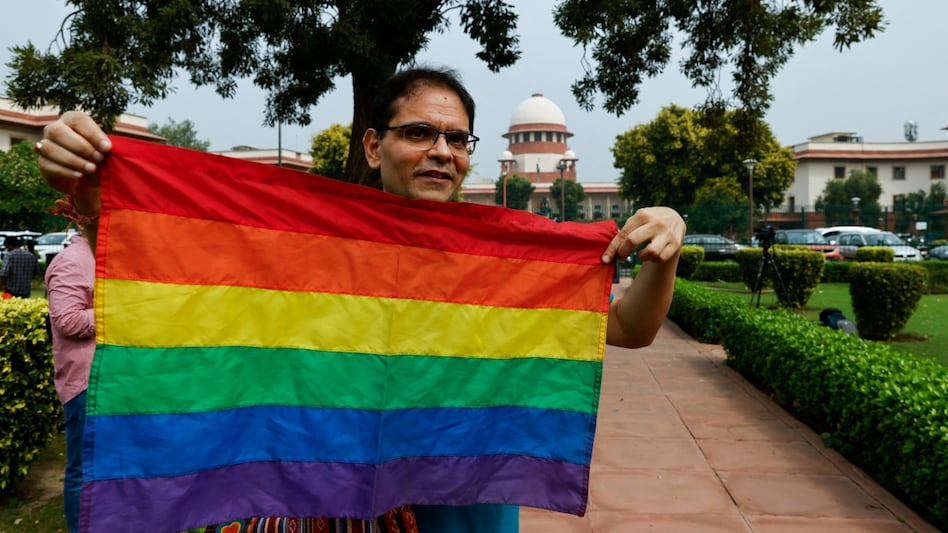
 In early November, one of the petitioners approached the apex court seeking a review of the October 17 judgement. (Representative Image/Reuters)
A plea was raised on Thursday before the Supreme Court to review the October 17 decision which denied legal recognition to marriages between individuals of the same sex.
Senior advocate Mukul Rohatgi, representing one of the petitioners, highlighted the necessity for an open court hearing to address the grievances of those advocating for the validation of same-sex marriages. Chief Justice D Y Chandrachud, leading the bench along with Justices J B Pardiwala and Manoj Misra, acknowledged Rohatgi's submissions, stating, "I have not examined the (review) petition. Let me circulate it (among judges of that constitution bench)."
Rohatgi further conveyed that all judges on the constitutional bench acknowledged a form of discrimination against LGBTQ+ individuals and expressed the need for relief in this regard. The apex court registry indicated that the review plea was scheduled for consideration on November 28.
In early November, one of the petitioners approached the apex court seeking a review of the October 17 judgement. The constitution bench, presided over by the Chief Justice, had delivered separate verdicts on 21 petitions seeking legal validation for same-sex marriages.
While all five judges unanimously declined to provide legal sanction for same-sex marriages under the Special Marriage Act, they emphasised that it falls within Parliament's jurisdiction to modify the law to validate such unions. However, in a 3:2 majority decision, the court ruled that queer couples do not possess the right of adoption.
The verdicts, composed separately by the CJI and Justices Kaul, Bhat, and Narasimha, also declined to invalidate or modify the sections of the Special Marriage Act (SMA) to encompass non-heterosexual couples. However, the judges held contrasting opinions on the extent to which a court can intervene, despite acknowledging that queerness extends beyond an "urban, elitist concept" and necessitates state protection for such couples. While the CJI and Justice Kaul asserted that the constitutional right of queer couples to form a union should be safeguarded and that the State is obligated to acknowledge these civil unions and provide them legal benefits, including adoption rights, the remaining three judges disagreed with this perspective.

 Can China really take down 'Sudarshan Chakra'? PLA's latest bold claim against India's S-400
 Cancer is leaving more children without mothers; India among six hardest-hit countries, says WHO
 RAM shortage declines global PC shipments down to 4.9%, Apple gains market share
 India renews lobbying deal with Trump ally Jason Miller for Rs 17 crore
 As AI reshapes cyber threats, EY bets on IP-led cyber platforms over traditional consulting
 Dubai Real Estate Outlook 2026: Why Rizwan Sajan Says Prices Could Surge After September
 Delhi-NCR Monsoon Misery Returns: Why Does Every Spell Of Rain Bring The Same Crisis?
 Why SBI Mutual Fund Is Going Public: Top Executives Answer Key Investor Questions
 Sony INZONE H6 Air Gaming Headphones Unboxing
 ISOIN Wealth Discusses ICICI Prudential Multi-Asset Active FoF
 Sensex, Nifty trim gains but settle higher; what's next for the market?
 Adani Enterprises shares gain as group forays into low-carbon chemical production
  Kalyan Jewellers shares zoom 25% in two days; is more steam left?
 TCS Q1 results: Net profit rises to ₹13,349 crore, revenue up 14% | Quarterly earnings details
 TCS Q1 FY27 results: Rs 12 per share interim dividend announced; check record date









