












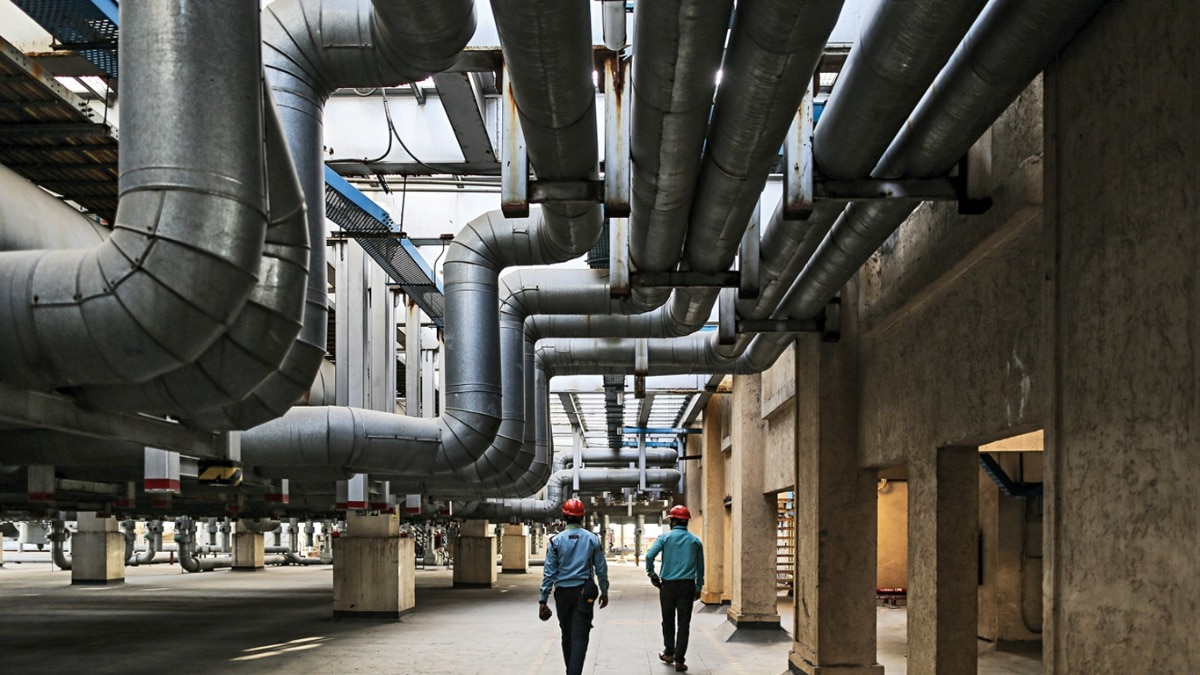
Artificial Intelligence (AI) workloads are rising globally. Futuristic ideas like orbital data centres are being explored to reduce pressure on land, water, and power resources. But on earth, and especially in India, the immediate challenge is how to build AI infrastructure sustainably.
AI data centres or AI’s factories, packed with power and water-guzzling chips, are coming up across cities and industrial corridors to fuel modern life. Global technology companies, including Amazon Web Services (AWS), Microsoft and Google, are collectively pouring in more than $60 billion into India’s AI and cloud infrastructure ecosystem. Domestic operators such as Ishan Technologies, RackBank, NeevCloud, Colt DCS and others are also expanding data centre capacity across the country. Separately, there are also enterprise partnerships that are being developed. In May, global ride-hailing major Uber entered into a pact with the Adani Group to set up its first data centre in India.
According to Sambit Patra, Partner and India Head of Energy & Natural Resources at Bain & Company, India has added close to 1 gigawatt of data-centre capacity over the last five years and is now racing towards achieving four to six times that capacity by 2030.
Data centre capacity, measured in watts, houses processors, ultra-fast networking, storage and massive power and cooling systems. As AI adoption explodes across sectors, including banking, healthcare, telecom, manufacturing, retail, and government services, more of these centres are being set up to support these services.
Data centres are not new to India. They were first established in 2000 to help power websites, banking systems, enterprise software, payments, cloud storage, and so on. These conventional data centres run on standard central processing units (CPUs). However, AI relies heavily on graphic processing units (GPUs) that process thousands of calculations simultaneously to train and run large models. These chips are significantly more power-intensive and generate far greater heat, requiring denser racks, advanced cooling systems and substantially higher electricity and water use than traditional facilities.
“The next phase of AI infrastructure growth will be defined not just by access to compute hardware, but by the ability to secure large-scale power ecosystems capable of sustaining continuous high-density AI workloads,” says Narendra Sen, founder and CEO RackBank and NeevCloud. Bengaluru-based NeevCloud is a sovereign AI cloud company, while RackBank is a data centre services provider, both founded by Sen, a technology entrepreneur.
AI campuses that once consumed 20-40 megawatts (MWs) of power are now being planned at 100-300 MW and sometimes even at a gigawatt scale. Rack densities (a measure of electrical power consumed, and heat generated) have jumped from levels of 5–10 kilowatts to as high as 150 kilowatts per rack, as companies cram more GPUs into facilities designed to train large language models.
The infrastructure is key to AI and promises jobs, cloud sovereignty, low-latency digital services and the computing muscle that India needs to compete globally. According to an IBM-India AI study released in May, AI could add $500 billion to India’s economy by 2030.
“India’s digital public infrastructure has created one of the strongest foundations for innovation globally. The next opportunity is to build on that momentum by enabling AI infrastructure at scale,” says Himani Agrawal, COO, Microsoft India and South Asia.

Microsoft has committed $17.5 billion over four years toward AI and cloud expansion in India, including a hyperscale region in Hyderabad. Amazon plans to invest over Rs 1 lakh crore in cloud infrastructure by 2030. Google, too, is building massive AI infrastructure projects, including a proposed facility in Andhra Pradesh.
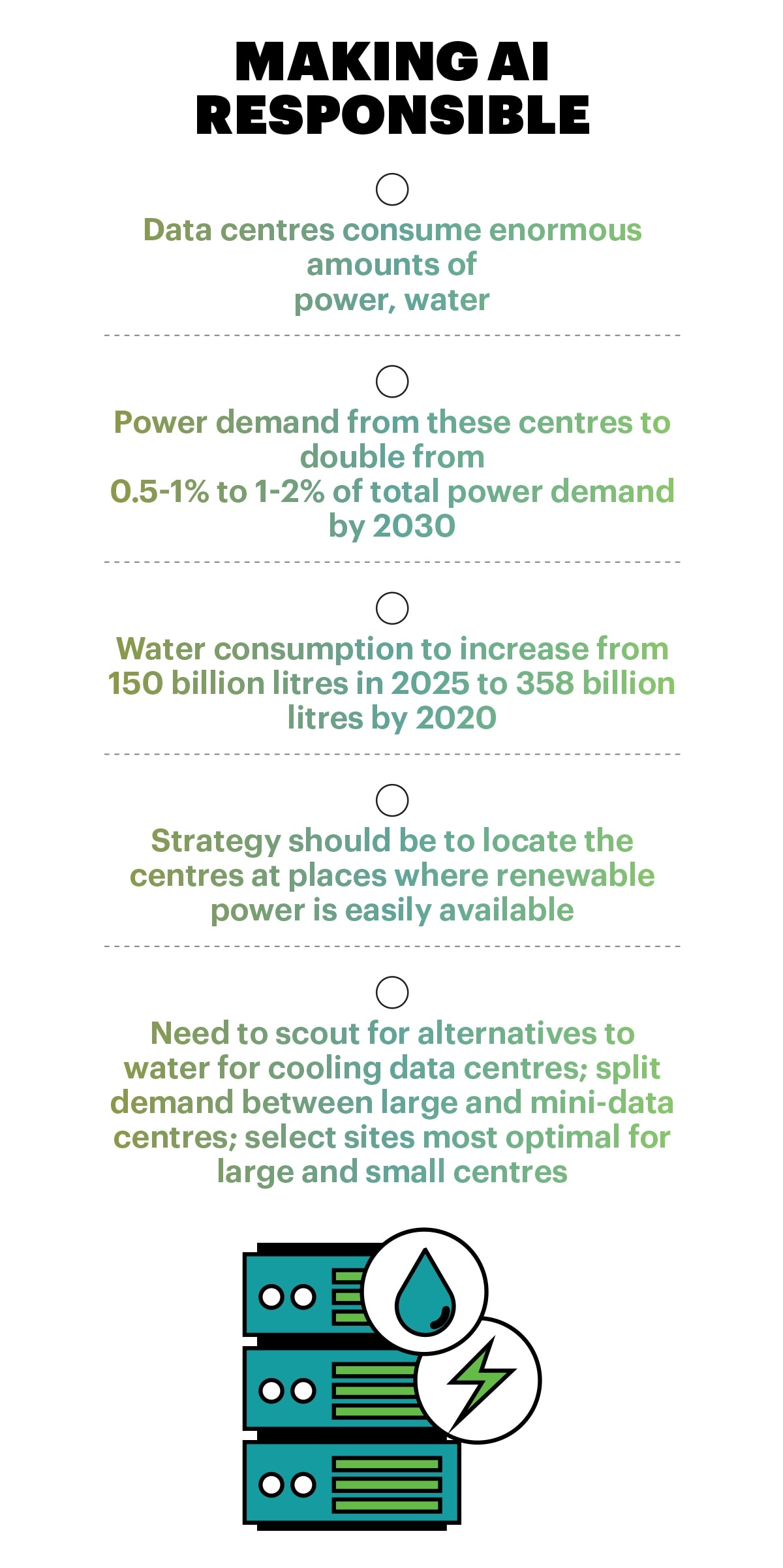
Despite the promises, the infrastructure powering India’s AI ambitions is also emerging as a formidable environmental challenge. What starts as a prompt on Gemini, CoPilot, Claude, Anthropic et al to answer a query, generate an image, create videos, etc, goes into a football-field-sized data centre stacked with hundreds of GPUs. These chips generate answers and consume resources at a scale that is beginning to rival heavy industry and even city power demands.
A simple prompt like ‘who will win the 2026 FIFA World Cup’ will consume as much power as running a microwave for one second. Multiply that by billions of queries to generate answers, videos, future aircraft design, etc.
“The wave of data-centre development in India is poised to significantly impact water resources and electricity consumption. They often use substantial water for cooling purposes, which could strain local water supplies, especially in water-scarce regions,” says Anjal Prakash, professor of public policy, Flame University and lead author, Intergovernmental Panel on Climate Change report.
India’s electricity grid already faces seasonal stress during peak summer months. According to the Ministry of Power, peak summer demand surges 8-12% over regular demand. Adding clusters of hyperscale AI facilities could push local systems to the brink unless power generation and transmission networks expand in parallel.
Not surprisingly, in a water and power-starved country, leaning on AI to transform the economy is easier said than done. Vibhuti Garg, Director, South Asia, Institute of Energy Economics and Financial Analysis, says, “India’s data centre boom is a double-edged sword. It will underpin the digital economy, but it will also intensify pressure on electricity systems, water resources and local environments if not managed carefully.”

Cooling systems are another problem. Conventional hyperscale campuses can consume millions of litres of water daily. In a country where several urban centres already face chronic water shortages, this creates the possibility of technology infrastructure competing with households and agriculture for basic resources. An unchecked AI infrastructure boom could create a paradox where the technology meant to optimise human systems ends up stressing the very resources people depend upon.
“Amazon does not use water for cooling its data centres in India. In 2024, Amazon announced a goal to return more water to communities in India than it uses in its direct operations by 2027,” says Saji PK, Director, AWS data centre operations, Asia Pacific, Japan and China. According to him, at AWS, water conservation has become central to facility design in India.
Amazon has invested over Rs 42 crore in water replenishment projects and expects its investments to restore more than three billion litres of water annually. Its facilities increasingly rely on air-cooling systems along with liquid-cooling capabilities for advanced AI chips.
Microsoft’s India facilities (at Hyderabad, Pune, Chennai and Mumbai) are being engineered for zero-water cooling while relying on renewable energy partnerships with companies such as ReNew and Amplus Solar.
According to the International Energy Agency (IEA), a 100 MW AI data centre will consume around two million litres of water daily, about as much water consumed by 6,500 households in a day. Presently, only 25% of the water requirement globally is from recycled sources or non-potable water sources, and the rest is fresh water.
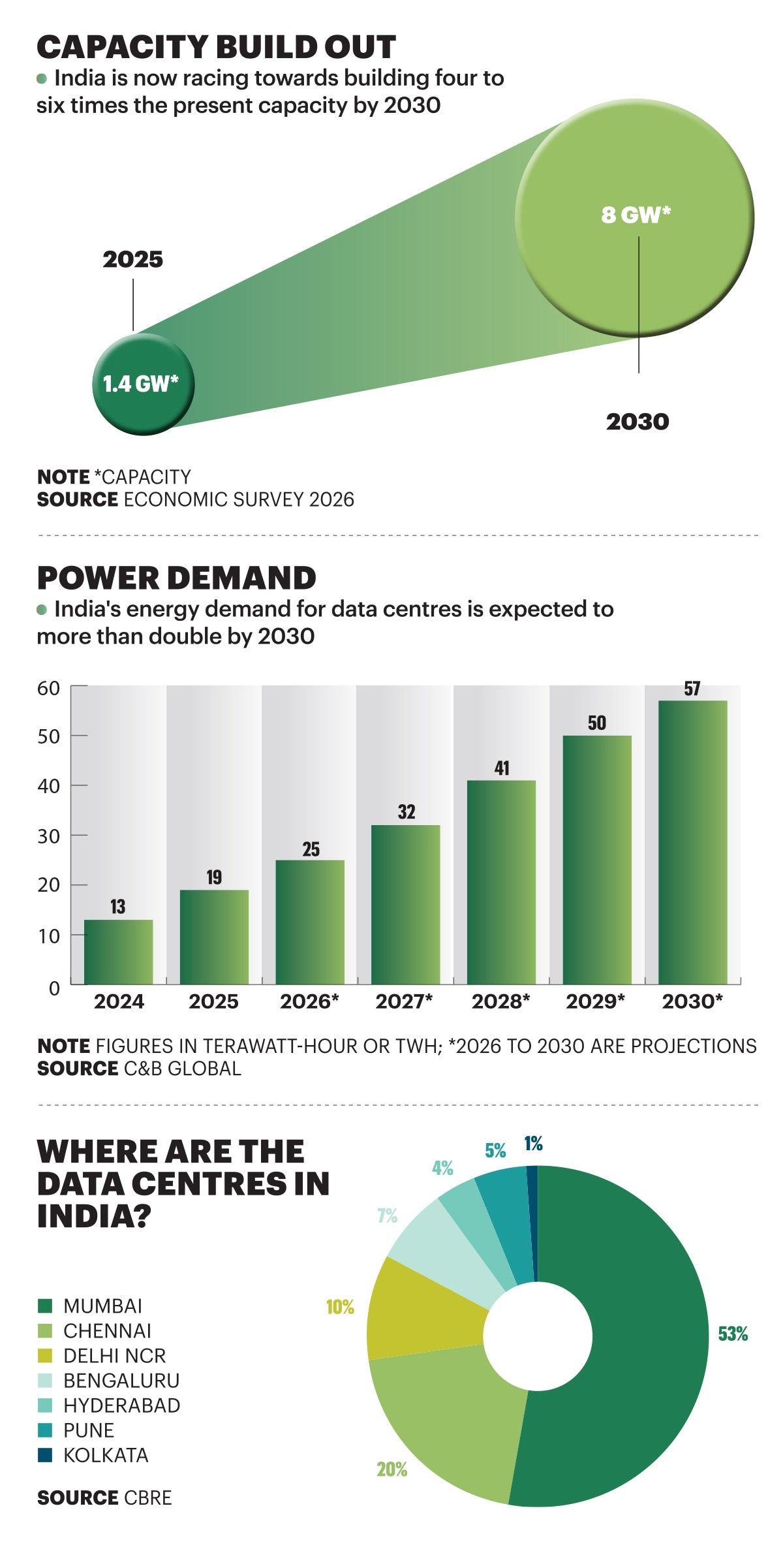
The location of these centres is another challenge. Mumbai accounts for 53% of India’s total data centre capacity, and they contribute to 5% of the city’s peak electricity demand. Chennai and the Delhi National Capital Region (NCR) were also sought-after locations because of better connectivity. But that is now changing as operators are scouting for locations based on power availability and renewable-energy potential rather than proximity to urban centres. While companies aim to strike a balance, AI data centres tend to select places where they can access massive, stable electric grids.
“Geographic diversification is key. Concentration in a few urban hubs (Mumbai, NCR) amplifies stress on already constrained water and power resources. Expanding into Tier II sites (like Visakhapatnam, Bhubaneshwar) can ease pressure on resources,” says Garg. Locating data centres in high renewable potential states such as Rajasthan or Tamil Nadu could reduce transmission losses and improve the reliability of green supply.
Developers could also look at sustainable models outside India. Climate-wise, India is like the United Arab Emirates (UAE) or Singapore, facing extreme heat and humidity. In humid coastal hubs like Mumbai, India could adopt Singapore’s tropical standards by raising operating temperatures to reduce cooling loads. In arid regions like Delhi, India could emulate Arizona and the UAE by mandating closed-loop liquid cooling and deploying dry air radiators.
The future of AI, increasingly, may depend not only on how intelligently machines think, but on how intelligently humans power them.


