












When Henry Ford introduced the moving assembly line at his automobile factory in 1913, it changed the economics of production. Cars could be built faster, more consistently and at lower cost, helping transform the automobile from a luxury product into a mass-market one.
More than a century later, manufacturers are once again experimenting with technologies that promise to reshape how factories operate. Artificial intelligence (AI), robotics, digital twins and connected machines are influencing product design, quality control, inventory management, and maintenance.
As India scales its electronics manufacturing, companies will have to look at making more and more components locally. And end-to-end manufacturing is different from assembling. “A manufacturer of components is dealing with far more complexity than someone who is assembling those components to make a final product. As companies scale up to make components, they will rely more on automated processes and robots,” says J.S. Gujral, managing director, Syrma SGS Technology, a Gurugram-based electronics manufacturing company which is setting up India’s largest Printed Circuit Board (PCB) plant at Tirupati, Andhra Pradesh.
To be globally competitive and scale up, companies will need newer, more automated, factories.
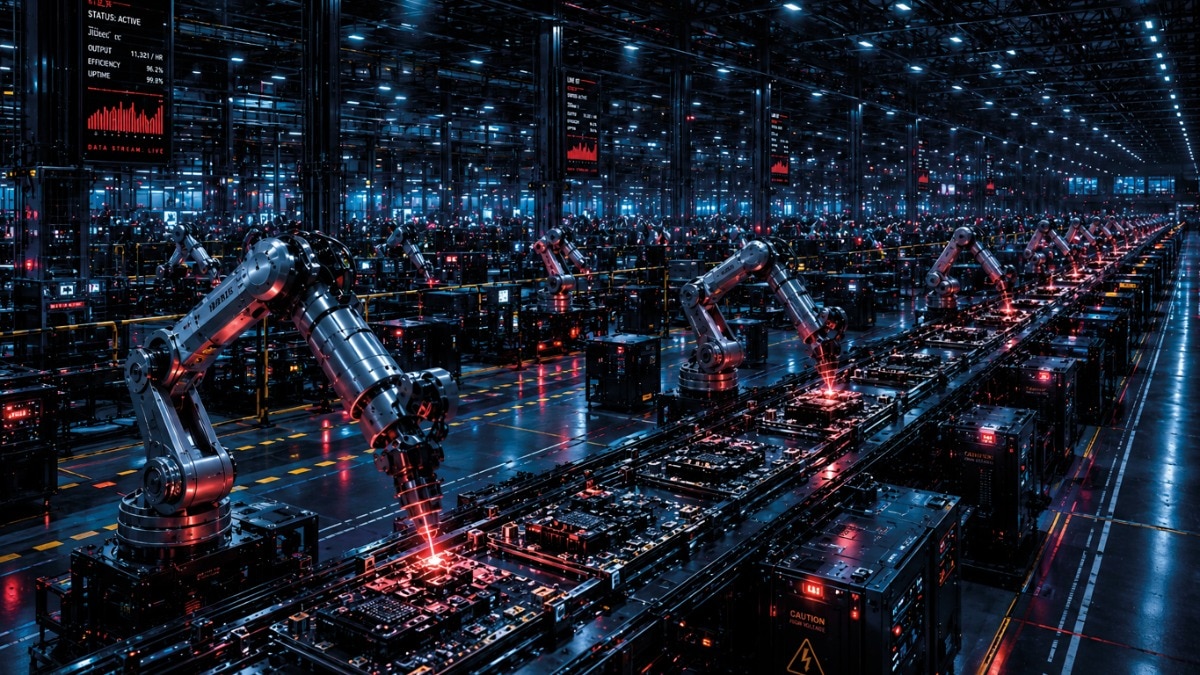
For example, beyond the main processor in a phone, there are hundreds of components mounted on PCBs. To make these precision components, factories need to upgrade with robots that can multitask. A line with robots might have no humans and could essentially run in the ‘dark mode’; such facilities are called dark factories, as no people working inside would mean that the factory may not need lights.
“There could be some version of hybrid dark factories now, but as component manufacturing increases, more robots and automated processes will be used,” says Gujral.
NEW VISION
The image of factories dominated by machines, metal and men could soon be replaced with more robots and automated processes. At present, some of the tasks in factories have been automated. There are a few robots here and there, but much of the heavy lifting is still labour-intensive.
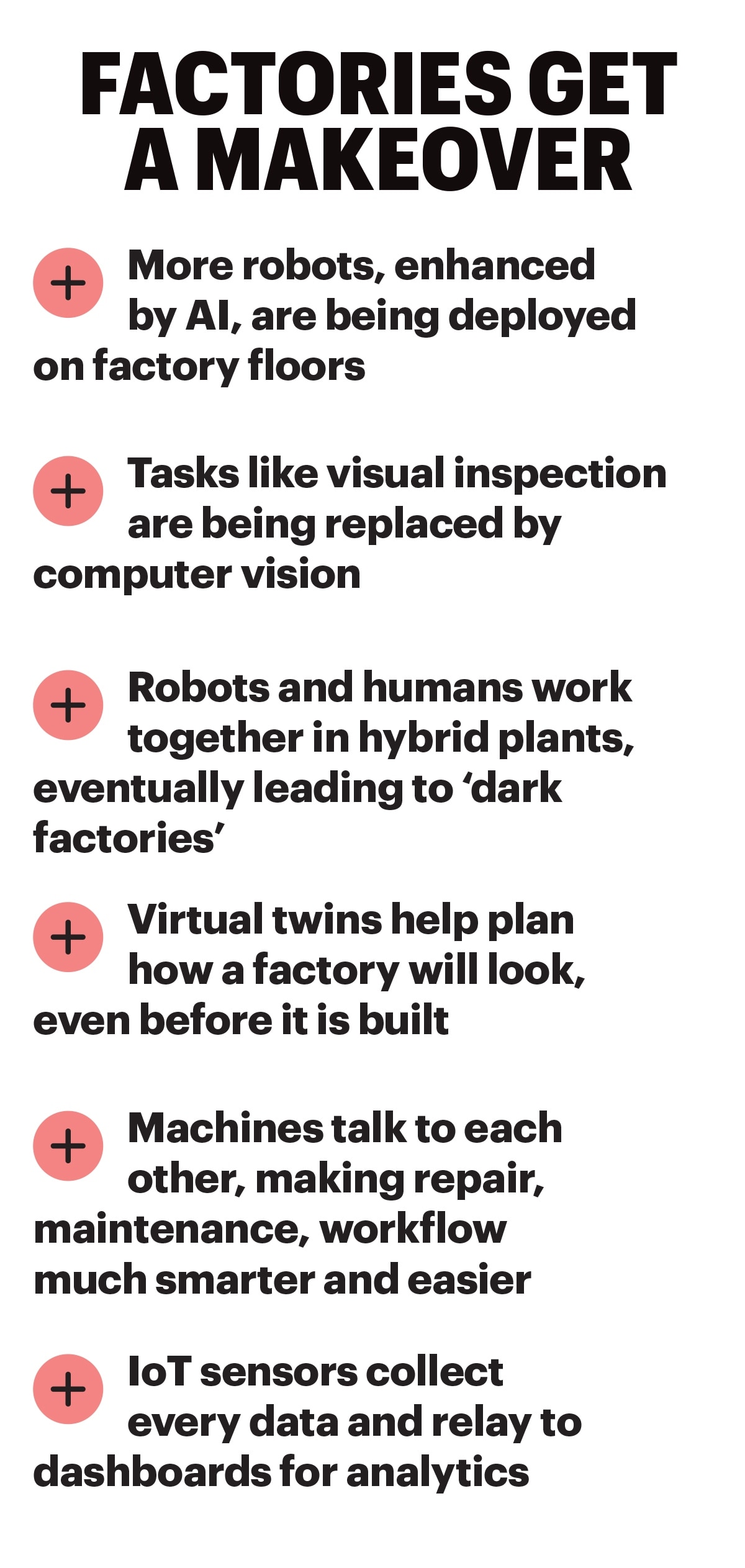
Cut to the modern factory, and that image is fast disappearing. Even before a single brick is laid or a machine ordered, companies are creating virtual twins to see what will be placed where, conduct stress tests, assess sustainability, and so on.
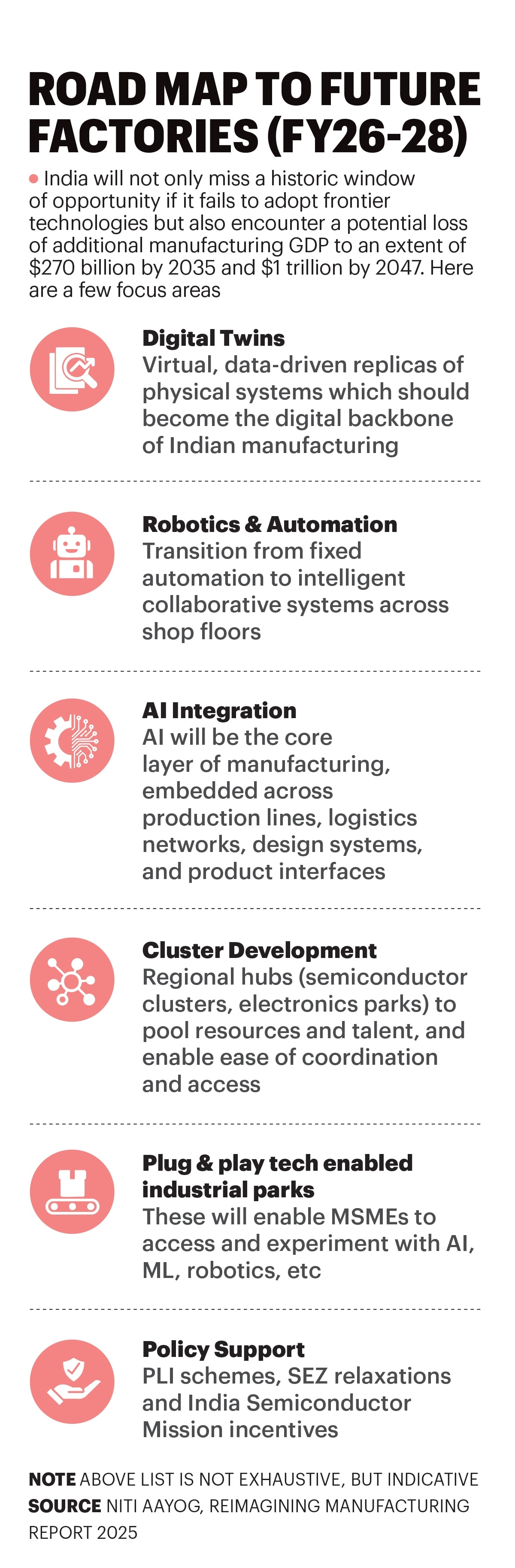
And these are just a few ways in which factories of tomorrow, churning out everything from handsets to smart speakers, are being built. The good part is that India is beginning to manufacture at a global scale, and units here can now leapfrog with some of the latest innovations to build future-ready factories.
Tejpreet Chopra, founder & CEO, industry.ai (which creates AI solutions for manufacturing), says, “We don’t have a choice but to adopt automation. Besides, the market (for manufacturers) is not just India. You can’t compete with other manufacturing destinations with legacy machines and tools.”
Also, there’s not much value in making basic components like nuts and bolts. Gokul N.A., founder of CynLr, a Bengaluru-based robotics company, says, “Everything we ship globally should have a piece of software or intellectual property (IP) inside it.”
That won’t come in legacy units. For instance, India makes smart LED bulbs, but what makes them smart is the chip, which is imported. This will change in the coming years as the semiconductor units being built in India start churning out chips by 2027-28.
TRANSFORMING INDUSTRY
Indeed, inside many of the new factories coming up across India’s electronics clusters—from Noida and Chennai to Bengaluru—the shop floor is quietly changing. For instance, Bengaluru-based space tech company GalaxEye uses Dassault Systèmes’ engineering software to create digital twins of satellites before building them. This enables extensive virtual testing and simulation of complex space hardware before production starts. JSW Motors also uses digital twins to create simulations of electric and plug-in hybrid vehicles. Gokul says, “In a digital twin environment, companies can test and fail repeatedly. Digital twins help augment and accelerate decision-making before the final product is made.”
At the heart of this transformation is the growing ability of machines to communicate with each other. “AI is changing the landscape of manufacturing—with machines on assembly lines now speaking to each other,” says Gujral. As data collection speeds up across machines and production lines, AI systems can analyse that information in real time and recommend adjustments that improve efficiency.
This constant stream of data allows factories to detect problems before they occur. Predictive maintenance systems, powered by AI models, can forecast when an equipment is likely to fail and schedule repairs before a breakdown disrupts production. Automated visual inspection systems use computer vision to detect defects in components faster and more accurately than human workers.
Vinod Sharma, chairman of the Confederation of Indian Industry’s (CII) National Committee on Electronics Manufacturing, says, “Such technologies are reshaping shop floors. AI-powered sensors can forecast machine failures before they occur, reducing downtime dramatically. Computer vision systems can identify micro-defects on circuit boards that would be almost impossible for the human eye to detect.”
A HYBRID MODEL
Industry experts like Gujral say the country’s manufacturing ecosystem will likely have hybrid factories rather than fully automated dark facilities due to availability of skilled labour and the high cost of building and running dark factories .
India’s likely path is hybrid manufacturing, combining low-cost labour with targeted automation. “Labour costs are relatively low and availability of manpower is high. But areas where fatigue affects quality or where human judgement becomes inconsistent will increasingly be automated,” says Gujral.
One example is visual inspection. On electronics assembly lines, workers often inspect components for defects. But after an hour of staring at tiny circuit boards, the human eye begins to tire. Automated optical inspection systems can perform this task far more consistently. As a result, such processes are among the first to be automated.
Electronic manufacturing companies have started using robots. However, the penetration gap compared to global levels is still very wide, says Gokul of CynLr.
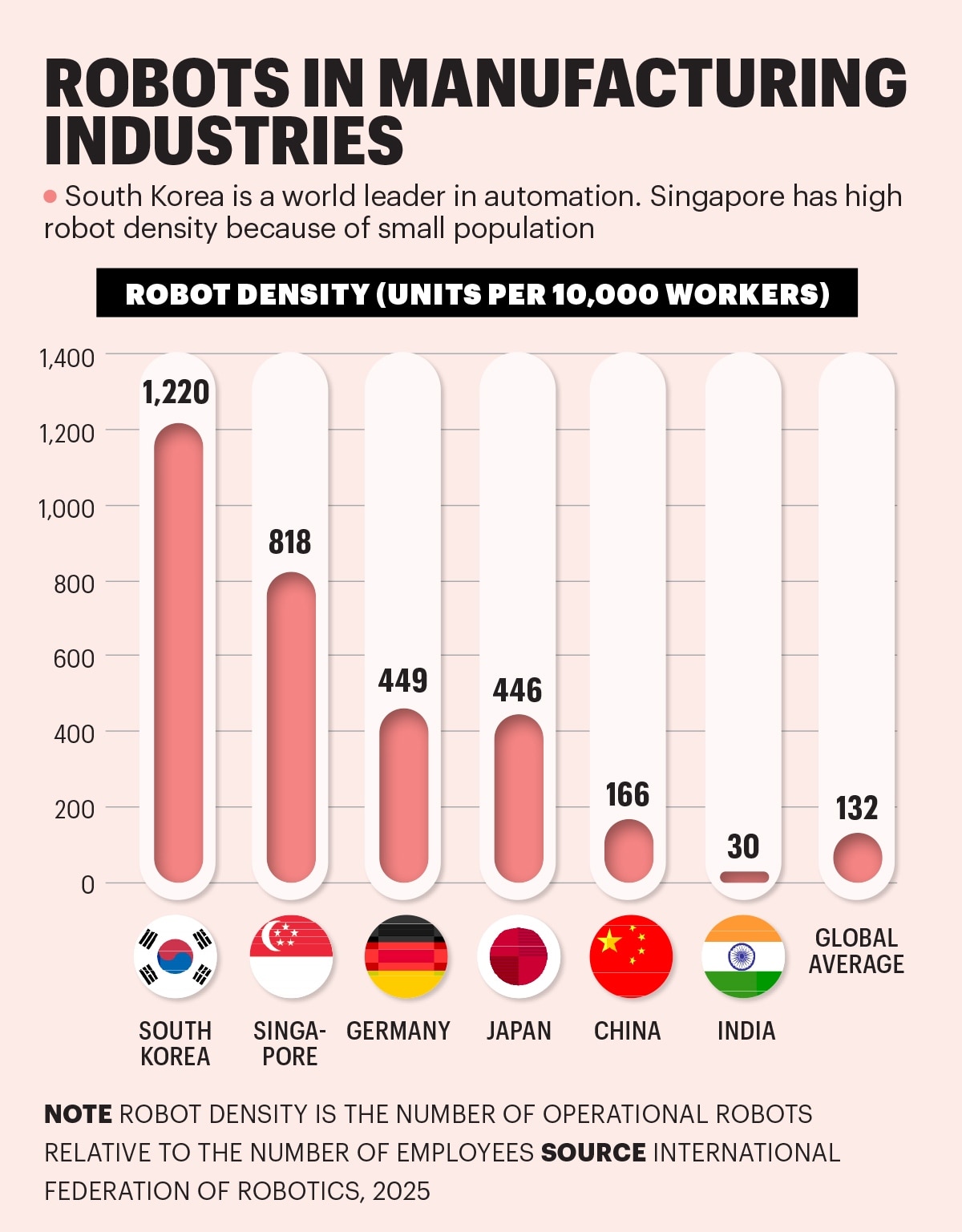
According to the International Federation of Robotics, India’s robot density is significantly lower than that of major manufacturing economies such as South Korea, China, Japan, Germany, and the US. Robot density is the number of robots per 10,000 human employees. India has a robot density of 30. South Korea is at 1,220 and China at 166, while the global average is 132, according to the report.
Sharma, who is also managing director of Deki Electronics, which makes various types of capacitors, says factories are using robots in areas where repeatability and precision are critical. For instance, robots can weld electronic components with consistent accuracy, ensuring that every weld meets the same specifications. Hybrid models, he says, are more realistic for India’s manufacturing landscape. “Robots can handle repetitive, unsafe or precision-heavy tasks while humans oversee operations, make decisions and manage complex processes,” says Sharma.
Another major shift shaping the factories of the future is the emergence of ‘virtual twins’ or digital replicas of physical factories. Deepak N.G., Managing Director, Dassault Systèmes India, says companies are increasingly designing and testing entire factories in the virtual world before building them. “When companies plan a new plant today, they often want to build it virtually first,” he says. “Every machine, every component, is modelled digitally with the same physical properties as the real equipment.”
In these next-generation factories, machines do more than just perform tasks. They continuously generate data that flows through virtual platforms. Managers can track production, quality metrics and operational performance on their phones in real time.

“If I have 50 machines in a factory line, all of them should talk to each other and to the product being manufactured,” says Deepak. “That allows companies to track production, identify faults and optimise operations instantly.”
FUTURE OF JOBS
This is dramatically speeding up the manufacturing pipeline. Tasks that once took weeks—such as pricing a new component—can now be completed within a day. The immediate impact is not necessarily job cuts but a dramatic boost in productivity. For instance, Gokul points out that laptops took away manual bookkeeping, librarian roles, basic record-keeping, accounting tasks, etc., but also vastly increased the number of accounts (or data) being managed. “Accountants didn’t get eliminated; they became managers of larger, more complex records. The same thing will happen on factory floors. Workers will not just be manning these machines but will also train machines to execute actions,” he says.
Much like humans are training AI models to do the tasks that humans are doing, such as making videos, infographics, discovering new drugs, interpreting radiology reports and so on. Chopra of industry.ai adds, “Jobs will not disappear but change. The quality of jobs will go up.”
For example, a large Noida-based manufacturer is evaluating using robots instead of humans for even tasks like lifting and shifting goods. “I employ five people and pay them all around Rs 1 lakh a month. A robot to do that will cost less than one year’s wages, but will be more productive, 24x7, without a break. The labour involved in this can be reskilled to do maintenance tasks or manage the dashboard to ensure the robot is doing the task correctly,” Chopra says.
Engineers can focus on higher-value tasks rather than repetitive follow-ups and data gathering. Some technologists believe that manufacturing could eventually shift towards what they call a “universal factory.” Gokul of CynLr envisions factories built not around specialised machines but around adaptable robots capable of performing multiple tasks.
Yet, even as automation accelerates, many experts believe human workers will remain an essential part of manufacturing for years to come. Assembly operations, for instance, still require dexterity and judgement that robots struggle to replicate. Human hands can apply delicate pressure and adjust to subtle variations in materials—capabilities that remain difficult to program into machines.

As India leapfrogs into advanced manufacturing, automation will gain currency. Whether these factories run in complete darkness or under the watchful eyes of engineers, one thing is clear: the manufacturing floor is becoming as much about algorithms and data as it is about machines and metals.


