
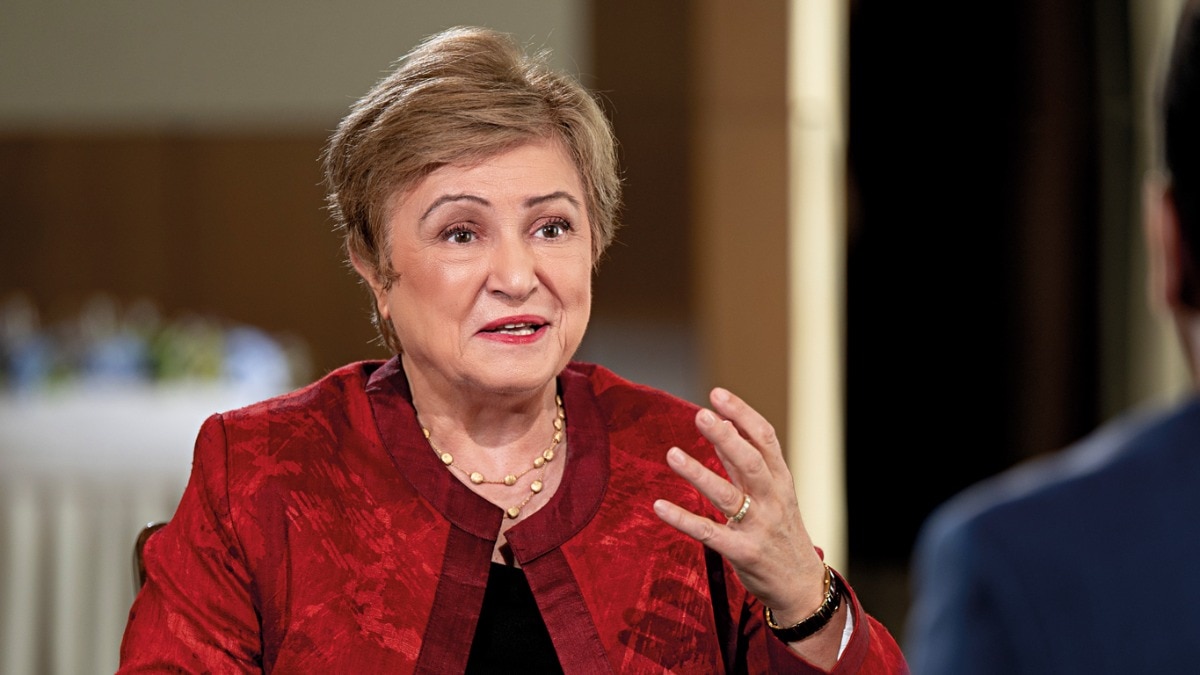
As governments grapple with pressures on growth and jobs, Kristalina Georgieva, Managing Director of the International Monetary Fund (IMF), has a front-row view of the fault lines across the global economy. She has spent decades at the intersection of economics and development—shaping responses to major shocks and making the case for growth that is resilient and inclusive. A Bulgarian economist, she has led the IMF since October 2019, after serving as CEO of the World Bank and holding senior roles at the European Commission, including overseeing the EU budget and directing humanitarian aid and crisis response. Now, as artificial intelligence (AI) begins to reorder productivity and the nature of work, Georgieva sees a familiar policy dilemma—how to capture the gains while cushioning those most exposed to disruption, especially vulnerable workers and economies at the risk of falling behind. In an interview on the sidelines of the recent AI Summit in New Delhi, she spoke to Siddharth Zarabi, Group Editor, Business Today, about India’s ambitions in AI, its potential role in global growth, and what governments must do to manage its labour-market impact. Edited excerpts:
What was delivered at the AI Summit?
What the summit did is to bring not just the world together, but to bring the developing world to India to meet those who are ahead on this journey. What India is doing in artificial intelligence is phenomenal because the goal of the country is to democratise it.
AI is already here, and the speed with which it is affecting the way we work, live, and interact with each other is the highest in the history of technological transformation. We risk falling behind if we do not lean forward with everything we have.
Two, it is a tremendous source of excitement and opportunity, but it also brings risks, and we must embrace the opportunities of higher productivity and growth, and manage the risks, especially the risks of displacement of workers.
What is the biggest risk?
That AI is going to open opportunities too widely. The haves and the have-nots may have a big distance in between. India is saying it need not be that way. We can work to make AI a source of benefit for the whole of society and we are determined to help the rest of the world, especially the global south, benefit from AI.
Already, there is evidence that the impact on the labour market is very significant. AI is like a tsunami hitting the labour market. We assess 40% of jobs globally, 60% in advanced economies, will be impacted by AI in the next few years, either enhanced, made more productive, or replaced.
And when we study what is happening, we find a very interesting story. Already in the United States, one in 10 jobs requires AI-enhanced skills, and it pays more. People in these jobs, with more money in their pockets, spend more, and that creates demand for low-skill workers in restaurants, in hotels, and in entertainment.
What is happening is that we have one part of the labour force getting better pay because of better skills, another part of the labour force getting jobs, but with less pay. And who gets squeezed? The middle —jobs that are not enhanced.
We also see automation eliminating entry-level jobs. So, recent graduates worry, where are the jobs for me? And this is where the attention of policymakers needs to go. We are not helpless. What we can do first is to redefine education for the era of AI.
We need to think through how to go about a transformative technology that brings enormous opportunities —we see this potentially lifting global growth by 0.8%. It means that we will have growth globally above the pre-pandemic level. Right now, it’s an anaemic 3.3%. We can break out of this path of low growth, high debt, with AI. But for productivity and economic growth to benefit the world, we have to work together as a global community in a world that is more fragmented today than it was before the AI revolution.
We need to put in place good social safety nets, so that if people are displaced, they have something to lean on for themselves and their families. There is a very good system in Denmark. I highly recommend that for this world of AI. Congratulations to India for the labour market reforms, but we need to combine that flexibility with security, and help people adjust.
What is your own assessment of the path that India seems to be choosing on AI, that is, to use what exists and build applications for public-good, like healthcare and in education. Is that the right way for a country like India?
It is the right way. India has invested over the years in digital public infrastructure. It is the foundation for AI to be more accessible to more people, to be applicable in more areas. India created digital ID for 1.4 billion people and that gave a big boost to the digital economy.
Now comes AI. And to make it beneficial for more people, it is appropriate to think of models that are specifically designed for a sector or a particular activity. And that democratisation of AI is impressive in India. Now, where the world is headed, inevitably there will be differences. And the issue is, how about the developing world, the countries that risk falling behind?
And there, I think the model that India is developing may be more applicable than the high-tech corporate model of the United States. What matters today is that we think ahead, independent of which path is chosen, what should we be most worried about? And frankly, I think our biggest worry should be guardrails. We want AI for good, not for evil. We want AI that protects dignity and rights of humans. And that requires more attention to the ethical foundation of AI, and much more attention to what are the guardrails.
If guardrails are necessary, how do we ensure that innovation is not curbed due to excessive regulation?
Well, that is the trickiest question. I think the only answer is to work together and identify what the biggest risks are and how we can put guardrails for those, and do that very carefully because you are right, innovation is what drives prosperity, and we have seen far too many times innovation getting suffocated with excessive regulation.
Over the last few years, India has worked hard to reduce its regulatory burden. I would argue that this is an area where more can be done to implement the great reforms that India has pursued.
Can, and should, Europe also deregulate?
I happen to know Europe very well; I was EU Commissioner, Vice President of the European Commission for a while. In Europe, the understanding now is that there is red tape that needs to be taken out.
But Europe thinks about it as efficient and effective regulation. The term deregulation is avoided because they don't want to send the signal that everything goes, that there are no protections for workers and for the well-being of citizens.
And yes, Europe must implement its single market to the fullest. So, if you go to Europe and register in Germany, what you do is applicable in all 27 countries. Europe needs a capital market union. Europe needs free movement of skills across the union and a unified energy system.
All of this must be done with optimal regulatory requirements, not with the regulatory capacity that it has today.
What is your sense about the long-term consequences of the changes in tariffs by the United States?
Not only do countries continue by and large to trade under the rules that have been established over decades, but there is an uptake of trade agreements, regional and cross-regional. India has its trade agreement with the UK, with the EU, a tariff agreement with the US, and is working on other trade agreements.
That uptick shows that if globally we are in a more difficult place to have uniform rules, countries will respond by regional, sub-regional integration. Here in South Asia, there is tremendous potential to deepen trade integration within the subregion, which India can lead and benefit from. So, my projection is the following: we are in a multipolar world. This is a reality. And, therefore, it would be more complex to have trade relations that would be more bilateral, plurilateral agreements.But the world would continue to trade. Supply chains will continue to cross borders. Why? Because we are integrated. We cannot pull apart. There is no going back to a place where everybody relies only on their own capacity. And if you go back in history, this is what we have been doing for years. Trade is like water. You put an obstacle; it goes around it.
With new multipolar arrangements and the evolving trade order, do you worry some countries would be left behind?
The global trade order, as it existed, lifted many countries out of poverty, created jobs, and created a global supply chain.
My biggest worry is that we are in a more shock-prone world. We have seen the pandemic, the war in Ukraine, the inflation spike, and high interest rates, one after another. Climate shocks are hitting many countries dramatically. This will continue. And what has happened over the last couple of years is twofold.
One, many countries have exhausted their fiscal capacity to respond to shocks. They borrowed to help their businesses and their people, and now the level of debt is high and the level of growth is disappointing.
When the next shock comes, rich countries are not going to be there to pour tonnes of money for the rest of the world. It's just not possible. So, this is my first worry. We exhausted buffers; we must rebuild them.
My second worry is that when a shock hits, what you said is going to be a tragedy in the making. The smaller, poorer countries will be most dramatically impacted, and the world has weakened its collective capacity for solidarity.
I very much welcome emerging market economies like India and Brazil, that are saying we have to nurture solidarity because it is the right thing to do, but also because in an unstable world, there are risks for everyone.
It is a matter of economic security not to let countries fall behind.
@szarabi













