










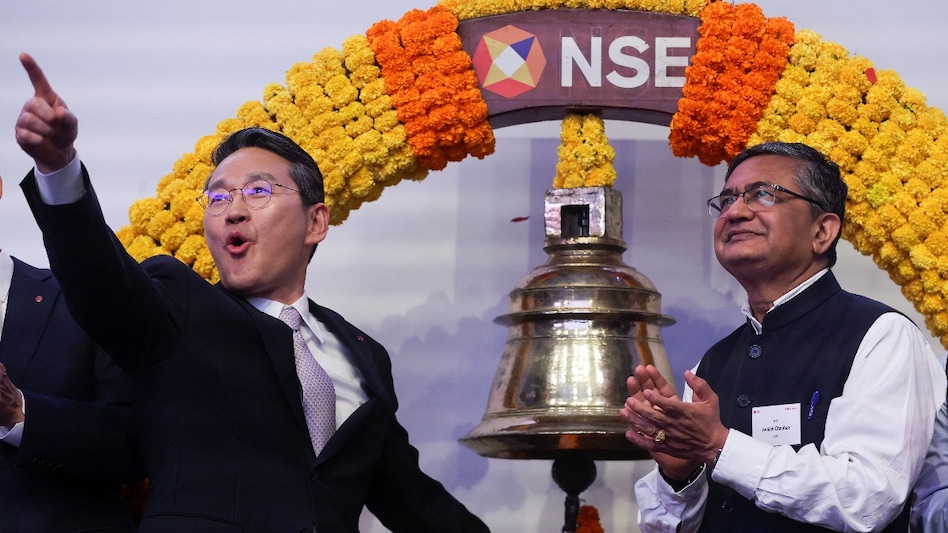
 While global peers like Ford, GM, and Nokia quit India after misreading local consumers, LG thrived by localising its supply chain, products, and customer strategy. (Photo: REUTERS/Francis Mascarenhas)
 While global peers like Ford, GM, and Nokia quit India after misreading local consumers, LG thrived by localising its supply chain, products, and customer strategy. (Photo: REUTERS/Francis Mascarenhas)
In a milestone moment for India’s consumer electronics sector, LG Electronics India Ltd made a stunning stock market debut this week — and in doing so, overtook the market capitalisation of its own South Korean parent company. The company’s shares, listed at a 50% premium at Rs 1,710 on the NSE, surged further to close 48.23% higher at ₹1,689.90, making it one of the most successful listings of 2025 so far.
The Rs 11,607-crore IPO, consisting entirely of an Offer for Sale (OFS) of 10.18 crore shares — about 15% of the South Korean parent’s stake — was oversubscribed 54 times, attracting bids worth over Rs 4,000 crore. The blockbuster response underscores LG’s unique position: a global brand that has become deeply embedded in India’s domestic economy.
Korean brand to Indian powerhouse
LG’s India journey stands apart in the history of multinational corporations. While global peers like Ford, GM, and Nokia exited India after failing to adapt to local consumer behaviour, LG doubled down — localizing its supply chains, product design, and customer engagement strategy.
“While many global giants packed their bags and left India, LG stayed — and built an empire from scratch. Here’s what consistency and localisation can do,” said CA Nitin Kaushik, a market analyst.
Rs 11,607 cr IPO — oversubscribed 55 times
Two massive factories in Noida & Pune
Over 50% of materials sourced locally from Indian suppliers
35,000+ dealer touchpoints across the country
FY24 revenue: Rs 24,367 cr; Profit: Rs 2,203 cr
The Indian strategy
LG’s decision to “think local” turned it into India’s largest home appliance and television maker. It built deep distribution networks, localized manufacturing, and customized products — from voltage-tolerant refrigerators for power-fluctuating regions to dust-resistant air conditioners suited for Indian conditions.
Unlike rivals who imported finished goods, LG invested in two large factories in Noida and Pune, and is now setting up a third facility in Andhra Pradesh with an investment of Rs 5,001 crore to expand refrigerator and washing machine production.
By sourcing more than half its components domestically, LG not only reduced costs but also aligned with India’s “Make in India” initiative. Its 35,000-dealer network — spanning metros to small towns — gave it unmatched market reach.
From televisions to washing machines, LG’s success rests on a foundation of trust and service reliability. The brand’s focus on after-sales service, quick repairs, and value-driven pricing made it a household name across India’s middle class.
As CA Kaushik puts it, “While others tried to dictate terms, LG adapted — and India rewarded it.”
With its blockbuster IPO and growing local footprint, LG Electronics India has transformed from a Korean exporter into an Indian manufacturing and consumer success story — proving that long-term commitment and localisation can outshine even the biggest global brands.
LG Electronics India outlook
According to Prashanth Tapse, Senior VP (Research) at Mehta Equities, investing in LG Electronics India offered investors both immediate upside and long-term growth potential. “Given LG’s reasonable valuation and strong Q3 earnings outlook, investors had clear visibility on its business momentum, which is reflected in the nearly 50% listing-day jump,” he said.
Chirag Jain, Deputy Head of Research at Emkay Global, added that the surge underscores LG’s strength in “balancing affordability with profitability through local sourcing and smart channel strategy.” Analysts at Nomura also remain bullish, citing India’s low penetration of white goods and rising premium demand. “LG’s focus on mass-premium products, exports, and B2B expansion will sustain growth,” said Nomura’s Siddhartha Bera and Kapil Singh, highlighting its strong technology edge and upcoming Rs 5,001 crore Sri City plant.
 The one tax form you absolutely, urgently need to fill now…here’s more
 BT Closing Bell | Sensex settles 251 pts lower, Nifty below 24,050; ICICI Bank, Eternal lead index losers
 All you need to know about Kiran Mazumdar-Shaw’s successor at Biocon
 JLR India cuts prices of Range Rover SV, Range Rover Sport SV by up to ₹75 lakh after India–UK FTA
 How Bangladesh media covered BJP's historic win in West Bengal
 Market Strategy Now: Where Should You Invest? | Shweta Rajani Explains
 Markets After Election Results: BJP Win, Political Stability | Where Should You Invest Now?
 Lotus Blooms From Gangotri To Ganga Sagar: BJP Sweeps 206 Seats In Historic 2026 Bengal Landslide!
 A New Dawn: Amit Malviya Explains BJP’s Historic 206-Seat Two-Thirds Majority In West Bengal!
 UDF Sweeps Keralam: VD Satheesan On How The Congress-Led Alliance Won 100+ Seats!
 BT Closing Bell | Sensex settles 251 pts lower, Nifty below 24,050; ICICI Bank, Eternal lead index losers
 Godrej Properties shares: Why global brokerages see up to 53% upside potential
 Q4 volume growth at 15-quarter high, GST benefits: What might go well for HUL stock ahead
 IREDA, Vedanta, Cyient DLM shares - Trading strategy | Daily Calls on BTTV
 Voltamp Transformers shares tumble 20% — here is why