








The quote 'What goes up must come down' may remind one of the Law of Gravity, but off late it seems to have become more than apt when it comes to the Indian market. Sensex and Nifty, which touched their all-time high levels in January-end this year, joined the global correction and made investors jittery over their equity investments. On January 29, 2018, Sensex and Nifty hit 36,443 and 11,171 levels, respectively reaching their lifetime highs on Union Budget expectations and hopes of healthy Q3 earnings.
The new peaks were a result of a record rally that saw Sensex rising nearly 46 percent or 11,573 points in two years to January 29, 2018. On January 29, 2016, the index stood at a meagre 24,870 points.
The Nifty too rose 47 percent or 3,608 points from January 29, 2016 level (7563 points) to 11,171 level on January 29, 2018.
The indices could not sustain the abnormally high levels for long and fell over 10% till date on 10% LTCG tax in Union Budget on February 1, ripple effects of rising bond yields in US on global markets and prospects of trade wars between the US and its trading partners.
In fact, the Indian market was among the major losers among its global peers in the last two months.
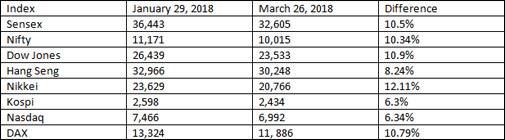
Investors have lost more than Rs 12,28,476 crore in BSE market capitalisation since market fell from its lifetime high after January 29.
With 10% LTCG tax coming into effect in the new fiscal from April 1, investors are curious about the the direction market is likely to take.
Anand James, chief market strategist at Geojit said, "Earnings in April will be a welcome distraction and should give a lot of stocks good upside traction, given the deep cuts that they have seen in the last two months. Alternate investment opportunities are not attractive enough for LTCG to act as a deterrent against equity investment in the new fiscal. So, LTCG should not have any material impact from here on."
On the likely direction of market, James said, "Given the fact that we have had a plus 10% correction from the top without any sizeable reversal, Nifty is ripe for a pullback that could see it in the 10,300-10,550 region in April, and 10,000 acting as a near-term base. However, it is noteworthy that over 50 percent of stocks are still below 200 day moving average, and a vertical rise past 10,550 is less expected at this point. Alternatively, fall below 10,000 should ideally re open potential for 9,200."
Meanwhile, the reality index performed the best in the 2017-18. The index grew 39%. IT Sector was a distant second with 18% and metals with 11% growth a poor third.
FMCG and Capital Goods sectors grew at par with the Sensex at the rate of 10%.
Banks and autos underperformed with a gain of 9% and 8% respectively. Oil and Gas grew 7%. Power and healthcare indices suffered a 7% and 14% fall, respectively.
The BSE small cap and Mid-cap indices grew 16% and 11%, respectively.
VK Sharma, Head - PCG & Capital Market Strategy at HDFC Securities said along with the global fears of rising interest rates and trade war fears, the markets were also weakened by the selling on account of LTCG. With the end of March, the LTCG related selling will also abate.
Sharma does not see any sales on account of LTCG in April. However, investors are likely to trade more often.
On the direction of markets, Sharma said Indian markets, which underperformed the global markets will outperform now.
 Adani Ports, HAL, M&M, LG India among top picks post Budget for upto 40% upside potential
 18% excise duty on unmanufactured tobacco withdrawn; will tobacco stocks be impacted?
 Hyundai Motor Q3 results: Profit up 6% at Rs 1,234 crore; revenue climbs 8%
 BEL, GRSE, RVNL among key Budget beneficiaries; ICICI Bank, Belrise among top picks
  'STT hike won't do anything...': STT revision on derivatives sparks debate as Zerodha’s Nithin Kamath flags unintended risks
 Unpublished Ladakh Memoir Triggers Rahul–Rajnath Showdown In Parliament
 Budget 2026: Exclusive Live Market Masterclass With Raamdeo Agrawal
 Daily Calls LIVE: Ask Your STOCK MARKET TODAY QUERIES | Market Update LIVE | Share Market News Today
 Exclusive: Naina Lal Kidwai Breaks Down Budget 2026 And Its Impact On Business And Economy
 Budget 2026 Backs Wellness & Wanderlust: Ayurveda, Mental Health And Tourism Get Big Push
 NSE IPO: Unlisted shares hold firm despite STT hike in budget as issue timeline clears
 'Indian markets are still domestically focused': Navam Capital MD calls for opening up for global listings
 Bajaj Housing Finance Q3 earnings: Net profit rises 21%, AUMs at Rs 1.33 lakh crore Hyundai Motor Q3 results: Profit up 6% at Rs 1,234 crore; revenue climbs 8%'STT hike won't do anything...': STT revision on derivatives sparks debate as Zerodha’s Nithin Kamath flags unintended risks