


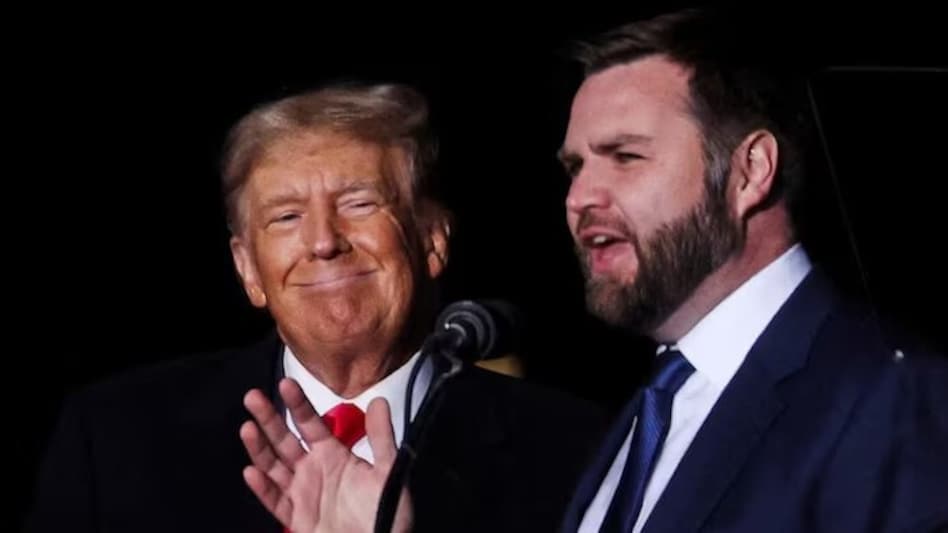
 Vance argues that America must pivot toward empowering blue-collar workers with technology rather than relying on migrant labour.
The H-1B visa — long a bridge connecting Indian talent to the American dream — has erupted once again into a political battleground in the United States. With Indian technology workers, engineers, and physicians forming the largest cohort of H-1B holders, every shift in US immigration policy sends ripples across India’s skilled workforce and its $150-billion IT services industry.
Now, the debate has reignited with a new force. US Vice President JD Vance has sharpened his rhetoric against foreign workers, dismissing them as “cheap workers” and arguing that America no longer needs immigrant labour to sustain its economy. His comments, delivered in a conversation with conservative host Sean Hannity, signal a deepening ideological divide at the highest levels of the American government.
Vance vs Trump
While Vance criticised what he called a “Democrat model” of importing “low-wage immigrants,” he also framed the upcoming election as a choice between “low-wage immigrants” and “America’s citizens empowered by technology.”
But Vance’s stance sits uncomfortably beside President Donald Trump’s own recent admission: that America does, in fact, lack certain specialised skills.
During an interview with Fox News host Laura Ingraham, Trump pointed to a battery plant in Georgia — where he personally ordered a raid — as evidence that US workers cannot simply be pulled “off an unemployment line” and trained overnight in advanced manufacturing or defence production.
“You don’t have certain talents. And people have to learn,” Trump insisted, rejecting the notion that domestic labour could instantly replace skilled foreign workers.
A mixed message
These conflicting viewpoints illustrate confusion within the administration: should the US eliminate dependence on foreign workers, or does the economy urgently need their specialised expertise?
Vance argues that America must pivot toward empowering blue-collar workers with technology rather than relying on migrant labour. But Trump counters that US industry — especially in high-tech sectors — cannot function without certain foreign skill sets, at least in the short term.
For Indian workers, who receive nearly three out of every four H-1B visas, this policy tug-of-war has become a source of anxiety.
Sudden regulatory shock
In September, Trump signed a sweeping proclamation titled “Restriction on Entry of Certain Nonimmigrant Workers”, introducing a stunning new requirement: Any H-1B petition filed after September 21, 2025, must include an additional $100,000 payment to be eligible.
Industry bodies have warned that such a fee could shut out smaller companies and drastically reduce the number of H-1B applications, even from large Indian IT firms that have long depended on the programme.
The move is seen as the opening salvo in a larger restructuring of high-skilled immigration.
Bill to end H-1B programme
Adding to the uncertainty, a US lawmaker announced plans to introduce a bill to completely eliminate the H-1B visa programme and dismantle its pathway to permanent residency — a system that allows employers to sponsor a Green Card, eventually leading to US citizenship after five years.
If passed, the bill would force all H-1B workers to return home once their visas expire, ending decades of migration trends that have shaped Silicon Valley’s workforce.
For India, the stakes could not be higher. The country’s tech ecosystem — built around talent mobility, onsite client work, and deep linkages with US corporations — depends heavily on the H-1B pipeline. Any disruption threatens not just individual careers but also billions of dollars in service exports, innovation collaboration, and startup ecosystems.
Indian doctors, who fill critical shortages across rural and urban America, could also face new hurdles under a blanket ban.
The clash between Vance’s “no more cheap labour” stance and Trump’s “we lack certain talents” admission captures a paradox at the heart of the American immigration debate: Can the US maintain technological leadership while cutting off the foreign talent that fuels it?

 Sterlite Technologies: What every investor should know about the stock post Q1 earnings
  BT Explainer | PVR Inox shares: Analysts bet big on Odyssey, Ramayana, Avengers & others post solid Q1
 ‘Merely because there is agitation…’: Supreme Court says right to peaceful protest is guaranteed
 First-time homebuyers beware! Five common home loan traps that could cost you big
 OpenAI's GPT-5 was labelled a high-risk AI model over biohazard concerns
 Oil Shock Looms As Hormuz Crisis Meets Houthi Threat To Bab El-Mandeb Shipping Route
 Air Pollution And Dementia: How Dirty Air Could Affect Your Brain Health | Sneha Mordani Explains
 Is Alexa Always Listening To You? Best Smartphones Under ₹20,000 | Tech Gear
 Tech Weekly Wrap: WhatsApp Update, iPhone Price Hike & Samsung Foldables
 AI Data Centers, Aerospace & Gas Turbines: What's Powering Indo-MIM's Future Growth?
 Sagility shares surge 8%; brokerages retain 'Buy' despite Q1 revenue dip QoQ; check target pricesSterlite Technologies: What every investor should know about the stock post Q1 earnings BT Explainer | PVR Inox shares: Analysts bet big on Odyssey, Ramayana, Avengers & others post solid Q1
 CarTrade Tech shares jump 12%; brokerage says OLX's Elite Buyer programme could drive growth
 AU SFB shares at Rs 800 or Rs 1,275? Targets by JPMorgan, Morgan Stanley, MOFSL and othersOil Shock Looms As Hormuz Crisis Meets Houthi Threat To Bab El-Mandeb Shipping Route
 Google confirms Pixel 11 price hike, says Android to use less RAMSagility shares surge 8%; brokerages retain 'Buy' despite Q1 revenue dip QoQ; check target prices‘Merely because there is agitation…’: Supreme Court says right to peaceful protest is guaranteedAir Pollution And Dementia: How Dirty Air Could Affect Your Brain Health | Sneha Mordani Explains









