



International players like Microsoft , Google , Facebook pledging technology and infrastructure support to this initiative gives it a very strong and positive impetus. India has become a large market place for retail, manufacturing, logistics, communication, travel & leisure and healthcare.
This growth has to be supported by a strong logistics backbone and a 'digitally transformed' Indian Railways and India Post can provide the much needed support to this endeavour.
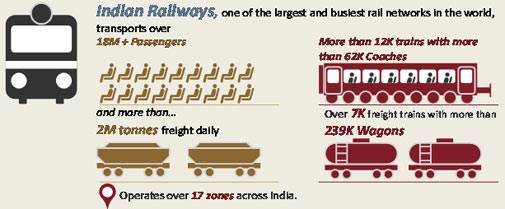
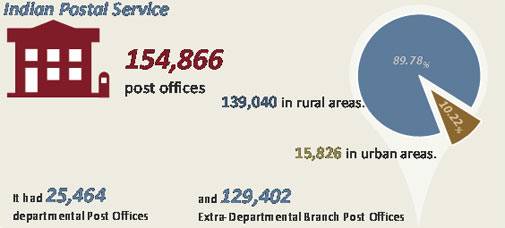
A sneak peek into these age old services unravels facts on the capacity, network and capabilities they can offer to both government and private sector:
With rising consumerism and an affluent middle class, ecommerce in India is expected to continuously grow in the next few years. The bulk of the customers of these players e.g. FlipKart, Myntra, SnapDeal etc. comes from the second and third tier cities of India.
In spite of the model being popular with the middle class, there is a large segment hailing from remote villages and other such locations who are not able to avail these services. Private courier and logistics providers - who work as the backbone for the supply and delivery for these providers - do not have the network or infrastructure yet to deliver a package to the furthest and the remotest corners of India with the same SLA as that of a metro city.
That is precisely where the Indian Postal Services can help. With more than 154,000 post offices, of which almost 90 per cent are in rural areas, the geographical reach and manpower strength it can offer is phenomenal.
With production and manufacturing across the country being encouraged and travel & leisure being on the rise, Indian Railways will have a growing role to play in the entire dynamics.
With more than 7,000 freight trains with 239,000 freight wagons, Indian Railways has a massive leverage over other means of transportation of freight across the country.
Indian Railways should be taking steps to attract the foreign and domestic tourists for leisure trips and business travellers for superfast business travels between key business hubs, at an affordable price.
In the age of customer experience, Indian Railways should be looking at options to connect to consumers directly, take their feedback in designing services and at the same time increasing passenger safety, providing improved and well maintained passenger services. Both these services need to transform themselves largely to support this vision for the future.
Right use of pertinent technology is going to be the key to success and both Indian Railways and India Post need to embrace digital technologies like social media, mobile, predictive analytics, cloud, machine to machine and Internet of Things.
Efficient operating models, agile data-driven decision making, streamlined operations, pre-emptive risk identification and mitigation have to be made the order of the day, powered by the digital enablers.
Efficient management of data (both master and transactional) along with data coming from outside the enterprise e.g. social media, public space, third party sources or from devices is key in terms of digital transformation.
Data assets in these organisations needs to be given due emphasis in terms of completeness, quality, governance and accuracy so that they can be the backbone for the digital transformation.
Predictive analytics as such has the most potential in terms of generating business value; e.g.:
From a capability perspective, both organisations need to start dealing with unstructured data e.g. data from GPS devices, control devices, image captures, mobile devices, satellite images, GIS information, social media, driver health information (e.g. alcohol test results) etc. to be able to create holistic profiles of people, products, services, equipment, shipped packages etc.
Richness of information in conjunction with statistical modelling of the data would lead to improved analytical insights for business.
In the coming years, Indian Railways and India Post can play a game-changing role in the Indian market place, which is on an evolution path, by embracing digital agenda and through collaboration with national and international technology players.
The time is ripe to invest in defining a strategy and roadmap for the future and have the budgets in place to implement the plan.
The author is a Director in Protiviti India.
 Trump announces import tariff up to 200% on generic drugs after 2026 window; India's $9.7bn exports at risk
 JP Nadda, Jitendra Singh meet Sonam Wangchuk: Here's what transpired behind closed doors
 Adani, GMR flights? Govt mulls letting airport operators own, run airlines, says report
 Stuck since 2016, now moving: Haryana clears Rs 29 crore six-lane road project in New Gurugram
 YES Bank share price target: What can trigger a re-rating for the stock?
 Will The Rupee Fall Further? Expert Explains Oil Prices, FII Flows & Dollar Pressure
 Why This Fund Manager Is Betting on I.T. Stocks, CapEx & Consumption
 Pharma Stocks Outlook: CDMO, Patent Cliff And China Plus One Opportunity Explained
 I.T. Stocks Ready For A Comeback? Expert Picks Persistent, LTIM & Coforge For Long Term
 Ram Temple Donation Theft Case: Cars, Bullet Bike Seized as SIT Probe Deepens
 IndiaMart share price targets: Why this stock fell 8% after Q1 results; is it still a Buy?
 Nestle India shares climb 4% to hit record high after Q1 results
 Adani Power, Adani Green, IndusInd Bank, Eternal Q1 results today: Key expectations
  Cube Highways Trust IPO opens today: Should you subscribe to this InvIT issue?
 Titan Company shares hit record high amid market crash; here's why









