








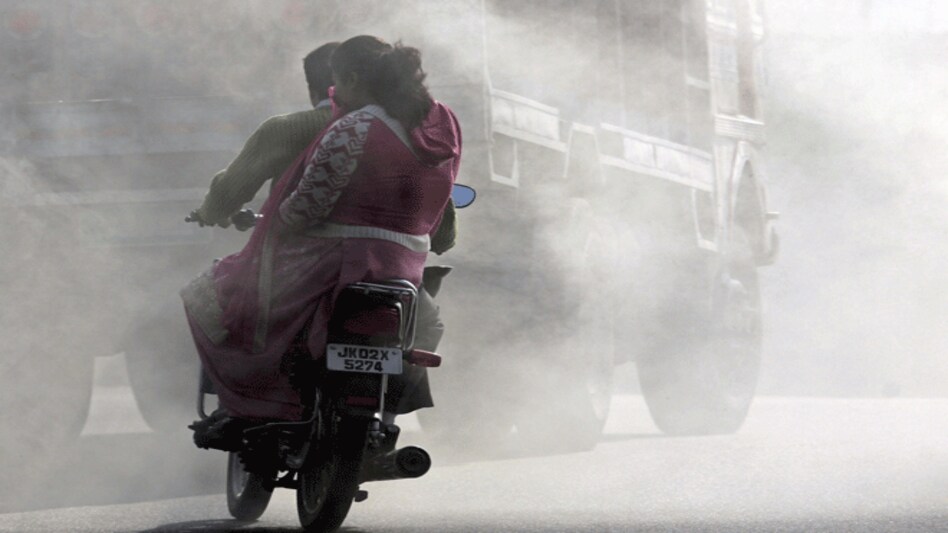

A study done by Greenpeace India based on national air quality index of 17 cities in the country has revealed that as many as 15 cities showed levels of air pollution far in excess of the prescribed Indian standards. Between April and November this year, pollution levels were high for more than half the number of days.
While Delhi garners the most attention in mainstream media and occupies most of the mindspace among policymakers, in at least five cities mentioned above, the average level of particulate matter of 2.5, believed to be the most harmful of all pollutants was actually higher than Delhi in November. Ideally, the respective governments in those cities should have been more concerned.
"As the political capital - and indeed, the most polluted of all cities - the bad air in Delhi gets the most attention. But scratch below the murky surface, and you will find concentrations of PM2.5 in several other cities - Lucknow, Ahmedabad, Muzzaffarpur and Faridabad, amongst others - that would justify the triggering of a 'Red Alert.'
"Even the government's own, largely inadequate NAQI data reveal that 23 of the 32 stations across India are showing more than 70 per cent exceedance of the national standards," said Sunil Dahiya, Campaigner, Greenpeace India. "The pollution levels in a few Indian cities have the embarrassing distinction of having exceeded the toxic levels of Beijing and other Chinese cities, demonstrating levels at least ten times higher than the WHO standards, making air pollution truly a national emergency."
As it stands, the NAQI figures in india themselves are very peripheral as the country has very few stations compared to Europe, US or China. On average, there are four air quality stations in cities in EU countries, five in US cities, and eight in Chinese cities displaying real time pollution levels, whereas 10 of India's biggest cities do not even have a single such monitoring station. A higher number of stations in India and in more cities would probably paint a bleaker picture,
As the government and courts debate measures like odd-even formula for cars, banning diesel vehicles or imposing higher taxes on commercial vehicles, perhaps it is also high time to broaden the ambit beyond just Delhi.
 NSE IPO may unlock mega gains for billionaire investors RK Damani, Premji
 India-US BTA: Harley Davidson bikes to get 0% duty, gradual tariff reduction on luxury cars
 India-US interim trade agreement: 'No GM modified product allowed, agri sector protected,' says Piyush Goyal
 'Decided to give 0% tariff on some cancer medications, neuro treatment': Piyush Goyal on what US got
 ‘How is this a win?’: Chidambaram slams India-US trade framework as opaque, US-tilted
 BT Golf 2025-26 Kochi, Kerala Awards Ceremony Marks A High-Energy, Successful Conclusion
 Golf Is An Addiction. We Eat And Sleep Golf!
 The Fairway Fixes Everything. Mindset, Life, Relationships
 BT Golf LIVE: Join AU Small Finance Bank Presents BT Golf 2025-26 For Its 4th Leg In Kochi, Kerala
 AI Will Change MBAs, Not Leadership: IMD President On India’s Global Education Rise
 RIL, SBI, Kotak Bank, Kalyan, HAL, BEML, BDL among stocks in focus next week; here’s whyNSE IPO may unlock mega gains for billionaire investors RK Damani, Premji
 SBI Q3 Results: Profit jumps 24% to Rs 21,028 crore; asset quality improves
 IDBI Bank stake sale: Kotak Mahindra Bank says ‘has not submitted a financial bid’
 BDL, Mazagon Dock, MRF, Hindustan Copper, RVNL, others to turn ex-dividend next week