








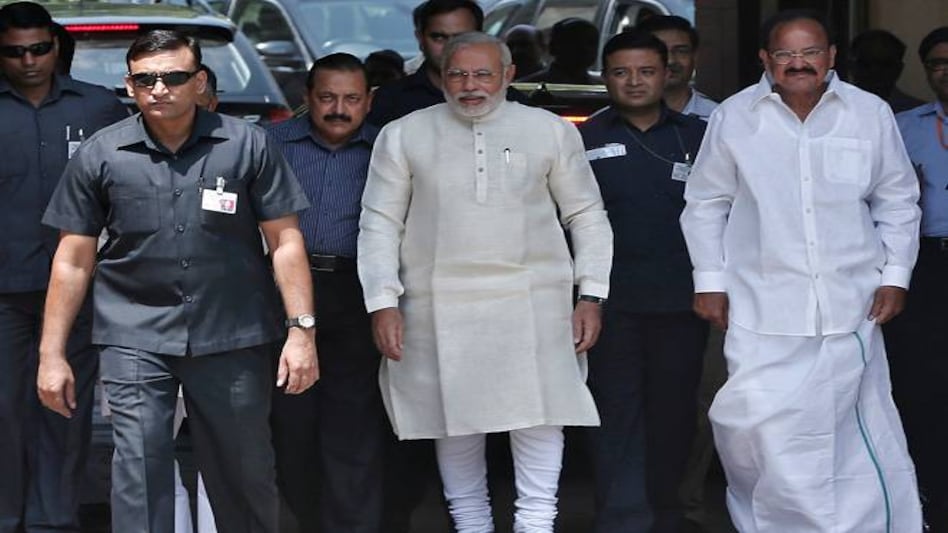
 PM Narendra ModiPM Narendra Modi
While the Union Cabinet cleared the National Intellectual Property Rights (IPR) Policy, which reiterates India's known position on IPR, the patent office reversed its own earlier decision to ensure patent protection for a hepatitis B drug sold by a US drug company. Global multinationals led by US based industries, which have been accusing India of not following an IPR regime that will maximise their profits from India, will not be happy to hear India sticking to its well known positions on IPR.
Though, they will definitely be glad to see India announcing an IPR policy that provides long term hope of further tweak in the existing laws. Additional sweetener has come in the form of a patent approval for a medicine, the application for which was earlier rejected on technical grounds. PM Modi's US visit during June 7th and 8th, will also include interactions with the US industry.
The IP Policy, which was approved on May 12, lays down seven objectives including creation of more awareness, generation of IPRs, stronger legal and legislative framework, modernisation of administration, commercialisation of IPRs, enforcement and human capital development.
The policy recognizes that India has a well-established TRIPS-compliant legislative, administrative and judicial framework to safeguard IPRs, which meets its international obligations while utilizing the flexibilities provided in the international regime to address its developmental concerns. It reiterates India's commitment to the Doha Development Agenda and the TRIPS agreement.
Announcing the IPR policy, the government has stated that with IPRs becoming increasingly important in the global arena, there is a need to increase awareness on IPRs in India, be it regarding the IPRs owned by oneself or respect for others' IPRs.
"The importance of IPRs as a marketable financial asset and economic tool also needs to be recognised. For this, domestic IP filings, as also commercialization of patents granted, need to increase. Innovation and sub-optimal spending on R&D too are issues to be addressed," it said.
The reversal of patent office's decision happened in the case of Sovaldi Hepatitis C medicine, sold by US based Gilead Sciences. The office had rejected the company's patent application last year on the ground that the new product was not a significant improvement over an earlier product developed by another company. As it stands today, India provides patent protection to only real innovations and not to incremental improvements over existing products.
Patient groups, opposing the patent office decision, has already called the decision as "political", and threatened to appeal against it.
Whatever be the reason behind the decision of the patent office, it will certainly help Prime Minister Modi avoid uncomfortable questions during his US visit.
 India-US trade deal, stock market: Sensex zooms 2,375 pts, Nifty vaults past 25,800 mark
 India-US trade deal effect: Rupee opens 111 paise higher amid positive sentiment
  India US trade deal: TCS, Bharat Forge, Infosys, Welspun Living among key stocks in focus
 India-US trade deal: Trump cuts India's tariffs from 25% to 18%, 'effective immediately' after speaking to PM Modi
 India-US trade deal: ‘Trump, Modi should take this win; should celebrate’, says Asia expert but with a caveat
 Why Enjoying Golf Leads To A Better Game
 Why FIIs Are Dumping India: Valuations, Earnings & The Budget Signal, Raamdeo Agrawal Explains
 STT Hike: Curbing Excess Or Hurting Markets? Raamdeo Agrawal Speaks
 Union Budget 2026: Why Policy Certainty Matters More Than Populism
 Budget’s Biggest Gorilla: Raamdeo Agrawal On Data Centre Opportunity
 Hindustan Zinc, MCX, Bharat Dynamics: How to trade these 3 buzzing stocks
 India-US trade deal impact: Sona BLW, Gokaldas, Bharat Forge, SRF shares gain up to 20%; here's whyIndia-US trade deal, stock market: Sensex zooms 2,375 pts, Nifty vaults past 25,800 markIndia-US trade deal effect: Rupee opens 111 paise higher amid positive sentiment India US trade deal: TCS, Bharat Forge, Infosys, Welspun Living among key stocks in focus