












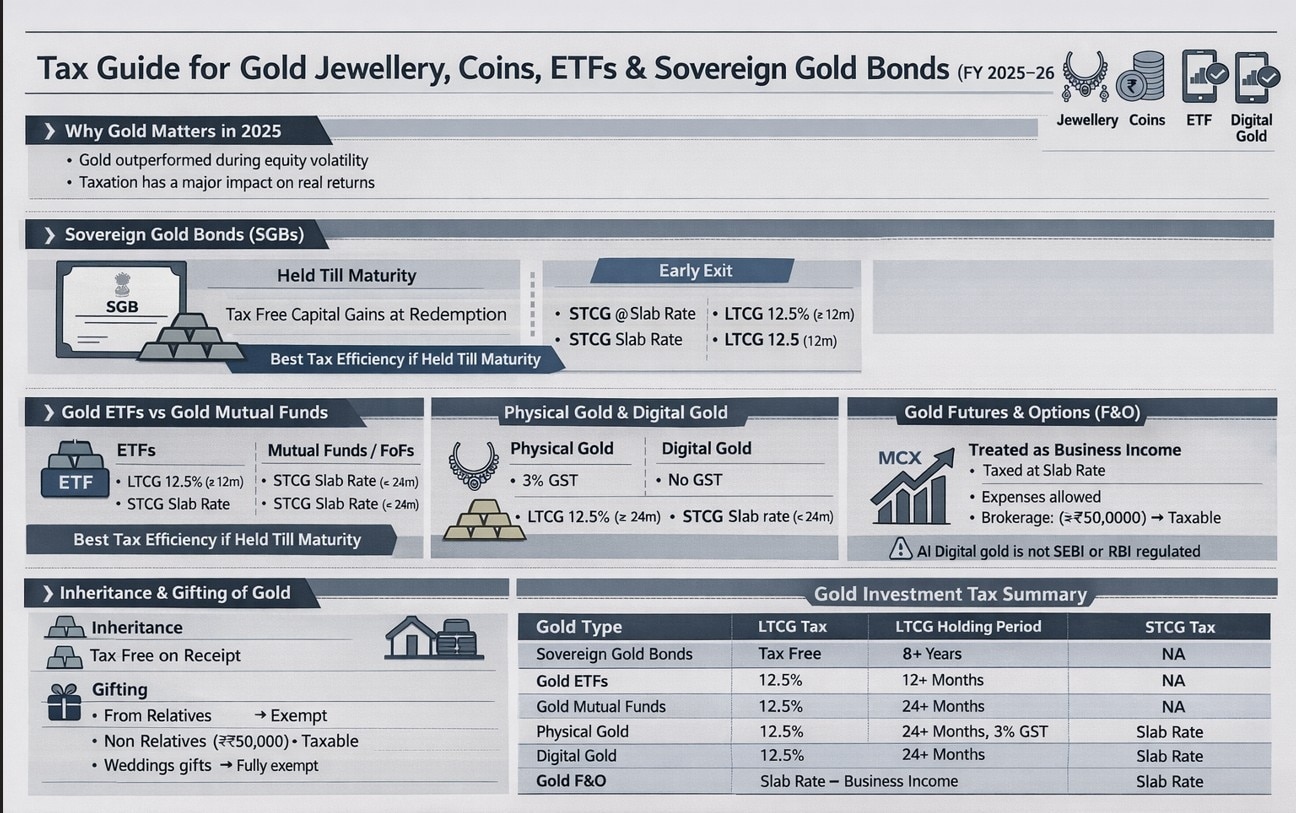



 Physical gold, jewellery, coins and bars, and digital gold often appear safer and simpler, but can quietly erode returns.
For decades, Indian investors have turned to gold as a hedge against inflation and a safe haven during market turmoil. In recent years, the yellow metal has strengthened that reputation by delivering returns that have often outpaced traditional fixed-income instruments such as fixed deposits and bonds. Yet, while gold’s price performance has impressed, experts warn that taxation can make or break the real returns investors finally take home.
Abhijit Chokshi, a SEBI-registered research advisor, recently highlighted how the form in which gold is bought can sharply alter post-tax outcomes. Illustrating with a simple example, he said two investors could each put Rs 5 lakh into gold, yet one could walk away tax-free while the other could lose up to Rs 1.5 lakh purely due to how their investment was structured. “Most Indians lose up to 30% of their gold returns just in taxes. It’s not the price of gold that hurts you — it’s the form you bought it in,” Chokshi said.

 Nifty’s festive comeback: Can the bulls keep the party going?
 Jio IPO listing to make it India’s 4th most-valued firm after RIL, Airtel, HDFC Bank
 SIR row: Supreme Court issues notice to EC; seeks response from Gyanesh Kumar, 2 other ECs
 Jio IPO: Meta, Google, ADIA, 7 others eye Rs 3.2 lakh crore stake value, gains on investment
 BT Explainer: What is BS-VII, what changes does the draft propose, and how could it impact vehicle manufacturers and buyers?
 Netanyahu, MBS And The Houthis: Is A New Middle East War Brewing?
 Jantar Mantar Protest Ban: Are Delhi’s Alternative Sites Fit For Protests? | Ground Report
 K Annamalai’s Political Test: Can We The Leaders Make An Electoral Mark?
 LIVE What’s Hot: Stocks, Gold & Big Money Moves | Daily Markets Show | October 15 | Business Today
 CEAT Q2 Results | CFO Kumar Subbiah on Profit Fall, Margins and Growth Outlook
 HDB Financial Services shares slump 8% to record low; brokerages cut targets post weak Q2
 BHEL target price: Stock falls 6% even as brokerage ups estimates; should you buy, sell or hold?
 HDFC AMC shares rise 6% on Q2 earnings, check details Nifty’s festive comeback: Can the bulls keep the party going?
 Tata Communications shares jump after Q2 earnings; key things to know
 Who is Uday Ruddarraju? The engineer building the computing backbone behind OpenAI’s AI ambitionsNetanyahu, MBS And The Houthis: Is A New Middle East War Brewing?
 'Particularly disturbing': India condemns mass shooting plot against Hindu temple in US
 Why Hip Replacement Recovery Is More Than Rest and Instructions
 Infosys is hiring 20,000 freshers in the AI Era. But will their jobs look the same?


