












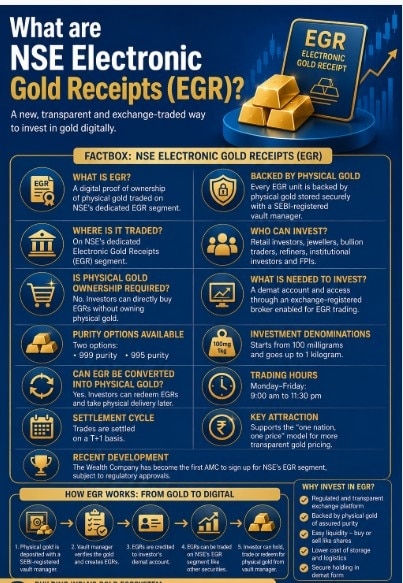



 According to NSE, retail investors, jewellers, bullion traders, refiners, institutional participants and Foreign Portfolio Investors (FPIs) can participate in EGR trading through exchange-registered members.
The Wealth Company, part of the Pantomath Group, has become the first asset management company (AMC) to sign up in principle for the National Stock Exchange’s (NSE) Electronic Gold Receipts (EGR) segment, subject to regulatory approvals. The development marks a notable step for India’s gold investment ecosystem as exchanges seek to move gold transactions into a more regulated, transparent and exchange-traded structure.
NSE Managing Director and CEO Ashish Kumar Chauhan said participation by asset managers could help create scale and strengthen investor confidence in the EGR ecosystem. The initiative aims to support the broader financialisation of gold by bringing investment activity into formal market infrastructure.

 'US took 100 years, India needs just one decade to develop': Nara Lokesh at Pan-IIT AP Summit 2026
 Beyond chatbots: Tavus's Griffin model passes video Turing test with 48% human success rate
 35 years after liberalisation, India’s global integration remains a work in progress, says Shankar Sharma
 RBI Governor: Today's resilience may not imply tomorrow's immunity
  Trump promises $100 checks & $5,000 midterm dividend to rebound from record-low approval rating
 Market Correction: Which Sectors Could Hold Up as Global Risks Pressure Indian Stocks?
 5-10 Year Wealth Creation: How Should Investors Build Their Long-Term Portfolio?
 How Much Should You Invest In Bonds At Different Stages Of Life? 20/60 Investing Rule Explained
 Bond Investing For Beginners: How To Choose, Check Ratings, Returns & Manage Risk
 Flexi-Cap Funds: How Much Does the Fund Manager’s Strategy Really Matter?
 Stock market sell-off: Nifty, Sensex log 8th straight weekly loss; key levels & top triggers now
 IPO boom: 69 Indian companies raise Rs 90,500 crore in Q3 despite stock market sell-off; what's next
 TCS, Infosys, HCL Tech, TechM, Wipro, LTM, Coforge, HEXT: Fresh target, Q2 previews for IT stocks
 Carlsberg India IPO: SEBI approves confidential filing; beer maker moves closer to listing
 Suzlon, KPIT Tech, RIL, IRFC, HDFC Bank, Infy: 56% Nifty500 stocks in bear grip amid market sell-off
 El Niño to dominate India’s post-monsoon season; neutral IOD raises rainfall concerns
 Asian Games 2026: India beats Pakistan by 19 runs, clinches gold in men’s cricket final'US took 100 years, India needs just one decade to develop': Nara Lokesh at Pan-IIT AP Summit 2026Trump promises $100 checks & $5,000 midterm dividend to rebound from record-low approval rating35 years after liberalisation, India’s global integration remains a work in progress, says Shankar Sharma


