









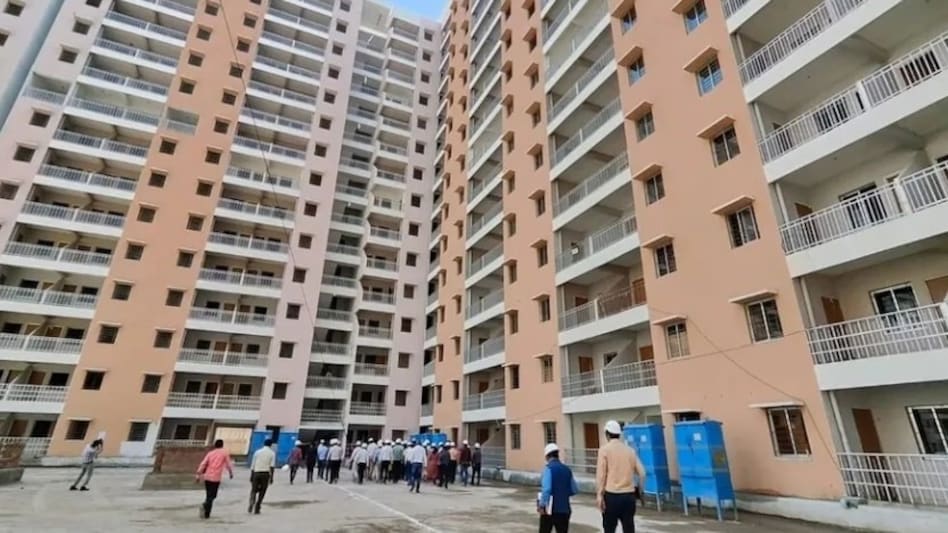
 The post sparked heated debate among netizens. Some argued that the price surge is driven not by fundamentals but by speculation and easy credit. (Representational photo)
 The post sparked heated debate among netizens. Some argued that the price surge is driven not by fundamentals but by speculation and easy credit. (Representational photo)
Siddharth Mukund, Founder of Rainbow Money, struck a nerve with India’s middle class by pointing out a stark reality: buying a home today is far tougher than it was for the previous generation.
“Our parents bought a 3BHK with a single salary. Today, most of us can’t afford an apartment even with dual incomes,” Mukund wrote in a widely shared post on LinkedIn. “The primary reason isn’t what you think. Like every asset class, housing prices are a simple function of supply and demand.”
He broke the problem down with sharp numbers: in Indian metros, the population-to-housing supply ratio is as high as 10:1, while in many developed countries the ratio is 3-5X lower, making homeownership far more attainable abroad. The challenge, he argued, isn’t just about having enough homes — it’s about having affordable, livable supply.
Despite over 11 million vacant urban homes, India faces a shortage of nearly 19 million units, mostly concentrated in the affordable housing segment. Developers, meanwhile, continue to chase profits in luxury housing, creating what Mukund described as a “distribution mismatch.” The result: a landscape skewed away from the average salaried Indian.
Adding to the crunch are structural factors — land politics, investor speculation, FSI (floor space index) constraints, and black money flows — leaving genuine homebuyers with little bargaining power. “So if you’re on the fence about buying versus renting, remember this,” Mukund concluded. “You’re not behind. You’re just playing a different game. For some, progress is owning a home. For others, it’s owning peace — and the freedom of choice.”
The post sparked heated debate among netizens. Some argued that the price surge is driven not by fundamentals but by speculation and easy credit. “Builders, in sync with banks handing out loans freely, are inflating values — creating a bubble,” one user wrote, warning of a correction reminiscent of Japan’s real estate collapse in 1989.
Others pointed to city-specific dynamics. A Bangalore-based professional noted that while homes in developing areas remain relatively affordable, most buyers prefer established localities despite traffic and infrastructure hurdles. “Hopefully, with improved infrastructure and government initiatives, homebuyers will have more viable options in the outskirts,” the comment read.
Another user highlighted the changing psychology of homebuying. “Parents saved for 30 years before buying. Now people buy at 27-30, often bigger homes for smaller families,” the comment said. “But financially, it makes sense to rent in your 30s and 40s — rents cost just 3% of the flat’s price while loans cost 8–9%. That 5% saved can be invested, creating a pool to buy later with less debt.”
The debate underscored what Mukund called the “different game” of home ownership today — one where aspiration collides with structural constraints, and where the traditional equation of hard work plus savings equaling a home no longer holds.
 BT Explainer: How India’s Rs 10,000-cr ATF Fund will operate amid aviation fuel shock
 'India Inc functions like zamindars': Navam Capital MD after Uday Kotak's wake-up call warning
 'IMF methodology is wrong': Capitalmind CEO counters Shankar Sharma on forex reserves
 India may cut bond taxes, ease investment rules to attract foreign capital: Report
 TMC splits for first time in 28 years, rebels tell Abhishek Banerjee: 'You have no role'
 Section 301 Tariffs Could Hit Indian Exports Just As Trade Deal Nears Completion
 Market Masters With Aniruddha Sarkar | Top Stock Ideas, Market Outlook & Investment Strategy
 The Retirement Strategy: NPS, SWP, Mutual Funds, Insurance & Passive Income Explained
 What’s Hot: Stocks, Gold & Big Money Moves | Daily Market Show | Business Today TV
 Maruti's Flex-Fuel Car Launch: Ethanol Industry On Fuel Pricing, Mileage & Demand
 CMR Green Technologies IPO subscribed 2.46 times on Day 1; check latest GMP, other key details
 Ola share price surged 10% amid heavy volumes; key details
 BT Closing Bell | Sensex recovers 850 pts from day's low on report of tax cut on foreign bonds
 IndiGo, SpiceJet, Taneja Aerospace, other aviation stocks jump up to 5%; here's why
 Reliance Jio IPO in focus ahead of AGM: What YES Securities said on valuations, growth & more